The fundamental difference between classes and structs is decisive: classes are reference types and structs are value types. That distinction determines memory layout, copy behavior, and runtime characteristics across languages such as C#, C++, and Swift. Choosing appropriately yields more predictable, higher-performing code and simpler reasoning about state.
January 29, 2026 (6mo ago) — last updated June 8, 2026 (2mo ago)
类与结构体:性能与使用指南
比较类与结构体的性能、内存行为和使用场景,涵盖 C#, C++, Swift 的最佳实践与代码示例,帮助你做出高性能选择。
← Back to blog
Classes vs Structs: A Developer’s Guide to Performance
Summary: Unlock the core differences between classes vs structs. Learn when to use each for high-performance, clean code in C#, Swift, C++, and more.
Introduction
The fundamental difference between classes and structs is decisive: classes are reference types and structs are value types. That distinction determines memory layout, copy behavior, and runtime characteristics across languages such as C#, C++, and Swift. Choosing appropriately yields more predictable, higher-performing code and simpler reasoning about state.
Understanding the Fundamental Difference
When you instantiate a class, the variable holds a reference pointing to an object on the heap. Copying that variable copies the reference; multiple references can point to the same object, so changes via one reference are visible through others. This reference semantics is why classes are often used for entities with identity1.
A struct represents the data itself. Creating a struct produces a concrete bundle of values—often stored on the stack or inline in arrays—so copying a struct yields an independent duplicate. Modifying the copy does not affect the original, which makes structs ideal for simple, immutable values1.
For further reading on encapsulation and object design, see the object-oriented encapsulation guide: https://cleancodeguy.com/blog/object-oriented-encapsulation.

Quick Comparison: Reference vs Value Types
| Characteristic | Class (Reference Type) | Struct (Value Type) |
|---|---|---|
| Memory location | Heap; object referenced by pointer. | Stack or inline; variable is the data. |
| Assignment | Copies the reference, not the object. | Copies the entire value. |
| Lifetime | Managed by garbage collection (or manual deletion in some languages). | Deallocated when out of scope or stored inline. |
| Identity vs value | Has identity; multiple references can point to one instance. | Represents a value; equality often based on data. |
Use a class when you need shared identity. Use a struct when you need a simple, self-contained value that can be copied without side effects.
This foundation informs deeper performance trade-offs: heap vs stack allocation, cache locality, and garbage-collection pressure, which we explore below.
How Memory Allocation Dictates Speed
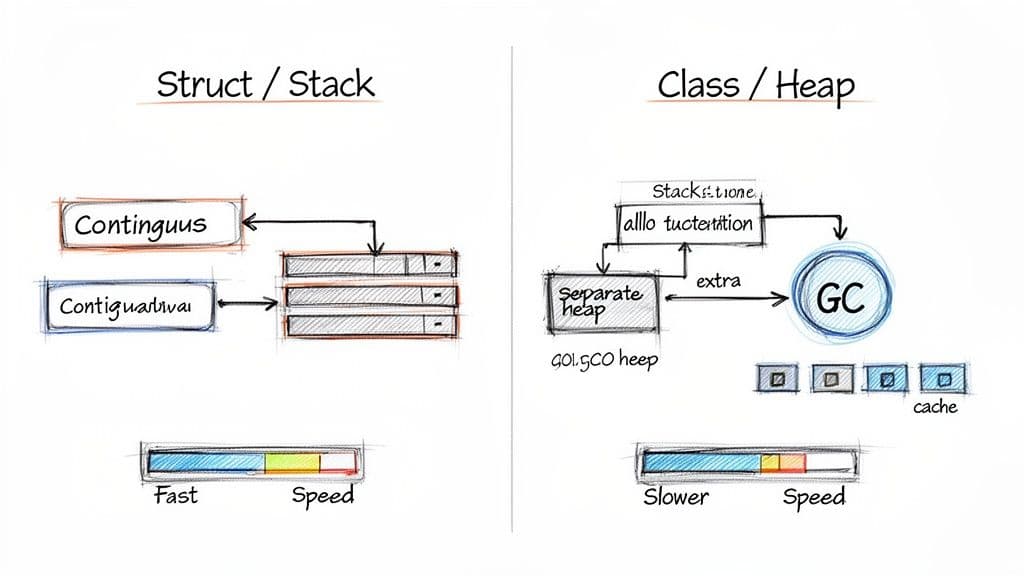
Memory layout affects CPU efficiency, throughput, and latency. Accessing class data typically involves an indirection: a pointer on the stack references data on the heap, adding cost and potentially harming cache behavior. Structs, stored directly where the variable lives, often avoid that indirection and enable tighter memory layouts with better cache locality5.
Garbage Collection Costs
Objects on the heap can be subject to garbage collection. GC cycles may pause execution and increase latency in real-time or high-throughput systems. Frequent allocation of short-lived class objects raises GC pressure and CPU overhead. Using value types for many small, short-lived objects reduces heap churn and GC work3.
Heap allocation can increase GC overhead; structs avoid that when they remain value-based and unboxed.
Reducing allocations directly lowers GC activity and often smooths runtime performance in scalable systems.
Cache Locality and Throughput
Modern CPUs rely on caches. Sequential layouts—such as arrays of structs—improve cache hits and throughput. Separate heap allocations for each class instance scatter data across memory, increasing cache misses and slowing processing. For tight loops and data-processing pipelines, contiguous value layouts are a major advantage5.
The Boxing Trap
Boxing occurs when a value type is converted to a reference type, for example when placed into a collection that expects objects. Boxing allocates a heap object and copies the value into it, negating the struct’s performance advantages and increasing GC load. Avoiding boxing is a core principle of efficient value-type usage4.
How Languages Differ: C#, C++, and Swift
Different languages enforce different conventions and capabilities. Knowing language-specific rules prevents applying one-language habits blindly to another.
C#: Clear Reference vs Value Model
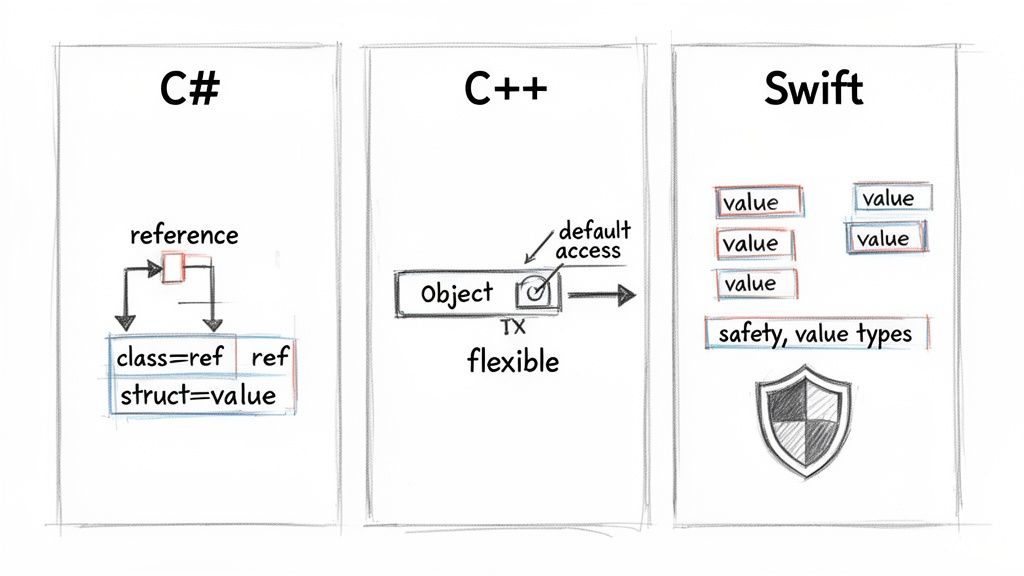
In C#, class means reference type and struct means value type. Use classes for entities with identity, such as Customer or DatabaseConnection, and structs for small, immutable values, such as Point or Color. Keeping structs small and immutable avoids subtle bugs and copying overhead1.
Common mistakes include making large or mutable structs; both lead to surprising bugs or performance regressions. Follow the immutable, small-struct guideline when optimizing in C#.
C++: Convention Over Language Restriction
In C++, the only syntactic difference between struct and class is default accessibility. Both can be allocated on stack or heap, have methods, and support inheritance. The convention is to use struct for plain data aggregates and class for encapsulated objects and RAII resource management.
This flexibility means C++ developers must rely on conventions and design choices rather than language-enforced value/reference distinctions. For patterns on polymorphism and inheritance, see the C++ design notes: https://cleancodeguy.com/blog/polymorphism-vs-inheritance.
Swift: Value-Oriented by Default
Swift encourages preferring structs for most custom types. Structs in Swift support methods, extensions, and protocol conformance, making them powerful yet safe defaults. Choose classes only when reference semantics, identity, or Objective-C interoperability is required2.
This value-first design encourages immutability and makes reasoning about data flow easier, especially in concurrent code.
When to Choose a Struct for Maximum Efficiency
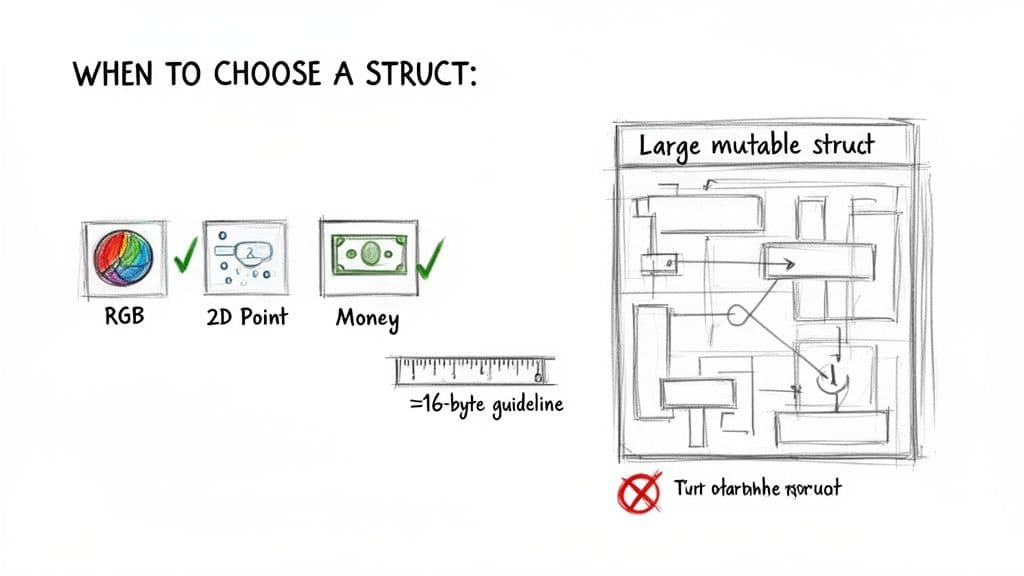
Structs are ideal for small, immutable bundles of data whose identity is defined entirely by their values. Typical examples:
- Geometric data: Point2D or RGBColor
- Financial values: Money (amount + currency)
- Small DTOs used in high-throughput pipelines
A practical size guideline is the “16–32 byte” rule: if a struct’s fields fit in roughly that range, copying cost is modest and often cheaper than heap allocation. If a struct grows larger or must be mutable, a class is likely the better choice5.
Immutability and Size Rules
- Prefer immutable structs: create values once and replace them rather than mutate them.
- Keep structs small: copying large structs frequently can become more expensive than passing references.
These rules help avoid silent bugs from mutable copies and performance traps from excessive copying or boxing.
Common Pitfalls and Refactoring
Two common problems are mutable structs and excessive boxing.
Mutable structs lead to surprising behavior because modifications affect only a copy. Refactor mutable structs into immutable ones that return new instances for state changes.
Boxing happens implicitly in many APIs and collections; identify and remove boxing hotspots to preserve struct performance benefits.
Example: Refactor a Mutable Point into an Immutable Struct (C#)
// Trap: mutable struct
public struct MutablePoint
{
    public int X { get; set; }
    public int Y { get; set; }

    public void Move(int dx, int dy)
    {
        X += dx;
        Y += dy;
    }
}

// Refactor: immutable struct
public readonly struct ImmutablePoint
{
    public int X { get; }
    public int Y { get; }

    public ImmutablePoint(int x, int y)
    {
        X = x;
        Y = y;
    }

    public ImmutablePoint MovedBy(int dx, int dy)
    {
        return new ImmutablePoint(X + dx, Y + dy);
    }
}
This refactor makes intent explicit and eliminates accidental state corruption. For more clean-coding practices, see the principles guide: https://cleancodeguy.com/blog/clean-coding-principles.
Practical Checklist Before You Choose
- Is the type small and frequently copied? Consider a struct.
- Does the type require shared identity or polymorphism? Choose a class.
- Will boxing occur in common usage? Reconsider a struct if boxing is likely.
- Is thread safety a concern? Prefer immutable structs or synchronized classes.
Bottom-line Recommendations
- Use structs for small, immutable value types that benefit from contiguous layouts and low allocation overhead.
- Use classes for identity, large mutable state, complex object graphs, or when inheritance and polymorphism are required.
- Measure and profile in your runtime and workload; microbenchmarks often mislead without realistic allocation patterns6.
Additional Q&A
Q1: When should I prefer a struct over a class?
Prefer a struct when the type is small, immutable, and represents a value rather than an identity. Structs excel for simple data like points, colors, or compact DTOs.
Q2: What performance pitfalls should I watch for?
Avoid mutable structs, large structs that are copied often, and implicit boxing into heap objects—these negate value-type advantages and hurt performance.
Q3: How do language differences affect my choice?
Follow language idioms: C# enforces value vs reference types; C++ relies on convention; Swift prefers value types by default. Learn platform rules before applying patterns across languages.123
At Clean Code Guy, we help teams apply these principles to real codebases. Our Codebase Cleanups and AI-Ready Refactors make software faster, safer, and easier to maintain. Visit https://cleancode.com to learn more.
1.
Microsoft Docs, “Choosing between classes and structs,” https://learn.microsoft.com/en-us/dotnet/standard/choosing-between-class-and-struct
2.
Apple Developer Documentation, “Structures and Classes,” https://docs.swift.org/swift-book/LanguageGuide/ClassesAndStructures.html
3.
Microsoft Docs, “Garbage Collection,” https://learn.microsoft.com/en-us/dotnet/standard/garbage-collection/
4.
Microsoft Docs, “Boxing and Unboxing,” https://learn.microsoft.com/en-us/dotnet/standard/boxing-unboxing
5.
NDepend Blog, “Class vs Struct in C#: Making Informed Choices,” https://blog.ndepend.com/class-vs-struct-in-c-making-informed-choices/
6.
Performance comparison and benchmarks, Sergey Teplyakov, https://sergeyteplyakov.github.io/Blog/benchmarking/2023/11/02/Performance_Comparison_For_Classes_vs_Structs.html
🙋🏻♂️
AI编写代码。您让它持久。
在AI加速的时代,干净代码不仅仅是好的实践 — 它是能够扩展的系统与在自己的重量下崩溃的代码库之间的区别。