Polymorphism and inheritance solve different design needs in TypeScript. Inheritance shares implementation via parent–child relationships; polymorphism uses interfaces so callers can work with different implementations uniformly. This guide shows concrete patterns, safe refactor steps, and tradeoffs to help you choose the approach that keeps code clean, testable, and easy to evolve.
December 18, 2025 (10mo ago) — last updated September 9, 2026 (1mo ago)
TypeScript: Polymorphism vs Inheritance
Decide between inheritance and polymorphism in TypeScript with examples, refactor steps, tradeoffs, and testing tips for maintainable code.
← Back to blog
TypeScript: Polymorphism vs Inheritance
Summary: Discover when to use polymorphism or inheritance in TypeScript, with examples, tradeoffs, refactor tips, and testing guidance for maintainable code.
Introduction
Polymorphism and inheritance address different design needs in TypeScript. Inheritance shares implementation through parent–child relationships, while polymorphism relies on interfaces or base types so code can treat different implementations uniformly. Use inheritance for stable, shared defaults and polymorphism when you want loose coupling, easier testing, or runtime flexibility. This guide covers practical patterns, safe refactor steps, and tradeoffs to help you choose an approach that keeps your code maintainable and testable.
Choosing Between Inheritance and Polymorphism
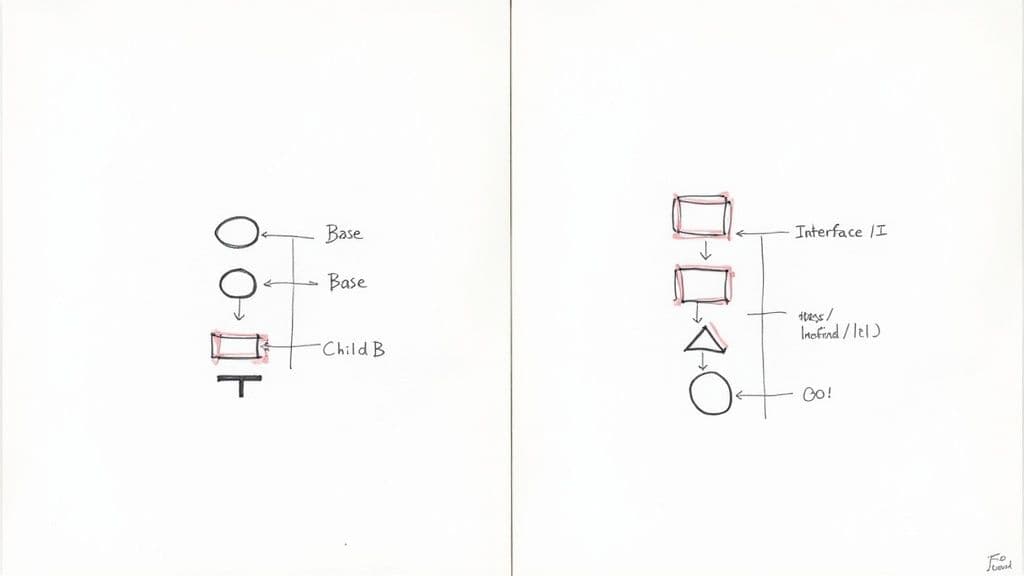
Practical observations to frame your decision:
- Base classes let you share common logic without duplicating code.
- Interfaces drive polymorphism, keeping modules decoupled and easy to test.
- Dynamic dispatch works well for plugin-style architectures.
- Shallow hierarchies document assumptions clearly; interfaces let designs evolve.
- Many teams begin with inheritance, then refactor to strategy or composition as systems grow1.
Quick Comparison
| Aspect | Inheritance | Polymorphism |
|---|---|---|
| Structure | Fixed parent–child tree | Interface or base-type flexibility |
| Coupling | Tighter coupling | Looser, decoupled modules |
| Reuse | Implementation sharing via base classes | Behaviour via interface implementations |
| Extensibility | Limited by inheritance depth | Add new types without changing base |
| Runtime | Static binding | Dynamic dispatch |
This table highlights where each pattern shines and where it can introduce hidden costs.
Understanding Key Concepts

In TypeScript:
- Use extends to share implementation and provide sensible defaults via abstract or concrete base classes2.
- Use interfaces to define contracts so different implementations can be swapped at runtime without changing callers.
- Runtime dispatch selects the concrete implementation based on the actual object you pass.
- Method overriding lets subclasses replace or augment inherited logic.
Interface-driven components make mocking trivial and keep tests focused. Deep inheritance chains, by contrast, tend to increase coupling and complicate refactors.
Class Design Scenarios
Choose based on needs:
| Scenario | Recommended Approach |
|---|---|
| Domain models with shared core logic | Abstract base class |
| Plugin systems requiring runtime extensions | Interface polymorphism |
| Components needing testable dependencies | Interface polymorphism |
| UI elements needing consistent defaults | Abstract base class |
See implementation patterns and examples on the site: Clean Code Guy — Abstraction.
Interface Testing Benefits
Interface-first design reduces fixture code and speeds up test runs:
- Inject fakes and stubs easily.
- Tests focus on behaviour rather than setup.
- Smaller, faster unit tests and clearer contracts.
Teams reported measurable improvements after moving to interface-first patterns in targeted modules3.
Runtime Dispatch Mechanics
Calling a method on a base type lets the runtime pick the concrete implementation. This makes it easy to add or swap implementations without changing callers — a core benefit of polymorphism.
Blending a shallow inheritance hierarchy for sensible defaults with interfaces for extension points often yields stable, flexible code that keeps maintenance costs low.
Comparing Tradeoffs
Design choices around inheritance versus polymorphism affect coupling, extensibility, testability, and runtime behaviour. Pick according to how much flexibility you need now and later.
Coupling
Deep inheritance can expose internals unintentionally, increasing coupling and risk during refactors. Interfaces keep implementations hidden behind a contract so changes stay local.
Extensibility
Base classes can force you to reopen and modify shared code to add behaviour. Interfaces allow new modules to plug in without touching existing types.
Testability
Deep class trees often require complex fixtures. Polymorphism supports lightweight mocks and faster feedback loops.
Runtime Performance
Static binding through inheritance can be marginally faster in tight loops, but interface dispatch overhead is usually negligible compared with I/O and DOM work. Measure only when you identify a hot loop4.
Example Patterns
In a React form, swapping validators via interfaces meant no base-class changes and faster feature toggles. In a Node.js service, moving to composed handler modules flattened call stacks and improved maintainability in production.
Refactoring Legacy Codebases
Legacy TypeScript and React apps often rely on inheritance for code reuse. Over time, class hierarchies become fragile. A pragmatic refactor path:
- Extract interfaces to decouple consumers.
- Replace deep subclasses with delegate objects.
- Apply the Strategy Pattern to swap behaviours at runtime.
Steps for safe refactors:
- Measure coupling, cyclomatic complexity, and build times.
- Extract a narrow interface to represent the behaviour you need.
- Implement a delegate that satisfies the interface and refactor callers.
- Roll out changes behind feature flags and monitor stability.
This incremental approach lowers risk and preserves backward compatibility. Case studies and write-ups describe improved defect rates and faster delivery after targeted refactors3.
Practical Techniques
Extract Interface: isolate public methods into an interface and refactor consumers to depend on that interface.
Replace With Delegation: move responsibilities into small helper objects and inject them where needed.
Strategy Pattern: define strategy interfaces and select concrete strategies at runtime.
| Technique | Benefit | Risk |
|---|---|---|
| Extract Interface | Clear contracts | Low |
| Replace With Delegation | Single responsibility | Medium |
| Strategy Pattern | Runtime flexibility | Low–Medium |
Use tests to lock behaviour before refactoring, and keep each change small and reversible.
Implementing Patterns and Avoiding Antipatterns
Avoid these common pitfalls:
- Deep multi-level inheritance that becomes hard to reason about.
- Excessive instanceof checks that scatter type logic.
- Fragile base classes that ripple changes across subclasses.
Prefer composition and small delegates where possible. For UI variants, use renderer interfaces and pass implementations as props instead of subclassing.
Example: replace deep button subclasses with a renderer interface.
interface ButtonStyle {
  render(label: string): JSX.Element;
}

function Button({ style }: { style: ButtonStyle }) {
  return style.render("Click");
}
This makes adding new variants a matter of providing a new style object, not creating a new subclass.
Real-World Use Cases
When inheritance excels:
- Stable domain models with consistent business rules, such as financial workflows.
- Systems where auditors value clear lineage and defaults.
When polymorphism excels:
- Plugin-based e-commerce, analytics adapters, and feature toggles where runtime flexibility is essential.
- Systems that must swap providers or adapters without redeploying core logic.
Match your choice to project goals: use inheritance for stable, domain-heavy code and polymorphism for extension points and plugin architectures.
Using AI to Assist Refactors
AI tools can accelerate detection of coupling hotspots and sketch interface scaffolds. Use them to generate candidate interfaces or strategy stubs, but review suggestions for style and architecture fit5.
Best practices for AI-assisted refactors:
- Fine-tune models on representative repository samples.
- Use prompt templates that prioritise composition-first solutions.
- Enforce lint rules and manual review for any AI-generated code.
When used carefully, AI reduces manual refactor time and surfaces repetitive patterns that make good extraction candidates.
Three Concise Q&A Sections
Q1 — What problem does polymorphism solve?
Polymorphism decouples callers from concrete implementations so you can swap behaviours without changing clients. It improves testability and supports runtime extension.
Q2 — When is inheritance still the right choice?
Use inheritance when multiple types share meaningful implementation and you want to provide default behaviour from a single place. Keep hierarchies shallow and focused.
Q3 — How do I measure refactor success?
Track coupling metrics, cyclomatic complexity, bug and rollback rates, test run times, and deployment confidence as you roll out changes incrementally.
Key Takeaways
- Use inheritance for stable default implementations and clear domain hierarchies.
- Use interfaces and composition for extension points, plugin systems, and testable modules.
- Refactor incrementally: extract interfaces, introduce delegates, and apply strategy patterns behind feature flags.
Further implementation patterns and refactor guides are available on the site: Clean Code Guy — Interface Design and Clean Code Guy — Abstraction.
Clean Code Guy
https://cleancodeguy.com
1.
Martin Fowler, “Prefer Composition Over Inheritance,” https://martinfowler.com/bliki/PreferCompositionOverInheritance.html.
2.
TypeScript Handbook: Classes and Inheritance, https://www.typescriptlang.org/docs/handbook/classes.html.
3.
Case studies and refactor write-ups describing interface-first benefits: https://microestimates.com and https://cleancodeguy.com.
4.
Guidance on performance and when to measure from V8 and performance experts: https://v8.dev/blog.
5.
Examples of AI-assisted refactor workflows and tool guidance: https://fluidwave.com.
🙋🏻♂️
AI writes code.You make it last.
In the age of AI acceleration, clean code isn’t just good practice — it’s the difference between systems that scale and codebases that collapse under their own weight.