Clean coding turns code that merely works into software that’s reliable, maintainable, and easier for teams to own. This guide focuses on practical habits—intentional naming, small functions, SOLID, DRY, KISS, and a safe refactoring plan—so you can write code that’s easier to read, test, and evolve.
November 9, 2025 (10mo ago) — last updated April 2, 2026 (5mo ago)
Clean Code Principles: SOLID, DRY & KISS
Practical guide to clean code: naming, SOLID, DRY, KISS, and safe refactoring for readable, maintainable software.
← Back to blog
Clean Code Principles: SOLID, DRY & KISS
Discover essential clean coding principles with this practical guide. Learn to write readable, maintainable code using SOLID, DRY, and KISS with examples.
Introduction
Clean coding turns code that merely works into software that’s reliable, maintainable, and easier for teams to own. This guide focuses on practical habits—intentional naming, small functions, SOLID, DRY, KISS, and a safe refactoring plan—so you can write code that’s easier to read, test, and evolve. We spend far more time reading existing code than writing new code1, so clarity is essential.
Why Clean Coding Principles Matter
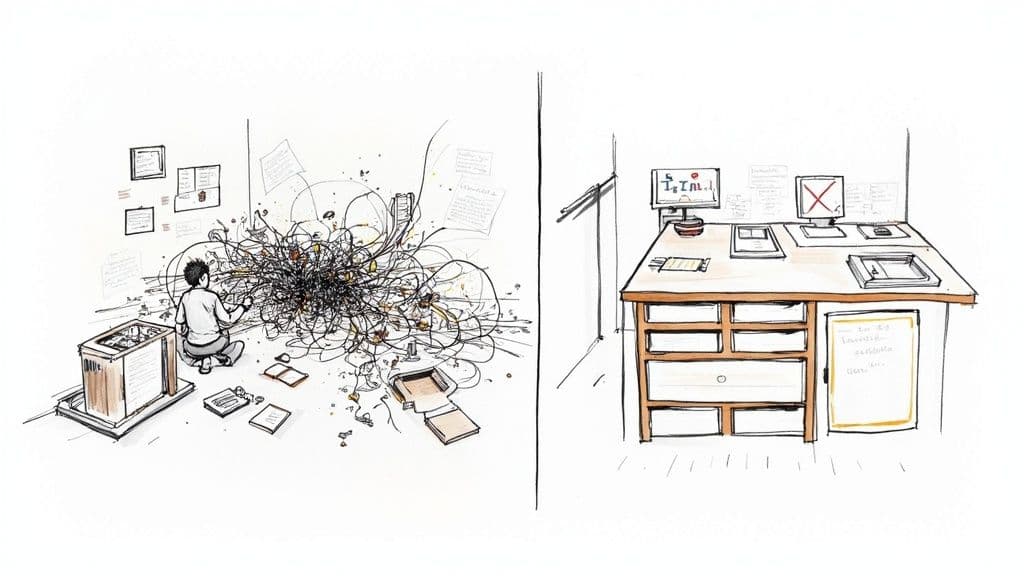
Ever come back to code you wrote six months ago and had no idea what you were thinking? Writing clean code is an act of empathy—for your future self and the people who’ll maintain your code. It’s a core defense against technical debt and a major driver of team productivity.
The Business Case for Quality Code
Putting effort into code quality pays real dividends. A clean codebase lets teams move faster and with more confidence. When a system is well organized, adding a feature or fixing a bug is a straightforward task, not a risky expedition.
| Pillar | Primary Goal | Key Benefit |
|---|---|---|
| Readability | Make code easy to understand at a glance. | Faster onboarding and easier debugging. |
| Simplicity | Solve problems with the simplest solution. | Fewer bugs and lower cognitive load. |
| Maintainability | Build code that is easy to change. | Lower long-term costs and faster delivery. |
| Testability | Structure code so tests are simple to write. | Greater release confidence and reliability. |
Key benefits of this efficiency:
- Faster onboarding: New developers get productive sooner.
- Reduced bug count: Clear code is less error-prone and easier to debug.
- Increased velocity: Teams ship features faster with less risk.
- Improved collaboration: Shared standards make reviews and teamwork smoother.
“The only way to go fast is to go well.” — Robert C. Martin (“Uncle Bob”)
Research shows that modularization and consistent design improve unit testing efficiency and software reliability2.
The Foundation of Sustainable Software
Clean coding is professionalism: building software that adapts to future needs. It’s essential for resilient platforms and long-lived products. For practical advice and audits, experts such as Clean Code Guy offer useful resources.
Naming Things and Keeping Functions Simple
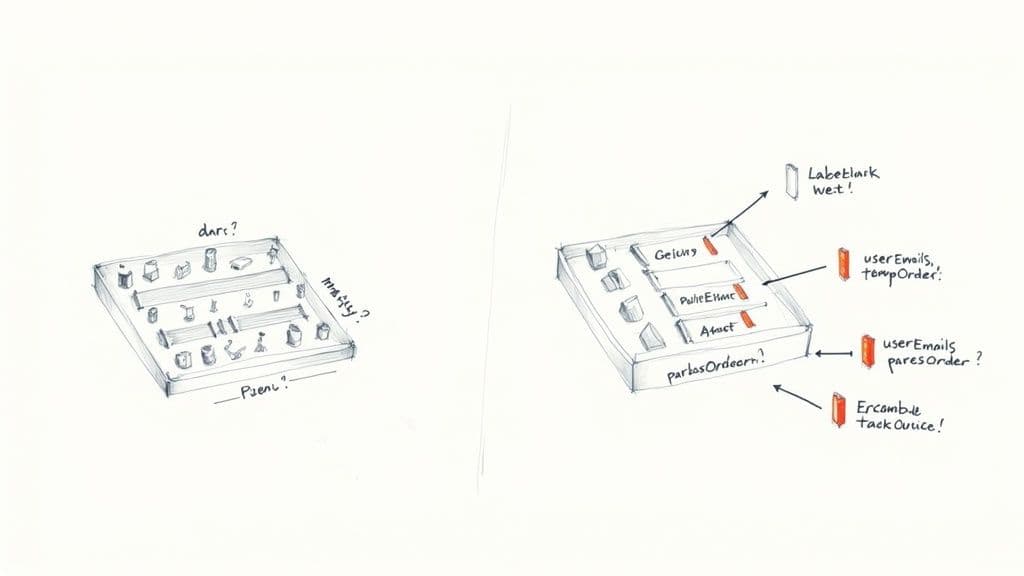
Master two habits and you’ll change the way you write code: choose intentional names and keep functions small. These are bedrock practices that make code understandable and safe to change.
Names That Tell a Story
Good names reveal intent. Avoid cryptic identifiers like arr, tempData, or i. Prefer descriptive names that answer: What does this hold? What does this function do?
Before: A vague mess
// What kind of items are these?
const getItems = (d: any[]) => {
  return d.filter(i => i.p > 100 && i.s);
};
After: Intentional and clear
interface Product {
  priceInCents: number;
  isInStock: boolean;
  // ...other properties
}

const getPremiumProductsInStock = (products: Product[]): Product[] => {
  return products.filter(product => product.priceInCents > 10000 && product.isInStock);
};
Now the function’s purpose and parameters are clear at a glance.
One Function, One Job
Functions should do one thing, and do it well. Break large, multipurpose functions into focused helpers. The payoff:
- Readability: Higher-level functions read like a list of steps.
- Easier debugging: Isolate faults quickly.
- Reusability: Small utilities are easy to reuse.
- Testability: Single-purpose units are straightforward to test.
See also: Building Robust Systems with SOLID Principles.
Building Robust Systems with SOLID Principles
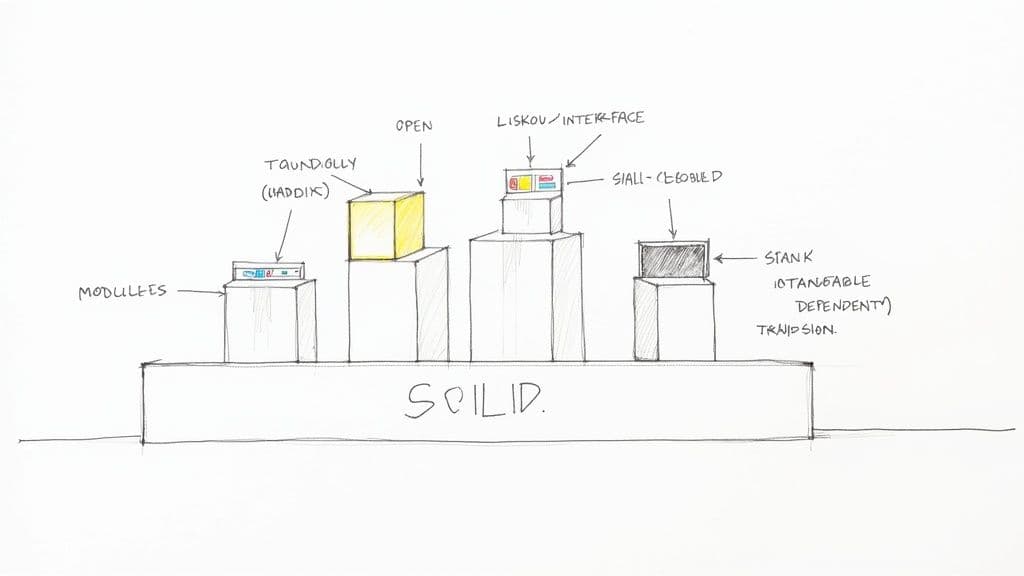
If naming and small functions are the bricks and mortar, SOLID principles are the architectural blueprint. They keep software adaptable, testable, and resilient to change.
S — Single Responsibility Principle (SRP)
A class or module should have one, and only one, reason to change. Split responsibilities: a UserRepository for data, UserValidator for rules, and UserViewModel for presentation.
O — Open/Closed Principle (OCP)
Software should be open for extension but closed for modification. Add new behavior by adding new code—use polymorphism or plugin patterns rather than editing stable core logic.
L — Liskov Substitution Principle (LSP)
Subtypes must be substitutable for their base types. If a Bird base class includes fly() and a Penguin cannot fly, the hierarchy needs rethinking to avoid surprises.
I — Interface Segregation Principle (ISP)
Avoid fat interfaces. Break large interfaces into focused ones so clients only depend on the methods they need.
D — Dependency Inversion Principle (DIP)
High-level modules should depend on abstractions, not concrete implementations. Rely on interfaces and inject concrete dependencies from the outside.
| Principle | Common Violation (Anti-Pattern) | Clean Code Solution |
|---|---|---|
| SRP | God class that mixes data, logic, and UI. | Split into Repository, Service, Controller/ViewModel. |
| OCP | Massive switch statements edited for every new type. | Use strategy pattern or polymorphism. |
| LSP | Subclass throws exceptions for inherited methods. | Restructure hierarchy or use composition. |
| ISP | Huge ISettings interface with many unused methods. | Create smaller role-based interfaces. |
| DIP | High-level class instantiates low-level classes directly. | Depend on interfaces and use dependency injection. |
These practices support long-term maintainability and were central to many stable platforms.
The Pragmatist’s Toolkit: DRY, KISS, and YAGNI
For daily coding, keep DRY, KISS, and YAGNI within reach. They’re practical guardrails that prevent duplicated logic, unnecessary complexity, and speculative features.
Don’t Repeat Yourself (DRY)
Each piece of knowledge should have a single authoritative place. If the same logic is copied in multiple places, abstract it into one function or module.
Keep It Simple, Stupid (KISS)
Ask: “What’s the simplest thing that could work right now?” Prefer straightforward solutions that the team can understand and maintain.
You Ain’t Gonna Need It (YAGNI)
Build only what’s required today. Avoid speculative abstractions and features that may never be used.
Clean, incremental updates are better than speculative architecture. Systematic, measured updates win in complex systems3.
Creating Your Code Refactoring Plan
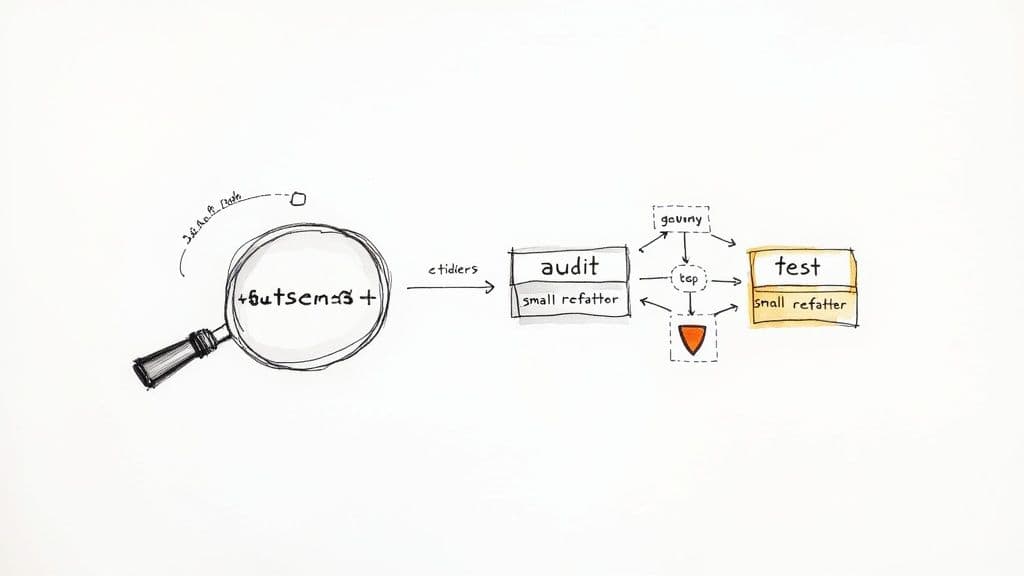
Refactoring a legacy codebase is best done incrementally. A “big bang” rewrite is risky; small, safe improvements compound into a maintainable system.
Conducting a Code Health Audit
Identify code smells and prioritize the worst offenders. Common smells:
- Long methods that do too much.
- Bloated classes that violate SRP.
- Duplicate code that creates maintenance risk.
- Excessive comments that cover up unclear code.
Building Your Incremental Refactoring Strategy
A practical plan:
- Prioritize pain points: Start where code changes most or where bugs concentrate.
- Ensure test coverage: Don’t refactor without automated tests guarding behavior.
- Refactor in small batches: Change one small thing per commit.
- Run tests often: Verify safety after each change.
- Repeat: Small improvements add up.
This incremental approach mirrors large-scale, systematic updates such as building-code processes used by regulatory bodies4.
Tools and Enforcement
Linters, formatters, and CI checks make consistency easier. For JavaScript/TypeScript, use ESLint and Prettier and enforce them in CI to make quality checks part of your pipeline5.
Answering Your Questions About Clean Coding
Do clean coding principles slow down development?
Initially, investing a few extra minutes in clarity can feel slower. Over a project’s life, that investment pays back many times in reduced debugging time, faster feature delivery, and lower maintenance costs.
How can I convince my team to adopt clean code?
Lead by example. Use clear names and small functions in your work, point out the benefits during reviews, and tie the discussion to business outcomes: faster onboarding, fewer bugs, and quicker feature delivery.
What tools help enforce clean coding?
Linters and formatters automate consistency. For JavaScript/TypeScript, use ESLint and Prettier and enforce them in CI/CD to make quality checks part of your pipeline5.
Quick Q&A — Common Concerns
Q: Where should I start when a codebase is messy?
A: Run a code health audit, add tests around critical areas, and fix the highest-risk code smells in small commits.
Q: How small should functions be?
A: Small enough that each function is easy to name and test. If you need a long comment to explain it, it’s probably doing too much.
Q: When is a rewrite justified?
A: Rarely. Consider a rewrite only if technical debt prevents any meaningful progress and the team has a clear migration plan with measurable milestones.
3 Quick Q&A Summaries
Q: What’s the single easiest improvement I can make today?
A: Rename unclear variables and functions to reveal intent, then run a linter to catch remaining naming issues.
Q: How do I keep refactoring safe?
A: Add tests around the code you’ll change, refactor in small commits, and run tests in CI after each change.
Q: How do SOLID and DRY work together?
A: SOLID helps you design maintainable modules; DRY prevents duplicate logic across those modules—together they reduce bugs and make change safer.
1.
Steve McConnell, Code Complete, 2nd ed. (Redmond, WA: Microsoft Press). Overview and context available at https://www.wiley.com/en-us/Code+Complete%2C+2nd+Edition-p-9780735619678.
2.
Research on modularization and testing efficiency: https://pmc.ncbi.nlm.nih.gov/articles/PMC8584773/.
3.
CALGreen adoption summary and local jurisdiction data: https://www.srcity.org/DocumentCenter/View/2838/CALGreen-Summary-and-Code-Adoption-Process-PDF.
4.
California 2025 Title 24 code changes and resources: https://www.dgs.ca.gov/BSC/Resources/2025-Title-24-California-Code-Changes.
5.
Linting and formatting tools referenced: https://eslint.org/ and https://prettier.io/.
🙋🏻♂️
AI writes code.You make it last.
In the age of AI acceleration, clean code isn’t just good practice — it’s the difference between systems that scale and codebases that collapse under their own weight.