Object-oriented encapsulation bundles data with the methods that operate on it and hides internal complexity behind a clear public interface. This guide explains why encapsulation matters, common mistakes, and a practical TypeScript example you can apply today.
January 4, 2026 (9mo ago) — last updated June 18, 2026 (4mo ago)
Object-Oriented Encapsulation: Practical Guide
Learn object-oriented encapsulation with clear principles, TypeScript examples, and practical refactoring steps to write safer, maintainable code.
← Back to blog
Object-Oriented Encapsulation: Practical Guide
Master object-oriented encapsulation to write cleaner, more maintainable code. This guide uses real-world examples and a practical TypeScript refactor to explain this core programming principle.
Introduction
Object-oriented encapsulation bundles data with the methods that operate on it and hides internal complexity behind a clear public interface. That protection keeps state valid, reduces accidental misuse, and makes large codebases easier to change and test. This guide explains why encapsulation matters, common mistakes, and a practical TypeScript example you can apply today. For a quick jump to the example, see Getting Your Hands Dirty: Encapsulation in TypeScript.
What Is Encapsulation and Why It Matters?

Think of driving a car. You use the steering wheel, pedals, and controls without needing to know how the engine or transmission works. Encapsulation provides that same separation in software: public controls for users and hidden internals for implementation. By keeping data private and exposing only well-defined methods, you create predictable components that other parts of the system can rely on.
The Protective Barrier of Code
Encapsulation prevents other parts of an application from changing an object’s internal state directly. Instead, interaction happens through public methods that validate inputs, enforce invariants, and log or audit changes. The benefits are immediate:
- Data integrity: Objects can enforce valid states (for example, preventing negative balances).
- Reduced complexity: Consumers rely on a simple interface, not implementation details.
- Safer refactoring: Internal logic can change as long as the public interface remains stable.
Encapsulation in classes traces back to the early days of object-oriented languages such as Simula, which introduced the class concept in the 1960s1.
Encapsulation Quick Reference
| Core Principle | What It Means | Why It Matters |
|---|---|---|
| Bundling | Grouping data (properties) and behavior (methods) in one unit. | Creates organized, reusable modules. |
| Data hiding | Restricting direct access to internal data. | Protects state and enforces invariants. |
| Public interface | Exposing only controlled methods. | Simplifies usage and hides complexity. |
Encapsulation creates a clear contract between an object and the rest of the system, making behavior predictable and easier to maintain.
Strategic Benefits of Encapsulated Code
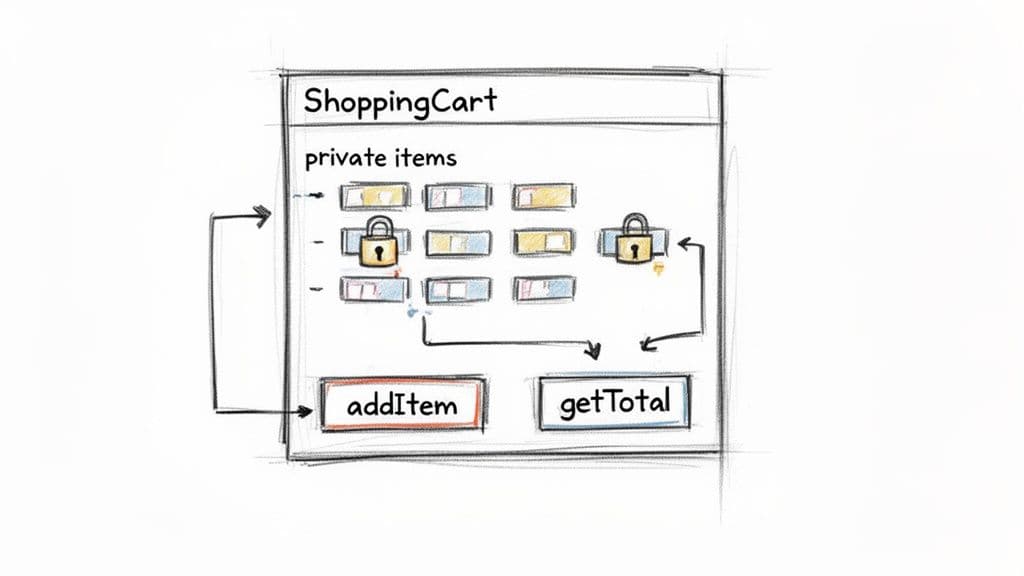
Encapsulation isn’t just a tidy pattern. Over time it reduces risk, lowers maintenance costs, and improves security — a key consideration given the high economic impact of software defects reported in industry studies5. When internals are exposed, changes can ripple through a codebase and cause unexpected bugs. Encapsulation creates a stable surface: you can refactor internals without affecting consumers that depend on the public API.
Flexibility and Vendor Isolation
If payment logic is scattered across an app, switching providers is risky. Encapsulating payment logic in a PaymentProcessor object isolates gateway-specific code behind a single interface like processPayment(). That makes it easy to replace Stripe with PayPal, for example, with minimal changes elsewhere.
Encapsulation also improves security. A User object that keeps password hashes private forces all access through methods that can add validation, logging, and permission checks.
Encapsulation acts like a firewall for objects: it controls what goes in and what comes out, reducing unintended side effects and simplifying debugging.
Team Productivity
Clear object boundaries shorten onboarding time and reduce cognitive load. Developers learn an object’s public interface, not its internals, which enables parallel work and safer refactors. These practices scale well for teams building complex systems.
Getting Your Hands Dirty: Encapsulation in TypeScript
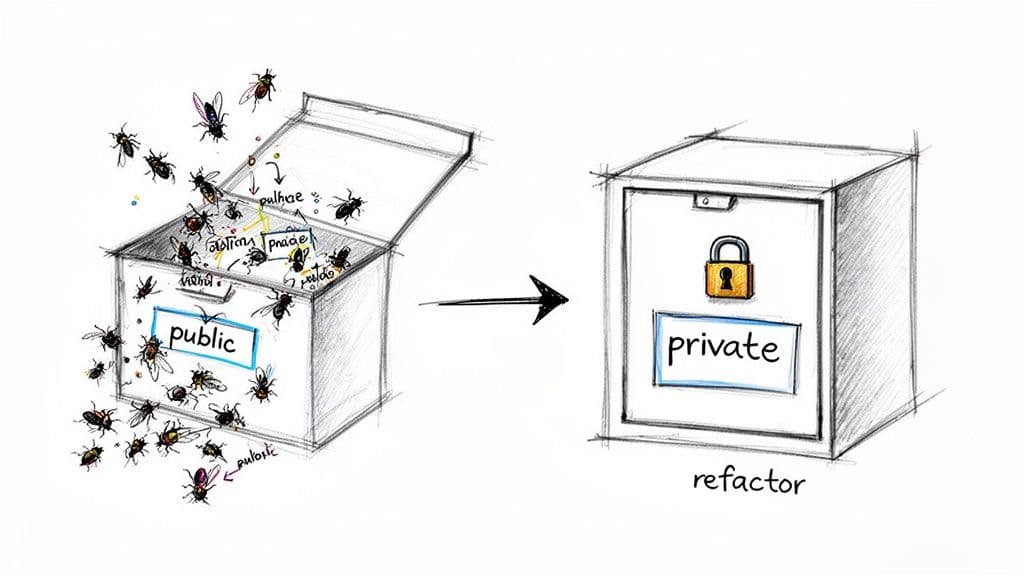
Here’s a practical contrast: a fragile shopping cart that exposes internal state, and a refactored class that protects it.
Anti-pattern: Exposed Data
// Bad example: free access to state
const badShoppingCart = {
  items: [
    { name: 'Laptop', price: 1500, quantity: 1 },
    { name: 'Mouse', price: 50, quantity: 2 }
  ],
  total: 1600,
  addItem: function(item) {
    this.items.push(item);
    // Manual total update is error-prone
  }
};

// External code can corrupt state
badShoppingCart.items[0].quantity = -5; // Invalid state
badShoppingCart.total = 100; // Now inconsistent
Any code can mutate items or total, making the cart unreliable.
Encapsulated Class (TypeScript)
class ShoppingCart {
  private _items: { name: string; price: number; quantity: number }[] = [];

  public addItem(name: string, price: number, quantity: number): void {
    if (quantity <= 0 || price < 0) {
      console.error("Invalid item quantity or price.");
      return;
    }

    const existing = this._items.find(i => i.name === name);
    if (existing) existing.quantity += quantity;
    else this._items.push({ name, price, quantity });
  }

  public removeItem(name: string): void {
    this._items = this._items.filter(i => i.name !== name);
  }

  public getTotal(): number {
    return this._items.reduce((t, i) => t + i.price * i.quantity, 0);
  }

  public getItems(): readonly { name: string; price: number; quantity: number }[] {
    return [...this._items];
  }
}
Why This Is Better
- Private state prevents external mutation.
- Public methods are gated points that validate and enforce invariants.
- Calculated totals avoid synchronization bugs.
- Defensive copying prevents callers from holding references to internal arrays.
This pattern turns a fragile data bag into a self-contained component that’s easy to reason about and test.
Common Encapsulation Mistakes to Avoid

Many projects undermine encapsulation through a few common mistakes.
Overusing Public Fields
Making fields public leaves the object helpless to enforce its invariants. Make fields private by default. Expose behavior through methods and provide specific getters only when necessary.
Generic Getters and Setters
A get/set for every field often recreates a public field with extra steps. Instead, model real operations: a BankAccount should have deposit() and withdraw(), not setBalance(). These behavior-rich methods are the right place for validation, logging, and business rules.
Fragile Base Class Problem
Inheritance can expose internal details to subclasses, creating tight coupling and the fragile base class problem. Research from the 1980s highlighted how inheritance can weaken encapsulation and create brittleness2. Favor composition: a Car has an Engine rather than being an Engine. Composition keeps interactions limited to public APIs and makes swapping implementations easier.
By avoiding these pitfalls you create stronger abstractions that remain useful and reliable as the system evolves.
How Encapsulation Shapes Development
Encapsulation improves testing, makes APIs predictable, and supports tool-assisted development. When internal state is hidden and access is controlled, unit tests become simpler and less brittle. Stable public contracts inside a codebase mirror the same benefits that well-defined external APIs provide for distributed systems.
Encapsulation and AI Assistants
AI coding tools are becoming common, but they rely on the context your code exposes. If fields are public, an AI may generate code that bypasses validation. With private data and a clear public interface, AI assistants naturally use the intended methods, reducing the chance of subtle bugs4.
Encapsulation in the Wild
Encapsulation remains underused. One deep analysis of Java code found a small portion of classes were fully confined, showing a large opportunity for improvement in real-world codebases3. Better tooling and habits could significantly increase the percentage of well-encapsulated classes.
Adopting a Clean Code Mindset
Encapsulation is a philosophy: protect data, hide messy details, and define clear boundaries. When you combine encapsulation with principles like the Single Responsibility Principle, you create components that are easier to maintain and evolve.
Start small when refactoring legacy code. Pick a troublemaker class, make fields private, expose behavior via methods, add validation, and iterate. Focus on areas that change frequently—those offer the highest payoff.
Ready to build software that lasts? Clean Code Guy helps teams ship maintainable, scalable code that empowers developers and AI tools to do their best work. Learn more at https://cleancodeguy.com.
Frequently Asked Questions
What’s the difference between encapsulation and abstraction?
Encapsulation is the technique of hiding data and exposing behavior. Abstraction is the concept of presenting a simplified interface that hides complexity. Encapsulation is how you achieve that abstraction in code.
Does encapsulation matter in functional programming?
Yes. Closures and module scope provide forms of encapsulation in functional code. The goal is the same: keep implementation details private and expose a small, clear surface for interaction.
How do I start refactoring a legacy codebase?
Pick a high-risk class, make fields private, introduce behavior-rich methods, add validation, and refactor incrementally. Prioritize parts of the code that change often.
Quick Q&A
Q: How quickly will encapsulation reduce bugs?
A: You’ll often see fewer state-related bugs immediately after encapsulating a high-traffic component because validation and controlled mutation stop many common errors.
Q: Should I always avoid inheritance?
A: Not always. Use inheritance when it models a true “is-a” relationship. Prefer composition for flexibility and better encapsulation.
Q: Can encapsulation hurt performance?
A: Usually the safety and maintainability benefits outweigh minimal overhead. If performance becomes critical, measure and optimize specific hotspots.
Top 3 Practical Q&A
Q: What’s the first small change I should make?
A: Make fields private and replace raw setters with meaningful methods like deposit() or addItem(). That single change prevents many accidental mutations.
Q: How do I check if encapsulation is improving my code?
A: Track defect rates, code churn, and how often core APIs change. Less churn and fewer state-related bugs are good signals.
Q: When is it okay to expose internal state?
A: Expose read-only snapshots or immutable views rather than direct references. Only expose internals when there’s a clear, documented reason.
1.
Dahl, Ole-Johan, and Kristen Nygaard. “Simula—An Algol-based Simulation Language.” 1967. https://en.wikipedia.org/wiki/Simula
2.
Snyder, Allan. “Encapsulation, Inheritance, and the Fragile Base Class Problem.” 1986. http://www.cs.tufts.edu/comp/150CBD/readings/snyder86encapsulation.pdf
3.
Palsberg, Jens, et al. Deep dive analysis on encapsulation in Java programs; study accessed at http://web.cs.ucla.edu/~palsberg/paper/toplas06.pdf
4.
GitHub Copilot features and documentation. https://github.com/features/copilot
5.
National Institute of Standards and Technology. “The Economic Impacts of Inadequate Infrastructure for Software Testing.” 2002; estimates large annual costs from software defects. https://www.nist.gov/publications/economic-impacts-inadequate-infrastructure-software-testing
🙋🏻♂️
AI writes code.You make it last.
In the age of AI acceleration, clean code isn’t just good practice — it’s the difference between systems that scale and codebases that collapse under their own weight.