A concise, practical guide to Uncle Bob’s Clean Code. Learn core principles, TypeScript/React patterns, and refactor strategies you can apply today to improve readability and reduce technical debt.
December 9, 2025 (8mo ago) — last updated May 5, 2026 (3mo ago)
Clean Code: Modern Guide to Uncle Bob’s Principles
Practical guide to Uncle Bob’s Clean Code: core principles, TypeScript/React examples, refactor tactics, and team practices for cleaner, maintainable code.
← Back to blog
Clean Code: Modern Guide to Uncle Bob’s Principles
A practical guide to Robert C. Martin’s Clean Code and how to apply its timeless principles in modern software development for clearer, more maintainable code.1
When developers talk about essential reading, one title comes up again and again: Robert C. Martin’s 2008 guide, Clean Code: A Handbook of Agile Software Craftsmanship1. This book isn’t just a reference; for many it’s the foundation of a professional mindset. Clean Code argues that good code doesn’t just work — it’s also a pleasure to read, simple to maintain, and thoughtfully crafted.
Why Clean Code Still Matters
In a field where last year’s framework can feel like ancient history, Clean Code remains influential because its lessons are language- and framework-agnostic. The book focuses on fundamentals: clarity, robustness, and adaptability. These engineering habits reduce long-term costs and prevent technical debt from grinding teams to a halt; organisations that adopt disciplined practices deploy far more frequently and have dramatically shorter lead times26.
Clean Code as a Professional Foundation
Uncle Bob’s core claim is simple: writing clean code is a central part of being a professional developer. It’s not optional polish you do when you have spare time — it’s the job. Teams that adopt these habits produce systems that are easier to debug, understand, and extend.
This emphasis on craft is visible in training and industry practice. Many educators and bootcamp instructors recommend Clean Code as foundational reading for new developers, especially in Canada where it’s often listed among must-read resources for students3.
Heuristics, Not Dogma
Treat Clean Code as a set of professional heuristics that build your intuition for what makes code good. The core pillars are:
- Readability: You’ll read code far more than you write it. Code should tell a clear story.
- Simplicity: Prefer direct solutions over clever ones that are hard to maintain.
- Maintainability: Software should be easy to change so it can evolve with the business.
These pillars apply whether you’re writing backend services, a React front end, or a TypeScript library.
Core Principles Explained

Move past checklists and adopt a craft mindset. Here are the fundamentals you’ll use daily.
Intention-Revealing Names
Names are your first line of communication. Vague identifiers like data, list, or processRecords() force readers to dig into implementation. Instead, use names that state purpose clearly, for example customerAccountList or elapsedTimeInDays. A well-named function such as generateSalesReportForRegion() tells you exactly what to expect.
“The only way to go fast is to go well.” — Robert C. Martin
Spending a little time on names saves hours of confusion later.
Functions Should Do One Thing
Functions should be small and focused. If a routine both validates input, writes to a database, and sends a notification, it’s doing too much. Break it into validateUserInput(), saveUserToDatabase(), and sendConfirmationEmail() so each piece is testable and reusable. This is the Single Responsibility Principle in practice.
The Boy Scout Rule
“Always leave the code better than you found it.” Small, incremental improvements prevent technical debt from accumulating. Rename a confusing variable, extract a duplicate block into a function, or clean up a conditional. Over time, these tiny changes keep the codebase healthy.
Applying Clean Code to TypeScript and React
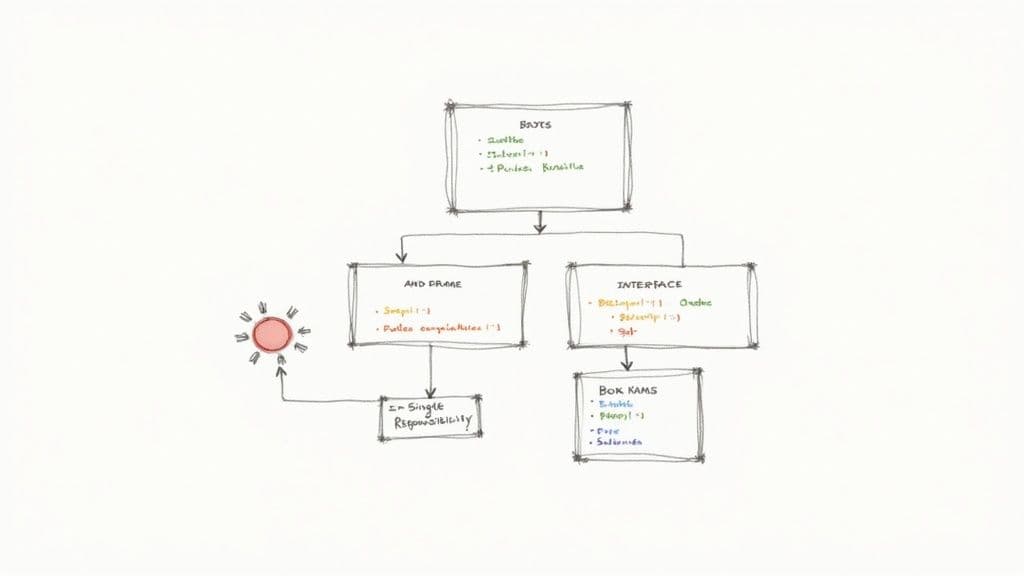
Clean Code’s lessons translate directly to modern stacks. A React component is a function with inputs and outputs; the same rules about small, focused functions apply. When a component fetches data, manages complex state, and renders UI, it’s a candidate for splitting. Move data logic into hooks (for example, useUserProfile) and keep components focused on presentation.
Focused Components and Hooks
A UserProfileCard should display user info, not fetch it. Separate concerns into presentation and data hooks. Benefits include:
- Testability: Isolated components are easier to test with mock data.
- Reusability: Hooks can be shared across the app.
- Clarity: Presentation code becomes easier to read and modify.
TypeScript as Self‑Documenting Code
TypeScript lets you encode contracts with interfaces. Instead of a vague data prop, define:
interface UserProfileProps {
  userId: string;
  userName: string;
  avatarUrl: string;
  memberSince: Date;
}
This reduces guesswork and prevents many common bugs.
Meaningful JSX Names
Component and prop names form the UI vocabulary. Prefer specific names: <UserAvatar /> is clearer than <Image />; onSaveClick is better than handleClick; isLoading is more descriptive than flag.
Spotting and Fixing Common Code Smells
A code smell signals rising technical debt even when code still works. Train yourself to spot these signs and apply the appropriate fix.
Bloated Functions
Long methods that do multiple tasks are hard to understand and test. Break each distinct logical step into its own function so the original becomes a high-level coordinator.
God Classes
Large classes that manage many responsibilities become bottlenecks. Identify the different roles they try to play and extract smaller, focused classes — for example, UserAuthenticator, UserProfileManager, and UserPermissionService.
Primitive Obsession
Using primitives for complex concepts invites bugs. Wrap things like email addresses or monetary values in small types or classes (e.g., an EmailAddress type) to enforce validation and intent.
Redundant and Misleading Comments
Comments that repeat code or fall out of date do more harm than good. Instead of commenting a tricky block, refactor it with clearer names or extract it into a small function. Aim for code that documents itself.
Clean Code in the Age of AI Assistants

AI tools like GitHub Copilot can generate code quickly, but they don’t know your architecture, constraints, or long-term goals4. Think of AI as a fast junior developer: it can produce working code, but it takes a seasoned engineer to shape that output into maintainable, long-lived solutions.
The Engineer’s New Role
Your job becomes reviewing, refining, and steering generated code. Ask: Is this readable? Is it doing one thing? Does it fit our architecture? Use Clean Code principles as the filter for accepting and improving AI output.
Prompting and Reviewing with Clean Code in Mind
- Write precise prompts: ask for a pure function named
validateUserEmailthat returns a boolean. - Critically review AI output for smells like long functions or vague names.
- Use AI to refactor its own code: request it extract database logic into a
UserRepositoryclass.
Clean Code gives you the vocabulary to ask better questions and keep fast generation from becoming fast technical debt.
Putting Principles into Practice
Turn theory into measurable business value with audits, refactors, and mentorship.
- Code audits identify high-risk areas and produce prioritized plans for improvement. See our audit services at https://cleancodeguy.com/services/audits.
- Targeted refactors reduce complexity and make future changes safer.
- Mentorship embeds the discipline of clean naming and small functions across the team.
These efforts convert a fragile codebase into a long-term asset. For example, integrating testing and refactoring cycles such as Red‑Green‑Refactor helps teams keep changes safe and incremental5.
Common Questions (Q&A)
Q: Is Clean Code still relevant for modern stacks like React and TypeScript?
A: Yes. The principles focus on clarity, simplicity, and maintainability — qualities that apply regardless of language or framework.
Q: Will adopting Clean Code slow development?
A: In the short term you may write more lines, but you’ll reduce cognitive load and bugs, making long-term development faster and less risky.
Q: How should teams get started?
A: Start with small, focused audits, enforce meaningful naming, apply the Boy Scout Rule, and use paired reviews to spread the practice.
At Clean Code Guy, the work is applying these principles to modern codebases — audits, AI-ready refactors, and training that help teams ship with confidence.
1.
Robert C. Martin, Clean Code: A Handbook of Agile Software Craftsmanship (Boston: Pearson/Prentice Hall, 2008). [https://www.oreilly.com/library/view/clean-code-a/9780136083238/](https://www.oreilly.com/library/view/clean-code-a/9780136083238/)
2.
Nicole Forsgren, Jez Humble, and Gene Kim, “State of DevOps” and related research on engineering practices and software performance. See the DORA research summary: https://cloud.google.com/blog/products/devops-sre/state-of-devops-2019/
3.
MasterBorn, “A Clean Guide to Uncle Bob’s Work” (blog), which discusses Clean Code’s influence in education and training. https://www.masterborn.com/blog/a-clean-guide-to-uncle-bobs-work
4.
GitHub Copilot product page and documentation on AI-assisted coding tools: https://github.com/features/copilot
5.
On Red‑Green‑Refactor and TDD practices, see Clean Code Guy’s discussion of test-driven cycles: https://cleancodeguy.com/blog/red-green-refactor-tdd
6.
DORA/Accelerate findings on elite performers: organisations that adopt strong engineering practices deploy more frequently and shorten lead time significantly. See DORA: Accelerate State of DevOps: [https://research.google/pubs/pub43231/](https://research.google/pubs/pub43231/)
🙋🏻♂️
AI writes code.You make it last.
In the age of AI acceleration, clean code isn’t just good practice — it’s the difference between systems that scale and codebases that collapse under their own weight.