The Singleton pattern ensures a class has only one instance and provides a single global access point. This article covers when Singletons make sense, common pitfalls, TypeScript examples, and safer modern alternatives like dependency injection and module scope.
January 16, 2026 (6mo ago) — last updated March 12, 2026 (4mo ago)
Singleton Pattern: Use, Pitfalls & Alternatives
Understand the Singleton pattern, its pitfalls, TypeScript examples, and modern alternatives like DI and module scope for testable, scalable code.
← Back to blog
Singleton Pattern: Use, Pitfalls & Alternatives
Summary: Learn when to use the Singleton pattern, common pitfalls, TypeScript implementations, and modern alternatives like dependency injection for testable, scalable code.
Introduction
The Singleton pattern ensures a class has only one instance and provides a single global access point to it. That sounds simple, and sometimes it is, but Singletons often introduce hidden dependencies, testability problems, and scalability limits. This article explains how Singletons work, when they make sense, how to implement them correctly in TypeScript, and modern alternatives that keep code clean and maintainable.
The Singleton pattern is a foundational concept you’ll see repeatedly. Its core idea is straightforward: make sure a class has only one instance and provide one global way for the application to access it.
This is a common solution for managing shared resources such as a database connection pool or a central configuration manager. You want every part of your application talking to the same object to avoid inconsistent behavior.
Unpacking the Singleton Pattern

A useful analogy is a kingdom with a single throne: no matter who rules, there is only one official seat. That throne is the single instance of your class. Anyone in the kingdom (your application) who needs to interact with the ruler goes through that one point.
The pattern solves the architectural problem of managing a resource that must be shared everywhere without creating multiple conflicting copies. Imagine creating a new logger or configuration object every time a component needed them—inefficient and error-prone.
Key takeaway: The Singleton’s purpose is twofold: enforce a single instance and provide a globally accessible gateway to it.
Why this matters
Without a single access point, teams often resort to passing the same instance through layers of code (prop drilling) or using globals. Prop drilling is tedious and fragile; globals create tight coupling and make testing hard. The Singleton centralizes creation and lifecycle management to avoid these issues.
Core Mechanics
A correct Singleton typically relies on three rules:
- A private constructor to prevent external instantiation.
- A private static variable to hold the single instance.
- A public static method (commonly getInstance()) that creates the instance once and returns it thereafter.
This guarantees every call to getInstance() returns the same object. The pattern is one of many useful design patterns in object-oriented programming.
When to consider the Singleton pattern
| Scenario | Is Singleton a Good Fit? | Reasoning |
|---|---|---|
| Global configuration | Yes | One consistent source of truth for application settings. |
| Database connection pool | Yes | Manage limited connections with a single manager. |
| Logging service | Often, yes | Centralized log writes prevent race conditions. |
| User session/authentication | Maybe | Holds state; DI or context APIs are often better. |
| Caching | Yes | In-memory cache benefits from a single instance. |
| UI component state | No | Creates tight coupling; prefer local state or state libraries. |
While useful in some cases, Singletons aren’t a silver bullet. Weigh the benefits against reduced testability and hidden dependencies before adopting the pattern.
Hidden Architectural Costs of Singletons

On the surface, Singletons look clean and simple, but convenience often hides long-term costs. Singletons create tight coupling and hidden dependencies: classes reach out to a global instance rather than declaring dependencies explicitly. That makes it hard to reason about a class’s real needs and complicates refactoring.
The ripple effect
Hidden dependencies can make a system fragile. Changing the Singleton’s behavior may introduce bugs in distant parts of the codebase because many components implicitly rely on its state. A ConfigurationManager used as a global state bag is a common source of surprising runtime behavior.
By creating a single global point of access, the pattern can encourage developers to treat the Singleton as a convenient global variable bucket—leading to code that’s hard to reason about, test, and maintain.
This problem also affects AI-based developer tools. When dependencies are concealed behind static getInstance() calls, automated assistants struggle to trace data flow and produce accurate suggestions or tests.
Quantifying the impact
Research and practitioner reports show higher coupling and complexity in codebases that rely on stateful Singletons, which increases maintenance cost and technical debt. For one observed dataset, code using stateful Singletons showed notably higher afferent coupling compared to non-singleton code (6.86 vs 3.35)1.
These long-term consequences usually add up to slower development cycles and more time fixing bugs. Managing technical debt proactively is essential for long-lived projects.1
Implementing the Singleton Pattern in TypeScript
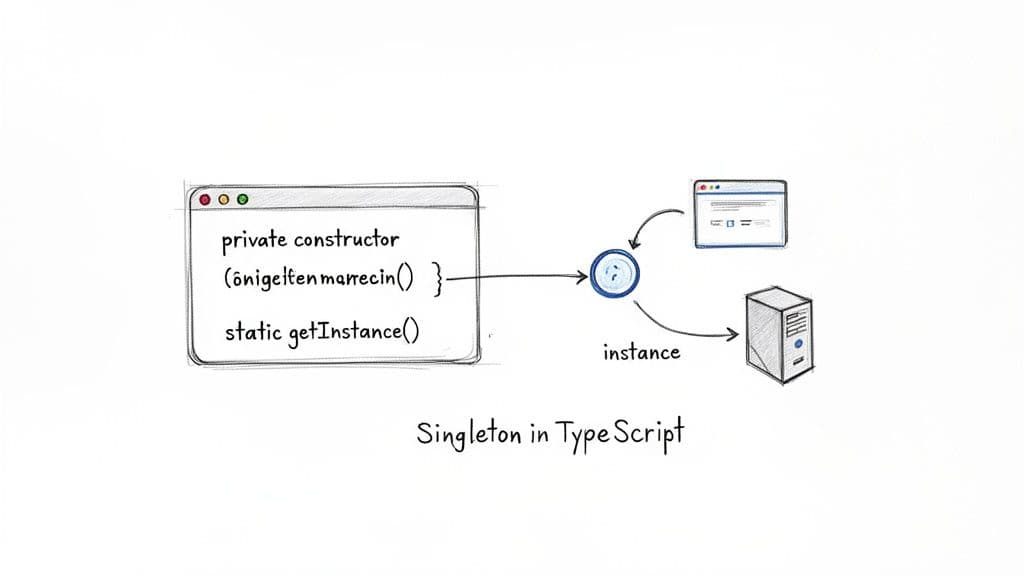
Implementing Singletons in TypeScript is straightforward but requires care. The private constructor, private static instance, and public static getInstance() enforce the single-instance rule.
Here’s a clean example for a SettingsManager:
class SettingsManager {
  private static instance: SettingsManager;

  private constructor() {
    console.log("SettingsManager instance created.");
  }

  public static getInstance(): SettingsManager {
    if (!SettingsManager.instance) {
      SettingsManager.instance = new SettingsManager();
    }
    return SettingsManager.instance;
  }

  public getSetting(key: string): string {
    return `Value for ${key}`;
  }
}

const c1 = SettingsManager.getInstance();
const c2 = SettingsManager.getInstance();
console.log(c1 === c2); // true
The private constructor prevents external new calls; the static accessor ensures one creation point.
Front-end example: central API service in React
For a React app, a Singleton can be used for a centralized ApiService that manages tokens, base URLs, and shared caching. This avoids prop drilling and keeps network logic out of components. Still, prefer dependency injection or context providers for easier testing and clearer dependencies.
Back-end example: database connection
On the back end, a Singleton managing a shared database connection or connection pool is a common pattern. Reusing connections avoids overhead and resource exhaustion. Wrap the connection logic inside a Singleton to ensure a single pool is reused across the app.
class DatabaseConnection {
  private static instance: DatabaseConnection;
  private connection: any;

  private constructor() {
    this.connection = this.connectToDb();
    console.log("Database connection established.");
  }

  public static getInstance(): DatabaseConnection {
    if (!DatabaseConnection.instance) {
      DatabaseConnection.instance = new DatabaseConnection();
    }
    return DatabaseConnection.instance;
  }

  private connectToDb() {
    return { status: "connected" };
  }

  public query(sql: string) {
    console.log(`Executing query: ${sql}`);
  }
}

const db = DatabaseConnection.getInstance();
db.query("SELECT * FROM users");
A common mistake
If you forget to make the constructor private, the Singleton’s guarantee is broken.
class IncorrectSingleton {
  private static instance: IncorrectSingleton;

  // Mistake: public constructor
  constructor() {}

  public static getInstance(): IncorrectSingleton {
    if (!IncorrectSingleton.instance) {
      IncorrectSingleton.instance = new IncorrectSingleton();
    }
    return IncorrectSingleton.instance;
  }
}

const s1 = IncorrectSingleton.getInstance();
const s2 = new IncorrectSingleton(); // Oops
console.log(s1 === s2); // false
Always make the constructor private when implementing a Singleton in TypeScript.
Why Singletons hurt testability and maintenance
Singletons introduce global state that can leak between tests, making unit tests brittle. Tests often need complicated setup and teardown to reset singleton state, undermining speed and isolation.
Mocking Singletons is difficult because classes calling MySingleton.getInstance() hard-code their dependency. That makes it hard to inject fakes and keep unit tests focused. The tight coupling forces broader integration-style tests, slowing CI feedback and reducing confidence in isolated behavior.
Violating fundamental principles
Singletons often violate the Single Responsibility Principle. They must enforce uniqueness and also perform business logic. Over time, Singletons can become “god objects” that centralize unrelated features—exactly the kind of architectural debt teams should avoid.
Where Singletons become performance killers
In high-concurrency systems, Singletons can cause lock contention and serialize access to a shared resource, reducing throughput and increasing latency5. Even small synchronous delays in a frequently used Singleton can create cascading performance problems.
Node.js relies on a nonblocking event loop, so blocking the loop with slow synchronous Singleton work can stall the entire process and degrade responsiveness2. Avoid blocking the event loop and design services to be asynchronous where possible.
Singletons also clash with microservice designs: there’s no global scope across distributed services, so patterns that rely on a single process-wide instance don’t translate well to distributed systems.
Modern alternatives
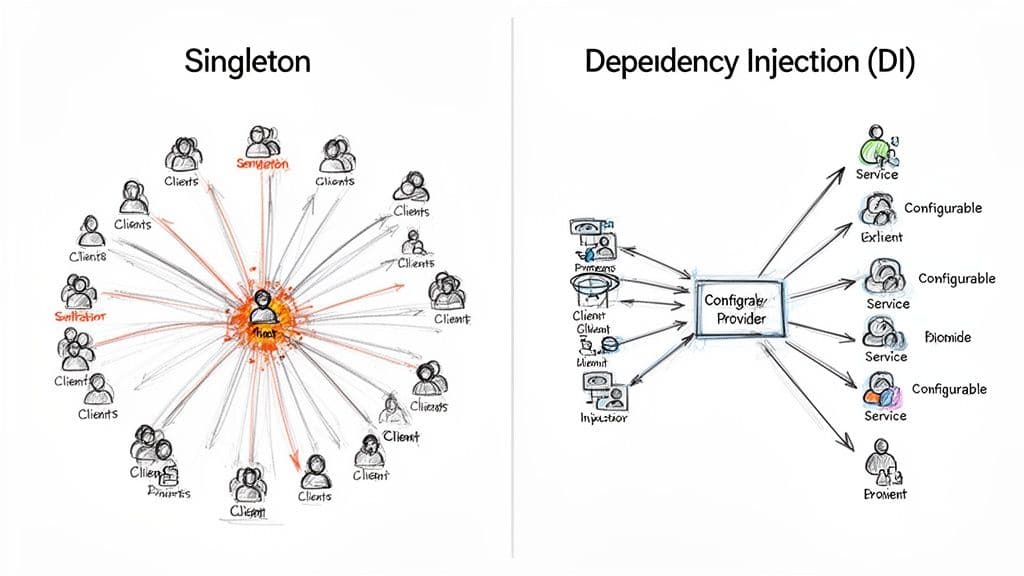
Better approaches let you keep the Singleton’s benefit—a single shared instance—without hidden dependencies.
Dependency injection (DI)
Dependency Injection flips responsibility: instead of a class reaching out to a global, the class receives dependencies through its constructor. DI makes dependencies explicit, simplifies testing (mocking is trivial), and reduces coupling. Many DI containers can still offer a “singleton” scope while keeping wiring explicit and testable3.
Module scope
ES6 modules naturally provide singleton-like behavior: an exported object or instance is cached by the module loader so every importer receives the same object. This is a lightweight, idiomatic alternative in modern JavaScript and TypeScript without the Singleton pattern’s boilerplate4.
| Attribute | Singleton Pattern | Dependency Injection (DI) |
|---|---|---|
| Coupling | High (tight) | Low (loose) |
| Testability | Difficult | Excellent |
| Dependencies | Hidden | Explicit |
| Flexibility | Low | High |
| Scalability | Poor | Good |
Dependency Injection or module scope gives you the same practical outcome as a Singleton—one shared instance—while avoiding hidden state and improving testability.
Refactoring a Singleton
To replace a Singleton with a DI-friendly approach:
- Find all calls to getInstance().
- Add constructor injection to classes that rely on the Singleton.
- Wire a single instance at the application entry point and pass it into constructors.
- Remove Singleton machinery: make constructor public and delete static instance/getInstance.
This gradual, mechanical process exposes hidden dependencies and improves long-term maintainability.
At Clean Code Guy, we help teams refactor tangled code into maintainable, testable systems. See how we approach architecture and refactoring at https://cleancodeguy.com.
Frequently Asked Questions
Q: When is it okay to use a Singleton?
A: Use Singletons sparingly—only for truly process-wide, mostly read-only resources like basic configuration or a centralized logger. Prefer DI or module exports when you need testability or flexibility.
Q: How do Singletons affect unit testing?
A: Singletons introduce global state that can leak between tests and make mocking hard. Refactor to constructor injection or use a DI container that supports test scopes to simplify isolation.
Q: What’s the fastest way to replace a Singleton in a legacy codebase?
A: Find all getInstance() calls, change consumers to accept the dependency via constructor, create a single instance at the entry point, and remove the static accessors once everything is wired.
Quick Q&A (concise)
What’s the main risk of using Singletons?
Singletons hide dependencies and increase coupling, which makes testing and refactoring harder.
When should I prefer DI over a Singleton?
Prefer DI when you need testability, flexibility, or when the service has significant state that could vary across contexts.
How can I keep a single instance without using the Singleton pattern?
Use DI with a singleton scope or rely on module exports, which naturally cache instances.
1.
Research and practitioner reports showing higher coupling in codebases that rely on stateful singletons: https://dev.to/rmaurodev/singleton-design-pattern-when-not-to-use-it-34j
2.
Node.js guidance on avoiding blocking the event loop: https://nodejs.org/en/docs/guides/dont-block-the-event-loop/
3.
Martin Fowler on Dependency Injection and inversion of control: https://martinfowler.com/articles/injection.html
4.
MDN article on ES6 modules and their caching behaviour: https://developer.mozilla.org/en-US/docs/Web/JavaScript/Guide/Modules
5.
Overview of locking and contention issues (concepts and impacts): https://en.wikipedia.org/wiki/Lock_(computer_science)
🙋🏻♂️
AI writes code.You make it last.
In the age of AI acceleration, clean code isn’t just good practice — it’s the difference between systems that scale and codebases that collapse under their own weight.