Robert C. Martin, known as Uncle Bob, shaped how developers think about professionalism, craftsmanship, and maintainable code. This practical guide distills Clean Code, SOLID, and Clean Architecture and shows how to apply them in TypeScript, React, and Next.js to reduce technical debt and keep teams productive.2
November 20, 2025 (10mo ago) — last updated August 12, 2026 (1mo ago)
Clean Code & SOLID: Practical Guide (TypeScript)
Practical guide to Uncle Bob’s Clean Code, SOLID, and Clean Architecture with TypeScript, React, and Next.js examples to reduce technical debt.
← Back to blog
Clean Code & SOLID: Uncle Bob’s Practical Guide
A practical guide to Robert C. Martin’s timeless principles. Apply SOLID, Clean Code, and Clean Architecture with TypeScript, React, and Next.js examples to reduce technical debt and keep teams productive.
Introduction
Robert C. Martin, known as Uncle Bob, shaped how many developers think about professionalism, craftsmanship, and maintainable code. This guide distills his core ideas — Clean Code, the SOLID principles, and Clean Architecture — and shows how to apply them in modern stacks like TypeScript, React, and Next.js. The goal is practical: write clearer code, reduce technical debt, and keep teams productive over time.2
Who Is Robert C. Martin (Uncle Bob)?
If you’ve ever had a teammate push to break a massive function into smaller pieces, pick clearer names than data2, or design a more resilient system, you’ve probably felt Uncle Bob’s influence. His career spans decades and he was one of the original signatories of the Agile Manifesto1. His work promotes software craftsmanship and professional engineering practices that keep codebases healthy over time.3
From Programmer to Thought Leader
Uncle Bob encourages a mindset that treats software as a craft built with discipline, care, and ownership. His books and talks are foundational for developers who want to write code that’s easy to read, test, and maintain.3
Uncle Bob’s Core Contributions at a Glance
| Concept | Primary goal |
|---|---|
| Clean Code | Write code that humans can read, understand, and maintain. |
| SOLID principles | Create flexible, maintainable object-oriented designs. |
| Clean Architecture | Keep business logic independent of frameworks and UIs. |
These concepts are practical guidelines for avoiding technical debt and building software that lasts. For further reading, see our guide on clean coding principles.
Clean Code: Philosophy and Practical Value

Clean Code isn’t just code that runs. It’s a professional practice focused on clarity, simplicity, and long-term maintainability. Think of a professional chef’s kitchen: every tool and ingredient is organized so the team can move fast without chaos. A messy codebase is the opposite — slow, error-prone, and costly to change.
Core tenets of clean code
Clean code centers on empathy for the next developer who’ll read your work. Key habits include:
- Meaningful names: Variables, functions, and classes should express intent.
elapsedTimeInDaysis clearer thand. - Small, focused functions: Each function should do one thing, making code simpler to test and reason about.
- Comments as a last resort: Prefer self-documenting code; use comments only to explain why, not what.
“Only by writing clear code can teams move quickly without paying later,” Uncle Bob teaches. Short-term shortcuts create long-term slowdowns.
Practical value
Clean code reduces time spent chasing bugs and makes onboarding faster. It’s not aesthetic; it’s pragmatic. Teams that prioritize readability and simplicity ship more reliable products and maintain momentum as they scale.5
Decoding the SOLID Principles with Examples
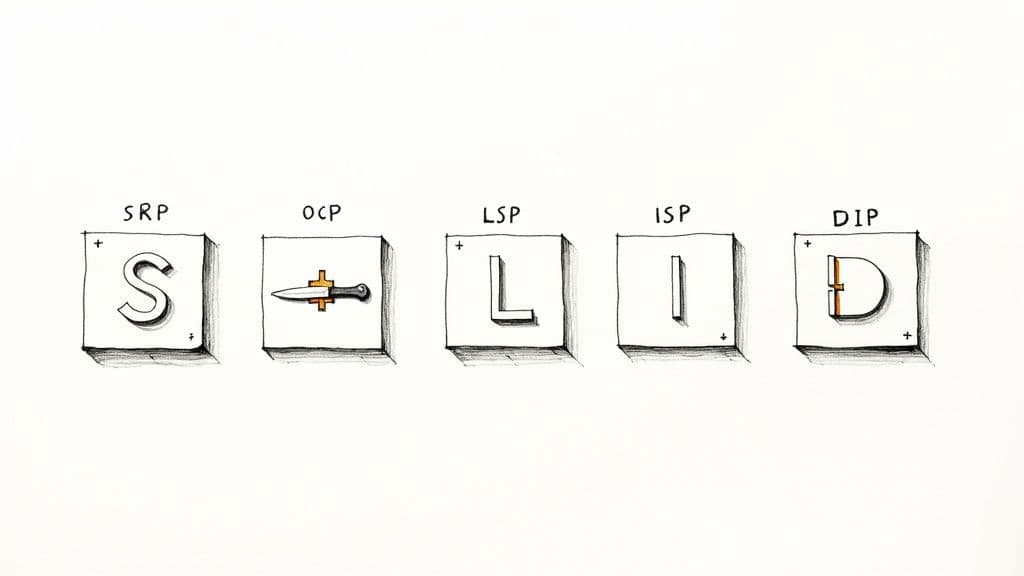
SOLID offers rules that prevent fragile designs. Each principle helps avoid a specific class of design problems.
The five pillars of SOLID design
- S — Single Responsibility Principle (SRP): A module should have one reason to change. Split responsibilities so changes affect isolated parts.
- O — Open/Closed Principle (OCP): Systems should be open for extension but closed for modification. Add new behavior by adding code, not by changing proven code.
- L — Liskov Substitution Principle (LSP): Subtypes must be substitutable for their base types without breaking behavior.
- I — Interface Segregation Principle (ISP): Prefer smaller, focused interfaces rather than large, monolithic ones.
- D — Dependency Inversion Principle (DIP): High-level modules should depend on abstractions, not concrete implementations.
These rules help build systems that are easier to test, debug, and evolve. Applying them prevents many common maintenance headaches.
Applying Clean Code in TypeScript, React, and Next.js
Principles matter when they guide day-to-day work. Here are practical ways to apply Uncle Bob’s ideas in modern stacks.
Break up the “god component” with SRP
A common code smell is a component that fetches data, manages many state variables, handles UI logic, and performs uploads. Break it into focused parts:
useUserDatahook: fetches and manages user data.BioEditorcomponent: handles the bio UI and state.AvatarUploadercomponent: deals only with image selection and upload.
Each piece is easier to test, reuse, and change.
Use dependency inversion in Next.js
Avoid importing a specific database client directly in API routes. Instead:
- Define an interface such as
IUserRepositorywith methods likegetUserById(id: string). - Implement a concrete class (for example,
PrismaUserRepository) that satisfies the interface. - Inject the concrete instance into your API route.
This keeps business logic independent of the database and makes swapping ORMs straightforward.
Small examples and patterns
- Prefer pure functions for logic that can be tested in isolation.
- Extract data-fetching into hooks to separate side effects from rendering.
- Favor composition over inheritance for React components.
Clean Architecture Explained for Modern Systems
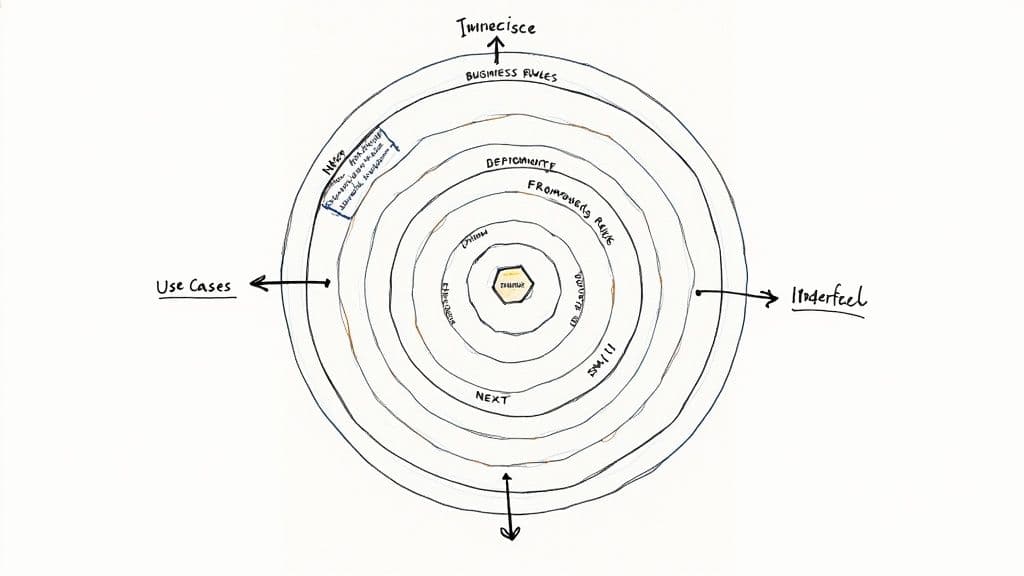
Clean Architecture provides a blueprint so core business rules remain independent of frameworks, databases, and UIs. The key idea is the dependency rule: source code dependencies point inward; inner layers never know about outer layers.
The concentric circles model
At the center are entities and core business rules. Moving outward, you have use cases, interfaces, and finally UI and infrastructure. This separation makes systems easier to test and maintain, and it simplifies future migrations.
Applying Clean Architecture in microservices
Each microservice can follow Clean Architecture, keeping domain logic isolated. That isolation reduces cross-service ripple effects and enables safer, incremental changes. For a practical layout, see our Clean Architecture summary.
Why Software Craftsmanship Matters
Software craftsmanship is professional responsibility. It’s more than neat code; it’s a commitment to quality, maintainability, and the ethical implications of the systems we build.
The ethical dimension of code
Engineers now face questions about fairness, privacy, and security. A craftsman asks not only, “Can we build this?” but also, “Should we build this?” This mindset supports more trustworthy products and healthier teams. Recent coverage highlights growing interest in ethics and professional standards in engineering teams.4
Building better products and teams
Teams that embrace craftsmanship ship higher-quality work, reduce technical debt, and foster trust across stakeholders. Developers consistently cite code quality and maintainability as top pain points when scaling projects.6
Frequently Asked Questions
Q: Is Clean Code still relevant with modern frameworks and AI tools?
A: Yes. Clean Code provides standards and judgment to guide generated code and maintain long-term quality. Without those standards, automation can accelerate the creation of hard-to-maintain code.
Q: Will Uncle Bob’s principles slow down a fast-moving startup?
A: No. The principles are an investment in sustainable velocity. Taking care early reduces costly rework and enables faster, safer changes later. Teams with strong engineering practices also deploy more frequently and recover faster.5
Q: Where should I start learning these ideas?
A: Begin with Clean Code, then read The Clean Coder and Clean Architecture. Practice by refactoring a small part of your codebase and applying SRP and DIP.3
Key questions — quick answers
- What is the single most valuable habit to adopt? Make names and functions intent-revealing so others understand your code without long explanations.
- How do I start refactoring a messy component? Identify responsibilities, extract hooks or subcomponents, and add unit tests before changing behavior.
- How does Clean Architecture help teams? It isolates domain logic so frameworks can change without rewriting business rules.
At Clean Code Guy, we help teams turn these principles into practice. From AI-ready refactors to in-depth codebase audits, we provide hands-on support to build software that lasts. Learn how we can help your team ship with confidence at https://cleancodeguy.com.
1.
Agile Manifesto, 2001, https://agilemanifesto.org/
2.
Robert C. Martin biography, https://en.wikipedia.org/wiki/Robert_C._Martin
3.
Clean Code: A Handbook of Agile Software Craftsmanship, Robert C. Martin, 2008. See author resources at https://cleancoder.com/books/
4.
Tech Lead Journal, developer culture and ethics coverage, https://techleadjournal.dev/
5.
State of DevOps and Accelerate research: teams with strong engineering practices deploy more frequently and recover faster, https://cloud.google.com/blog/products/devops-sre/state-of-devops-2019
6.
Stack Overflow Developer Survey 2022, developer concerns on code quality and maintainability, https://survey.stackoverflow.co/2022/
🙋🏻♂️
AI writes code.You make it last.
In the age of AI acceleration, clean code isn’t just good practice — it’s the difference between systems that scale and codebases that collapse under their own weight.