Discover why The Pragmatic Programmer book is a must-read for engineering leaders. Learn its core principles and how they apply to modern software development.
January 20, 2026 (6mo ago) — last updated May 15, 2026 (2mo ago)
Why The Pragmatic Programmer Book Shapes Modern Software Teams
Discover why The Pragmatic Programmer book is a must-read for engineering leaders. Learn its core principles and how they apply to modern software development.
← Back to blog
Why The Pragmatic Programmer Book Shapes Modern Software Teams
Discover why The Pragmatic Programmer book is a must-read for engineering leaders. Learn its core principles and how they apply to modern software development.
More than just a book about coding, The Pragmatic Programmer is a masterclass in the philosophy of software craftsmanship. It’s less of a manual and more of a mindset, packed with practical advice and timeless wisdom that transcends any single programming language or framework.
Why The Pragmatic Programmer Still Matters
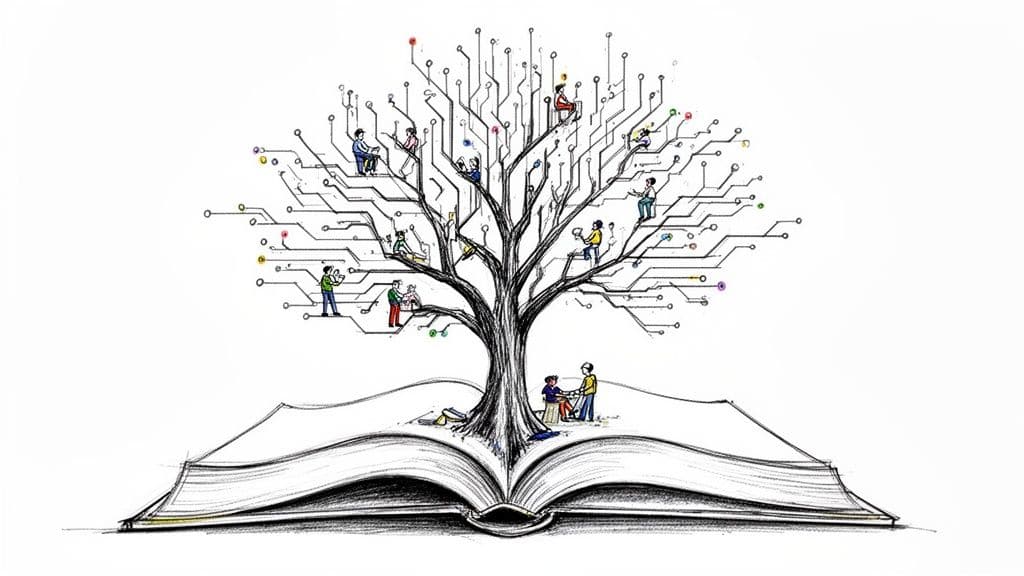
In an industry that reinvents itself every few years, it’s fair to wonder if a book published over two decades ago can still be relevant. The answer is a resounding yes. The Pragmatic Programmer has endured because it doesn't teach you what to think; it teaches you how to think like a professional developer.
Its power comes from principles that are just as applicable to a modern TypeScript/React codebase as they were to the technologies of 1999. The book champions a culture built on continuous learning, personal responsibility, and adaptability—the very traits that help teams reduce technical debt, boost velocity, and build software that stands the test of time.
For instance, these are the exact principles we leaned on when architecting projects like lifepurposeapp.com, where long-term maintainability was non-negotiable from day one.
A Foundation for Healthy Teams
Embracing the pragmatic mindset means building quality into your team's DNA. It’s about creating a shared vocabulary and a set of proven practices that help everyone tackle tough challenges, from junior developers to senior architects. This philosophy is the foundation for sustainable growth, seen in robust applications like fluidwave.com that are built on clean code principles.
The real value of The Pragmatic Programmer isn't just in the individual tips; it's in the holistic mindset it cultivates. It’s about being a professional who takes pride in their craft, communicates effectively, and delivers real value.
Here in Canada, this book has been a cornerstone for engineers aiming to build clean, maintainable systems. It's a key investment. Price tracking data for the 20th Anniversary Edition shows its cost has fluctuated, averaging $47.16 CAD since 2019.1
This guide will break down not just what the book says, but how to turn its ideas into concrete actions for your team—including how these principles make new tools like AI pair-programming even more effective. For a wider look at essential reading, see our list of other great clean code books.
Key Pragmatic Principles At A Glance
The book is built on several philosophical pillars. While the text is filled with dozens of specific tips, a few core principles truly define the pragmatic mindset. This table gives you a quick look at the big ideas and why they still matter so much today.
| Pragmatic Principle | Core Idea | Impact on Modern Teams |
|---|---|---|
| Care About Your Craft | Take pride in your work. Sign your name to it and be responsible for its quality. | This fosters ownership, leading to higher-quality code and fewer bugs. It combats a “just get it done” mentality. |
| Think! About Your Work | Don’t operate on autopilot. Actively engage with the problem and question assumptions. | Encourages critical thinking and prevents teams from blindly following trends. Leads to better architecture and more innovative solutions. |
| Provide Options, Don’t Make Lame Excuses | Instead of saying “it can’t be done,” explain what can be done and what the trade-offs are. | Empowers developers to be problem-solvers, improving communication with stakeholders and enabling realistic planning. |
| Don’t Live with Broken Windows | Fix small problems (bad design, wrong decisions, poor code) as soon as you find them. | This fights technical debt and preserves codebase health before problems snowball.2 |
| Be a Catalyst for Change | You don’t have to be in charge to make a difference. Identify opportunities for improvement and guide the team toward them. | Creates a culture where everyone feels empowered to improve processes and tools, enabling continuous growth. |
| Remember the Big Picture | Don’t get lost in the details. Understand the context of what you’re building and why it matters to the user. | Aligns technical work with business goals so teams build the right thing, not just build the thing right. |
Ultimately, these principles are about more than just writing code. They're about building a professional, effective, and resilient engineering culture that can handle whatever comes next.
The Core Philosophy of Pragmatic Programming
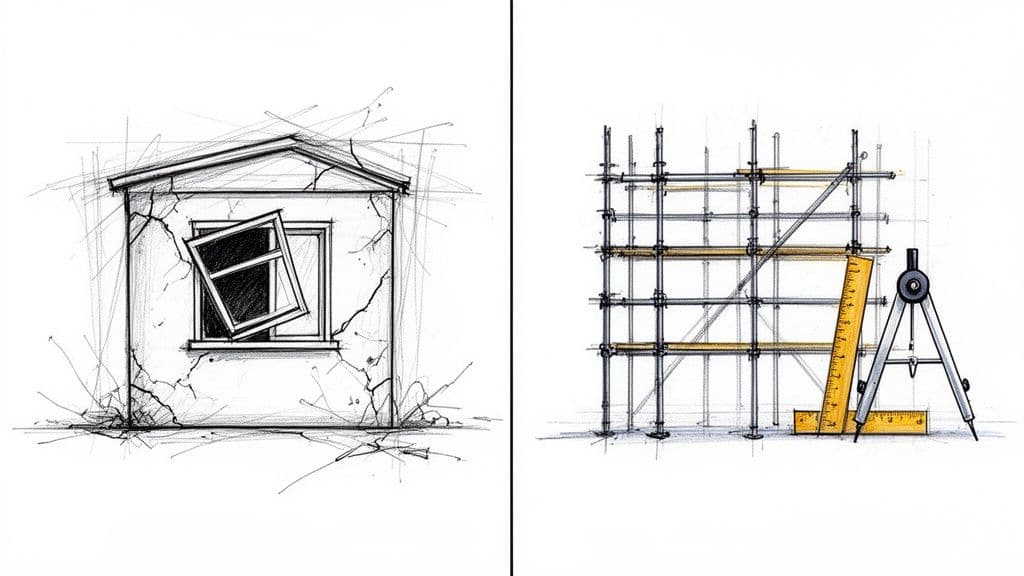
At its heart, The Pragmatic Programmer isn't a book about specific technologies. It's about a mindset. It treats software development as a craft, like a master carpenter building a house. The goal isn’t just to nail some boards together; it's to create something solid, dependable, and easy to maintain for years.
This philosophy starts with a simple but powerful idea: “Care About Your Craft.” A pragmatic programmer doesn't just clock in and churn out code that “works for now.” They take genuine ownership and strive for quality and professionalism, signing their name to their work with pride.
That sense of responsibility leads directly to another core tenet: “Provide Options, Don’t Make Lame Excuses.” When a tough challenge pops up, the easy way out is to say, “That's impossible.” The pragmatic developer changes the conversation. They explain what is possible, lay out the trade-offs, and give stakeholders the information they need to make smart decisions.
The Broken Windows Theory in Code
One of the most powerful analogies in the book is the Broken Windows Theory. It’s an idea borrowed from criminology: a single broken window left unrepaired in a building signals that no one cares. Pretty soon, more windows get broken, graffiti shows up, and decay takes hold.
The exact same thing happens in software.
A poorly designed piece of code, a confusing variable name, or a test that’s “temporarily” disabled is a broken window. It signals that quality isn’t a priority, making it easier for the next developer to cut another corner.
Ignoring these small problems is how technical debt starts to fester. Over time, neglect snowballs, and a once-clean codebase becomes a tangled mess that’s a nightmare to change. This is a huge reason we push for proactive code quality in projects like microestimates.com. Studies suggest technical debt can consume a large portion of development effort, reducing capacity for new features and refactors.2
Fostering a Culture of Quality
For engineering managers, getting the team to adopt this philosophy can completely change the game. When you build a culture where developers feel empowered to fix broken windows as they find them, the impact is massive. It slashes the buildup of technical debt, which some research shows can take up to 40% of a developer’s time.2
Embracing the pragmatic mindset helps you build a team that’s proactive, responsible, and committed to doing great work. This doesn't just improve your software; it boosts morale and creates a far more sustainable engineering environment. It’s about building codebases that are built to last—a principle we’ve baked into our work on applications like fluidwave.com, ensuring they are just as maintainable tomorrow as they are today.
Putting Pragmatic Principles Into Practice
Knowing the philosophy behind pragmatic programming is a great start, but the real magic happens when you turn those ideas into daily habits. This is where The Pragmatic Programmer really delivers, giving you concrete techniques that change how you write code, run projects, and deliver value.
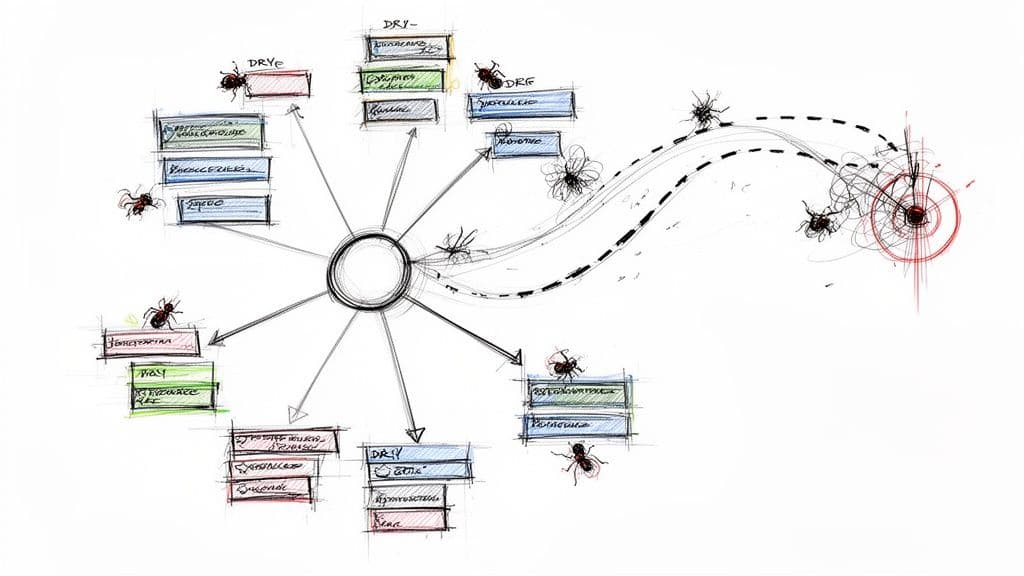
Two of the book’s cornerstones are Don’t Repeat Yourself (DRY) and Orthogonality. They sound simple, but when you truly internalize them, you can eliminate entire classes of bugs and build systems that are easy to change. These concepts are at the heart of the clean, maintainable systems we build for clients, including platforms like lifepurposeapp.com.
Embracing DRY to Prevent Chaos
DRY is often reduced to “don’t copy‑paste code,” but it’s more than that. The real goal is to ensure every piece of knowledge in a system has a single, unambiguous authoritative representation.
Imagine a Next.js app where three components show a user's subscription status. If the logic for that status is copied, a business rule change becomes a treasure hunt. Miss one spot and you’ve created a bug and a confused customer.
Instead, create a single source of truth—maybe a custom hook (useSubscriptionStatus) or a shared utility. That single point of control is the essence of DRY.
The Power of Orthogonality
Orthogonality means building components that are independent and don’t interfere with each other. A change in one shouldn’t cause a ripple effect of failures in others.
A car stereo is a good analogy: turning up the volume doesn’t change the radio station. Each control is orthogonal—it does one thing, and one thing only.
A system with good orthogonality is easier to debug, test, and understand. When components are decoupled, you can reason about them in isolation, which reduces cognitive load and simplifies maintenance.
Following these principles naturally leads to better documentation. When your system’s design is clean, explaining it becomes a lot easier. For modern documentation approaches, see best practices in effective software documentation.
Pragmatic Tips vs Common Pitfalls
| Pragmatic Tip | Common Anti-Pattern | Business Outcome |
|---|---|---|
| DRY: Abstract business logic into a single source of truth. | Copy‑Paste Coding: Duplicating logic across components or services. | Fewer bugs & faster updates: change once and propagate everywhere. |
| Orthogonality: Build small, independent modules with single responsibilities. | Monolithic Components: "God objects" that do too much. | Increased maintainability: teams can work in parallel without breaking each other. |
| Tracer Bullets: Build a thin, end‑to‑end slice of functionality first. | Big Bang Prototyping: Hope separate layers will integrate later. | Early risk detection: find architectural issues in days, not months. |
| Document in Code: Write self‑explanatory code and comments that explain why. | Outdated Wikis: External docs that are rarely updated. | Higher developer velocity: new hires onboard faster by reading the code. |
Ultimately, these pragmatic tips lead to more robust, flexible, and cost‑effective software. It's about working smarter, not just harder.
Using Tracer Bullets for Faster Feedback
The tracer bullet is a thin but complete slice of functionality that travels through every layer of your app—from UI, through API, to the database, and back. It validates the architecture early, becomes the first piece of the final system, and delivers tangible value faster.
This approach forces you to tackle tricky integration problems up front and provides a foundation to build on. It’s a perfect fit for pragmatic goals and works well with collaborative methods like pair programming.
Applying Pragmatism to Your Modern Tech Stack
The ideas in The Pragmatic Programmer endure because they aren't tied to specific technologies. They’re a mindset. Even though the book predates tools like TypeScript and React, its wisdom is a perfect blueprint for component-based architecture and tricky state management.
A common trap the book calls “Programming by Coincidence” is when code appears to work but you don’t know why. This shows up in complex React apps—tossing another dependency into a useEffect array or wrapping a function in useCallback to silence a linter without understanding side effects is programming by accident. That builds fragile code. A pragmatic developer insists on understanding their tools.
Crafting Better Component APIs
The book’s idea of Domain‑Specific Languages (DSLs) maps well to designing clean component APIs in React. Treat component props as a small language: make APIs obvious, predictable, and hard to use incorrectly.
Good: <Button variant="primary" size="large">Click Me</Button>
Bad: <Button isPrimary={true} isLarge={true} text="Click Me" />
A well-designed API prevents invalid combinations and keeps interfaces consistent. We apply this approach when building scalable front ends for clients like fluidwave.com.
“Instead of programming in a language, you should be programming into a language.” This encourages extending tools to better fit the problem, making solutions more robust and readable.
Automating for the AI Era
Pragmatic programmers automate repetitive work—builds, tests, deployments. Automation becomes a force multiplier when using AI pair-programming tools like Cursor or GitHub Copilot. When your codebase is clean, consistent, and covered by tests, AI tools generate more accurate and useful code. Evidence shows that well-structured codebases can improve the usefulness of AI code suggestions significantly.6
Applying the book’s principles is becoming more visible in Canada’s tech scene. With a large developer population, investing in clean code and automation is essential for productivity and maintainability.45
For teams bringing AI into their workflow, these practices boost tool efficiency and reduce friction. If you want to learn about the authors and their philosophy, see the official site for the book.3
Pragmatic Estimation and Project Management
Accurate estimation is one of the hardest parts of software development. The Pragmatic Programmer proposes a practical approach: stop giving single-point estimates. Instead, use ranges with confidence levels. For example, say, “I’m confident this will take between three and five days.” That communicates uncertainty clearly and protects team credibility.
This approach supports sustainable pacing and reduces the pressure to cut corners to meet unrealistic deadlines. It’s the kind of thinking that helps tools like the ones at microestimates.com deliver reliably.
The Power of Probabilistic Thinking
Using ranged estimates encourages probabilistic thinking, which is a more realistic way to plan software work. It protects your team’s credibility: if you estimate “three to five days” and deliver in five, stakeholders still see a win.
“Overly specific estimates are worthless. It’s your duty as a professional to quantify the uncertainty in your estimates.”
This honesty prevents technical debt accumulation caused by rushed work. You can learn more about managing and reducing technical debt in our guide on what is technical debt.
Improving Accuracy Over Time
The book suggests building mental models for estimates. Teams that adopt these practices often improve accuracy over time, reducing rework and improving predictability. For engineering managers dealing with messy Next.js codebases, understanding scope and uncertainty can cut estimation errors and help scale predictably.
To take project execution further, explore project management best practices at lathire.com.
Building a Lasting Pragmatic Team Culture
The ideas in The Pragmatic Programmer aren’t just personal productivity tips—they’re the raw materials for a resilient engineering culture. When a whole team adopts these principles, the impact reaches beyond a single project and influences company-wide technical health.
You’re creating an environment where doing things the right way becomes the path of least resistance. Excellence becomes the default.
Scaling with Confidence
A pragmatic culture lets teams scale without falling apart. When everyone shares a commitment to clean architecture and automation, adding features—or new developers—doesn’t introduce chaos. That foundation makes it easier to adopt new frameworks or integrate AI tools into daily work.
It’s the mindset we applied when engineering our own projects, like the maintainable codebase powering lifepurposeapp.com.
Adopting these principles isn’t just a technical choice; it’s an investment in your team’s future. You’re building an organisation that’s productive today and nimble enough to handle what’s next.
Ultimately, you kickstart a virtuous cycle: a culture of ownership means engineers fix broken windows before they become derelict buildings. A clean codebase boosts morale and enables everyone to do their best work. That’s the foundation for sustainable innovation.
A Few Common Questions About The Pragmatic Programmer
Even after all these years, people still have a few questions before they crack open The Pragmatic Programmer. Here are answers to the most common queries.
Is The Pragmatic Programmer Still Relevant Today?
Yes. Its staying power comes from its focus on the mindset of a software professional, not on specific languages or frameworks. Advice on automation, debugging, adaptability, and ownership remains central to lasting software.
Which Edition Should I Read?
If you’re reading it for the first time, get the 20th Anniversary Edition (2019). The authors preserved the original’s spirit while updating examples for the modern world.3
How Does This Book Compare to Clean Code?
They complement each other. The Pragmatic Programmer covers the philosophy of being a great developer; Clean Code dives into the tactics of writing excellent code. Together they form a practical curriculum for software excellence.
Quick Q&A: Common Reader Questions
Q: How do I start applying pragmatic principles on my team? A: Begin with small, visible practices: enforce a single source of truth for shared logic, add a tracer bullet to validate architecture, and make fixing broken windows part of code review culture.
Q: How do we measure progress after adopting these ideas? A: Track reduced bug reopen rates, cycle time for changes, and the percentage of time spent on unplanned maintenance versus feature work.
Q: Will this slow us down initially? A: You may invest more time upfront, but those investments pay off quickly through fewer regressions, faster onboarding, and steadier delivery.
1.
Price tracking data for the 20th Anniversary Edition shows fluctuating costs and averages: https://camelcamelcamel.com
2.
Studies and industry reports on technical debt indicate significant time lost to maintenance and legacy issues: https://www.castsoftware.com
3.
Information on the 20th Anniversary Edition and author background: https://pragprog.com/titles/tpp20/the-pragmatic-programmer-20th-anniversary-edition/
4.
Estimates of Canada’s software developer population and industry data: https://www.statista.com
5.
Workplace and legacy code challenges reported in developer surveys: https://survey.stackoverflow.co/2023/
6.
Evidence on how clean, well-tested code improves AI-assisted development and suggestion quality: https://github.com/features/copilot
🙋🏻♂️
AI writes code.You make it last.
In the age of AI acceleration, clean code isn’t just good practice — it’s the difference between systems that scale and codebases that collapse under their own weight.