Think of an enterprise IT architecture framework as the master plan for your company’s technology. It’s the blueprint that ensures software, hardware, and data work together to support your key business goals—helping you scale faster, cut costs, and reduce risk.7
December 22, 2025 (9mo ago) — last updated May 7, 2026 (4mo ago)
Enterprise IT Architecture Framework
How enterprise IT architecture frameworks align technology with strategy to boost agility, cut costs, and enable scalable, secure systems.
← Back to blog
Enterprise IT Architecture Framework Guide
Summary: How enterprise IT architecture frameworks align technology with strategy to boost agility, cut costs, and enable scalable, secure systems.
Introduction
Think of an enterprise IT architecture framework as the master plan for your company’s technology. It’s the blueprint that makes sure software, hardware, and data work together to support your most important business goals. With a clear framework you move from guessing to building a stable foundation for growth, faster delivery, and lower long-term costs7.
Understanding the Blueprint for Your Digital Future

Picture trying to build a modern city without a plan. You’d end up with traffic problems, disconnected neighbourhoods, and wasted resources. An enterprise IT architecture framework is that city plan for your organization’s technology.
It’s not a dry technical manual. It’s a strategic guide that links business goals—like launching new products or entering new markets—to the technology needed to achieve them. For any company serious about scaling, a structured approach is essential.
Why a Framework Is Non-Negotiable
Without a solid framework, departments pick their own tools, systems fail to interoperate, and data gets trapped in silos. That creates an expensive, fragile IT environment that slows the business.
A well-designed framework sets clear rules across four core areas:
- Business architecture: maps strategy, governance, organization, and core processes.
- Data architecture: defines logical and physical data assets and data management requirements.
- Application architecture: outlines each application, how they interact, and how they support business functions.
- Technology architecture: describes the hardware, platforms, and infrastructure needed to support everything else.
By creating a common language and shared principles, every project and investment reinforces strategy. This shifts teams from firefighting to proactively building durable platforms like Fluidwave.
“An enterprise IT architecture framework is the bridge between business strategy and execution. It ensures technology investments are strategic assets that deliver measurable business value.”
Turning Complexity into Clarity
As businesses grow, systems, applications, and data sources multiply. A framework imposes order, making the IT landscape understandable, manageable, and easier to evolve.
This clarity reduces costs by identifying redundant tools and standardizing solutions—many organizations see measurable reductions in duplicate applications after rationalization efforts6. It improves security through consistent standards and creates an agile foundation so the business can seize new opportunities without being hamstrung by a fragmented tech stack.
Comparing Major Enterprise Architecture Frameworks
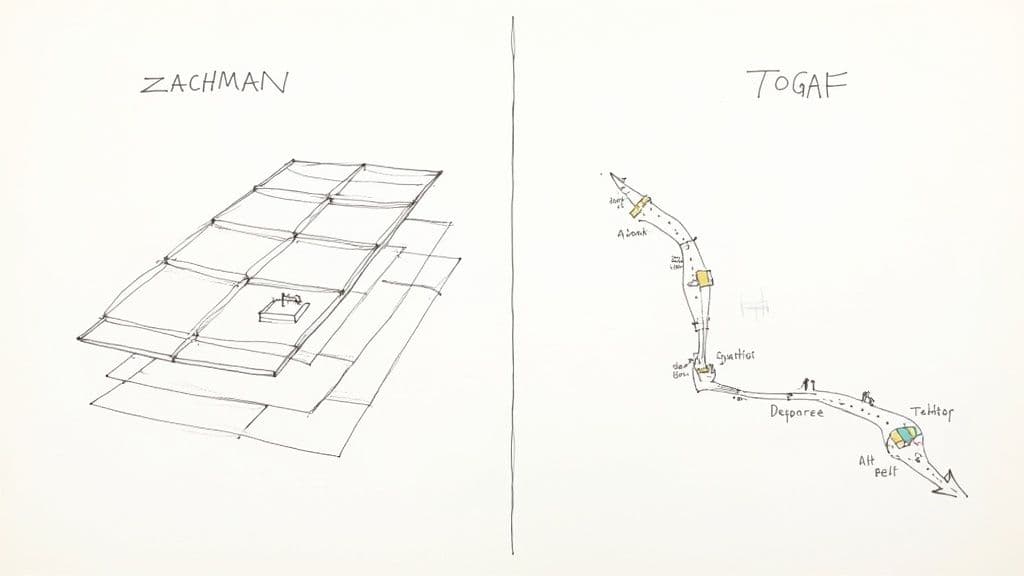
Picking a framework is like choosing a navigation system for a long trip. There’s no single best choice. It depends on your destination, vehicle, and travel style. Some teams need a prescriptive process, while others prefer a flexible way to organize thinking.
TOGAF: The Process-Driven GPS
The Open Group Architecture Framework, or TOGAF, is widely adopted and provides a repeatable process called the Architecture Development Method (ADM) to move from vision to implementation1. TOGAF is prescriptive and process-oriented, which makes it a favourite in large, complex organizations that need standardization and governance.
A 2019 review of the Canada Border Services Agency’s EA program found strong engagement with architecture teams but lower-than-expected reuse of standardized solutions, highlighting real-world trade-offs between rigor and delivery timelines3.
Zachman: The Comprehensive Map
If TOGAF is a turn-by-turn GPS, the Zachman Framework is a detailed map. It’s a two-dimensional matrix that captures What, How, Where, Who, When, and Why across different stakeholder perspectives. Zachman is descriptive rather than procedural, making it flexible for teams that want a complete classification without being told how to develop artifacts.
| Attribute | TOGAF | Zachman |
|---|---|---|
| Core focus | A process for developing and governing enterprise architecture. | A classification scheme for organizing architectural artifacts. |
| Structure | Iterative ADM process. | 6×6 matrix of interrogatives and perspectives. |
| Primary use case | Guiding step-by-step creation and governance. | Ensuring completeness and consistency of architectural descriptions. |
| Ideal fit | Large organizations needing repeatability and governance. | Teams that value flexibility and comprehensive modeling. |
TOGAF gives you a recipe to follow. Zachman gives you a well-organized pantry and lets you choose what to cook.
Other Notable Frameworks
- FEAF (Federal Enterprise Architecture Framework): tailored for U.S. federal agencies.
- DoDAF (Department of Defense Architecture Framework): specialized for defense and interoperability.
Choose the framework that matches your culture, size, and regulatory environment.
How Architecture Shapes Modern Software Engineering
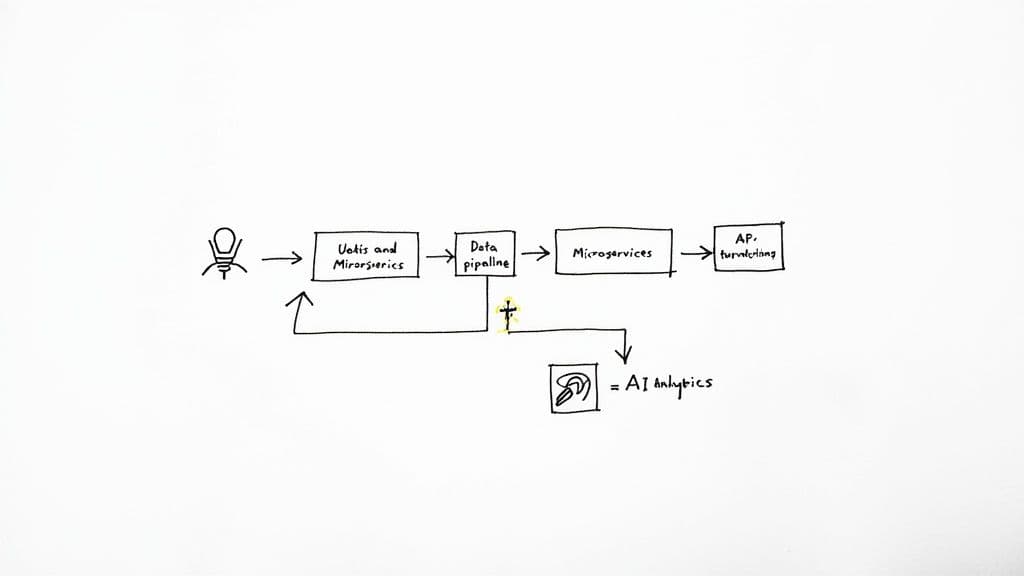
These frameworks don’t live only in slide decks. They shape how engineers design, ship, and maintain software by translating business goals into engineering principles.
For example, an objective like “omnichannel customer support” nudges teams toward modular services and clear APIs rather than a single monolithic application. That alignment leads to smaller, independently deployable services that are easier to test and scale, which improves delivery speed and system reliability.
From Business Capabilities to Modular Code
A framework turns business capabilities into modular services. “Inventory management” becomes a well-defined service with clear responsibilities and interfaces. Teams can develop, test, and deploy that service independently, accelerating innovation without risking the whole system.
“An architecture framework is a forcing function for good design. It transforms business goals into engineering constraints that yield modular, maintainable software.”
Explore how architecture connects to programming in our guide on architecture and programming in software development.
Driving Better Engineering Practices
A framework also enforces non-functional requirements—scalability, reliability, testability, and observability.
- Observability: Distributed systems require metrics, logs, and traces to understand system behavior.
- Testability: Modular services allow isolated testing and faster feedback.
- Interoperability: Clear, versioned APIs prevent fragile coupling and enable independent evolution.
The Government of Canada’s digital framework calls for service-oriented designs and high availability as core principles, making monitoring and resiliency mandatory for public-facing services2.
Building a Foundation for AI Readiness
AI projects depend on high-quality, accessible data. A strong data architecture and governance model answers questions about data ownership, location, cataloging, and security. This prepares organizations to reuse trusted data for analytics and machine learning, improving the odds of successful AI initiatives5.
Your Step-by-Step Framework Adoption Checklist
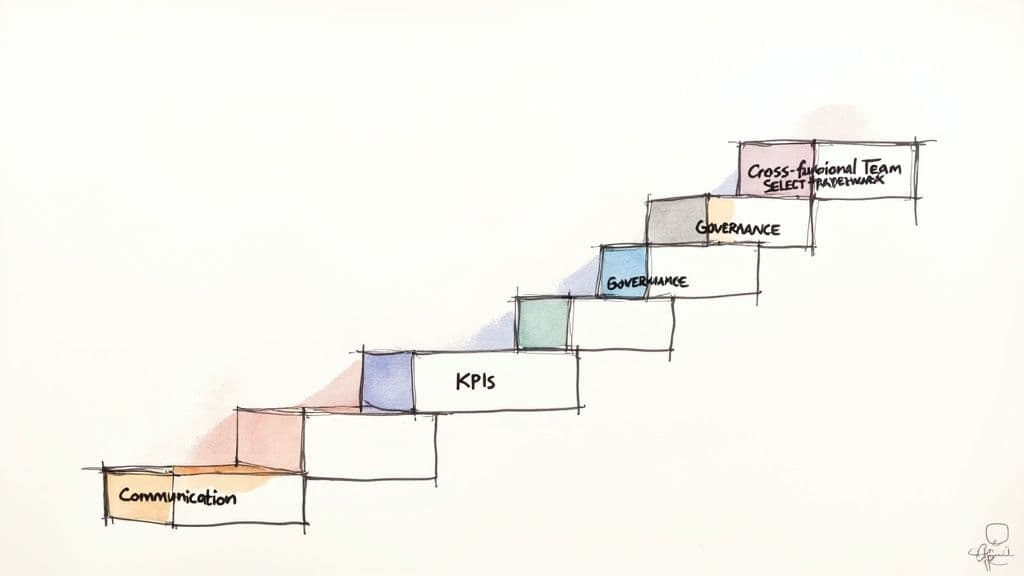
Adopting an enterprise IT architecture framework is more than a tech project. It’s a change in how business and IT teams collaborate. Follow these steps to make the framework part of your organization.
1. Secure Executive Sponsorship
Get visible C-suite support. Build a business case that focuses on outcomes leaders care about: lower operating costs, faster product delivery, and reduced risk.
2. Assemble a Cross-Functional Team
Success requires input from business strategists, technical architects, product managers, and financial analysts.
3. Select the Right Framework
Choose a framework that fits your company’s culture and maturity. Startups might choose a lightweight, flexible approach; large regulated organizations may need a prescriptive model like TOGAF1.
4. Establish Clear Governance
Create an Architecture Review Board (ARB) to review major projects, drive standardization, and catch integration or security issues early. The ARB should act as guardrails, not gatekeepers.
5. Choose the Right Tooling
Use modern EA tools to model, analyze, and communicate the architecture. These tools become the single source of truth for applications, data flows, and dependencies.
6. Define and Measure KPIs
Track KPIs to prove value. Start with cost reduction, faster time-to-market, system reliability, and project success rates.
7. Create a Communication Plan
Use town halls, newsletters, and training to share wins and best practices so the framework becomes part of the company culture.
Weaving Governance and Tooling into Your Architecture
Governance and tooling must work together to make the blueprint a living part of the organization. Governance provides the structure; tooling provides the leverage.
The Real Job of Governance and the ARB
An ARB should ensure projects align with strategic goals, champion shared platforms, and identify design risks early. When governance is done right, teams can deliver better software from day one.
Read more about architectural design choices in our guide on architectural design in software.
Choosing Tools That Actually Help
Modern EA tools act like a central nervous system, tracking application inventories, data flows, and technology dependencies. Statistics Canada’s “technology brick” approach treats approved technologies as modular components to manage standards and roadmaps effectively4.
With the right governance and tooling, organizations can standardize their stack, reduce costs, and get value to customers faster.
Common Implementation Pitfalls to Avoid
Adopting a framework is a marathon. Avoid these common traps.
Ivory Tower Architecture
If architects design in isolation, the result may be a perfect plan that’s unusable. Embed architects in product teams so designs reflect real-world constraints.
Analysis Paralysis and Lack of Sponsorship
Don’t overplan. Start with a small, high-impact use case, prove value, and iterate. Also, secure executive buy-in so the program has the resources and attention it needs.
A framework that delivers incremental value beats a perfect framework that never gets implemented.
Common Questions
Are These Frameworks Just for Huge Companies?
No. Startups and mid-sized companies benefit from lighter, agile versions to keep technology aligned with business goals and avoid crippling technical debt.
How Does This Work with Agile? Aren’t They Opposites?
They complement each other. A framework sets strategic guardrails while agile teams decide how to deliver within those boundaries, balancing vision and speed.
How Do We Measure ROI on This?
Track business-focused KPIs: cost savings from eliminating redundant apps, reduced time-to-market, improved project success rates, and fewer security incidents. Many organizations report clear ROI within the first one to two years after starting focused EA initiatives7.
Three Concise Q&A Summaries
Q: What is an enterprise IT architecture framework and why does it matter?
A: It’s a strategic blueprint that aligns technology with business goals, reduces redundancy, improves security, and enables faster delivery.
Q: Which framework should my organization choose?
A: Choose based on scale and culture. Large, regulated firms often prefer TOGAF; teams that want modeling flexibility may choose Zachman.
Q: What are the first practical steps to get started?
A: Secure executive sponsorship, assemble a cross-functional team, pick a suitable framework, set governance with an ARB, choose EA tooling, and measure KPIs.
At Clean Code Guy, we help teams build maintainable, scalable software that stands the test of time. Whether you’re wrestling with legacy code or building the next product, our expertise in clean architecture and modern practices can help you ship with confidence. Learn more at https://cleancodeguy.com.
1.
The Open Group, “TOGAF,” https://www.opengroup.org/togaf.
2.
Government of Canada, “Government of Canada Enterprise Architecture Framework,” https://www.canada.ca/en/government/system/digital-government/policies-standards/government-canada-enterprise-architecture-framework.html.
3.
Canada Border Services Agency enterprise architecture adoption review (2019); see CBSA publications at https://www.cbsa-asfc.gc.ca.
4.
Statistics Canada resources on technology standards and registries; see https://www.statcan.gc.ca.
5.
On the importance of clean, governed data for AI projects, see IBM, “What is machine learning?” https://www.ibm.com/cloud/learn/what-is-machine-learning.
6.
For guidance on application rationalization and reducing duplicate systems, see Gartner, “Application Rationalization” https://www.gartner.com/en/information-technology/glossary/application-rationalization.
7.
For research on EA value and digital transformation outcomes, see Forrester and industry TEI studies; see https://www.forrester.com.
🙋🏻♂️
AI writes code.You make it last.
In the age of AI acceleration, clean code isn’t just good practice — it’s the difference between systems that scale and codebases that collapse under their own weight.