Architecture sets the blueprint and programming places each brick. This article shows how teams can keep design and code aligned, avoid architectural drift, and use CI checks and refactor patterns to stay scalable and AI-ready.
November 26, 2025 (9mo ago) — last updated August 23, 2026 (28d ago)
Scalable Architecture for Modern Software Teams
Practical strategies, CI quality gates, and refactor patterns to build scalable, testable software and reduce technical debt for growth and AI readiness.
← Back to blog
Scalable Architecture for Modern Software Teams
Summary: Learn practical strategies, CI quality gates, and refactor patterns to build scalable, testable software, reduce technical debt, and prepare systems for AI.
Introduction
Architecture and programming are two sides of the same coin: architecture provides the strategic blueprint, and programming lays each brick. This article shows how those two must stay in step, where choices create work or friction, and what teams can do every day to keep systems scalable, testable, and easy to evolve.

Architecture and Programming: A Continuous Conversation
Too many teams treat architecture and programming as separate stages. An architect draws a plan and hands it off, and developers are left to figure out the rest. That leads to technical debt and project delays. Great teams treat architecture as a continuous conversation: architects set direction, and developers feed back practical constraints and discoveries.
For architects, that means understanding the daily struggles developers face and adjusting the design when needed. For programmers, it means respecting architectural boundaries and patterns so the system remains dependable as it grows. This back-and-forth keeps the product well designed and practical to build and support.
“Good architecture makes the system easy to understand, develop, test, and deploy.”
How High-Level Design Shapes Daily Code
Architectural choices like monolith versus microservices aren’t just diagrams — they change how engineers think, test, deploy, and debug. These decisions cascade down to every line of code.
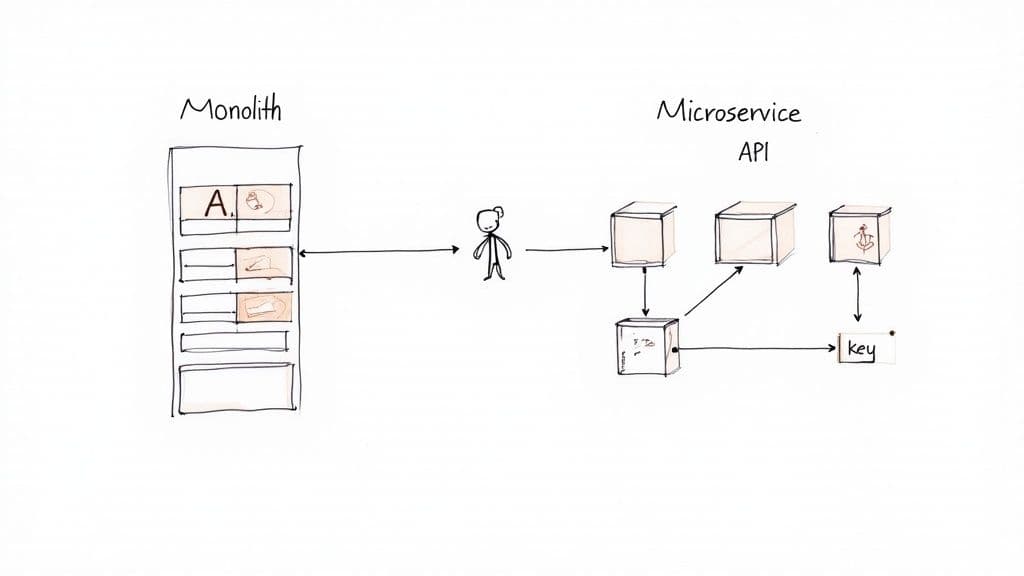
Microservices: Networked Concerns
In a microservices architecture, developers spend much of their mental energy on the world outside their service: API contracts, network latency, retries, and observability. Building resilience with retries, circuit breakers, and timeouts becomes routine. Data becomes distributed, and patterns like sagas and eventual consistency are common challenges.
When done well, microservices let independent teams move fast. When done poorly, you get a distributed monolith: the coordination overhead of microservices combined with the coupling problems of a monolith3.
Monoliths: Discipline and Boundaries
A monolith’s danger isn’t network failure; it’s internal entropy. Preventing a “big ball of mud” requires deliberate modularity: namespaces, packages, and strict dependency rules. With good discipline, a monolith can be efficient and simpler to operate, but it demands consistent boundary enforcement.
Architectural Patterns and Programming Impact
| Pattern | Programming Focus | Common Challenges |
|---|---|---|
| Monolith | Internal modularity, dependency injection, clear separations | Spaghetti code, long builds, hidden dependencies |
| Microservices | API design (REST/gRPC), resiliency, observability | Network latency, distributed debugging, consistency |
| Event-Driven | Asynchronous flows, brokers (Kafka/RabbitMQ), idempotency | Message tracing, ordering, poison messages |
| Serverless | Stateless functions, IaC, cold-start management | State handling, local testing, vendor limits |
Decisions about databases or queues also change programming practices. Switching from SQL to NoSQL alters query patterns; adding a message broker shifts teams to asynchronous thinking.
Recognizing Architectural Smells
Architectural smells are early warning signs that the blueprint and the implementation are drifting apart. Spot them early to reduce technical debt and avoid large rewrites.

God Object
A “God Object” centralizes too many responsibilities and becomes a single point of failure. It violates the Single Responsibility Principle and creates merge conflicts and fragile change paths.
Excessive Coupling
If a small change requires edits across many unrelated modules, your boundaries are leaking. Excessive coupling stops teams from reasoning about parts of the system in isolation.
Inconsistent Data Handling
When teams invent their own data access patterns, you get multiple sources of truth, scattered business logic, and redundant network calls. These are textbook signs of growing technical debt.
Practical Strategies for Architectural Integrity
Maintaining architecture is a continuous effort, not a one-off cleanup. Focus on tools and habits that make the right choice the easy choice.
Automated Quality Gates
Automate enforcement of architectural rules in CI. A robust linting and pipeline setup can enforce module boundaries, block deprecated APIs, and flag excessive complexity. Useful checks include:
- Dependency rules to prevent high-level modules from importing low-level components.
- Complexity thresholds (cyclomatic complexity) to catch growing God Objects.
- Pattern enforcement to ensure generated code follows team conventions.
When these checks run in CI, architecture becomes part of daily development rather than an afterthought. High-performing teams that adopt CI/CD practices deploy more frequently and recover from incidents faster1.
See an example ruleset for CI quality gates in the CI quality gates guide and a sample architecture lint configuration at [/patterns/architecture-lint].
Refactor with Purpose: The Strangler Fig Pattern
Large rewrites are risky. The Strangler Fig Pattern offers an incremental approach: build new functionality as separate modules or services that slowly replace parts of the legacy system. It reduces risk and delivers value continuously2.
Governance and Real-World Design
Strong architecture comes from pragmatic governance: clear interfaces, single responsibilities, and modular ownership. Platforms that follow these rules can evolve without breaking the rest of the system.
Designing AI-Ready, Future-Proof Systems
Preparing for AI and other future changes doesn’t require guessing tomorrow’s tools. It requires data modularity, flexible APIs, and observability. Treat models as external services behind stable APIs so teams can scale and iterate models independently.
Use asynchronous processing and task queues (RabbitMQ, Redis) for heavy workloads so user-facing systems remain responsive. The same decoupling that prepares you for AI also reduces technical debt and improves long-term velocity.
Data Modularity and Flexible APIs
Keep data models clean and expose data through clear, versioned APIs. This enables independent scaling, polyglot development, and simpler updates to models and services.
Building Better Software Together
Architecture’s health is everyone’s responsibility. Shared ownership—where architects and developers collaborate—is the strongest defense against architectural drift. Practices that help include:
- Regular architectural reviews with the whole team.
- Clear documentation of key decisions and why they were made.
- Cross-functional pairing to align design and implementation.
When teams co-own architecture, they build systems that stay robust as they grow.
Quick Q&A (Concise Takeaways)
Q: What’s the biggest cause of architectural failure? A: Treating architecture as a one-time handoff instead of an ongoing feedback loop.
Q: How do I start paying down architectural debt? A: Run automated quality gates, prioritize small refactors, and use incremental strategies like the Strangler Fig Pattern.
Q: How do I make my system AI-ready? A: Modularize data, expose ML via APIs, and offload heavy tasks to asynchronous workers.
Common Questions About Architecture and Programming
What’s the biggest mistake teams make?
The biggest mistake is separating architecture from implementation. When architects hand off designs with no feedback loop, the architecture becomes theoretical and developers create fragile workarounds. Treat architecture as a hypothesis that must be validated by code.
How can a junior programmer contribute to architecture?
Junior programmers can reinforce architecture by writing modular, well-tested code and by asking why certain decisions were made. Their questions often reveal confusing patterns that need clarification.
Do frameworks replace architecture?
No. Frameworks accelerate implementation but don’t answer high-level design questions. Use frameworks as tools, not as a substitute for architectural thinking.
Practical Links and Services
For teams that need help aligning architecture and implementation, Clean Code Guy offers Codebase Audits and AI-Ready Refactors to create actionable roadmaps and automated checks. Learn more at https://cleancodeguy.com.
Bottom-line Q&A
Q: How do I choose between monolith and microservices? A: Choose the architecture that matches team boundaries and operational maturity. Start with a modular monolith and split to microservices when you need independent scale or release velocity.
Q: What quick wins reduce architectural risk? A: Enforce dependency rules in CI, add complexity limits, and introduce small strangler-style refactors that replace high-risk components.
Q: How do I measure architectural health? A: Track module coupling, build and deploy frequency, failure recovery time, and the rate of cross-team changes. Combine metric trends with regular architectural reviews.
Concise Q&A Pack — Common Pain Points (3 short sections)
1) When should we split a monolith?
Q: How do I know it’s time to split?
A: When teams can’t work independently, release cadence slows, or scaling a single component causes operational pain. Prefer incremental splits and measure impact.
2) How can we stop adding technical debt?
Q: What immediate steps reduce recurring debt?
A: Add CI quality gates, enforce dependency rules, and require small, frequent refactors instead of big rewrites.
3) How do we prepare for AI workloads?
Q: What infrastructure changes are most valuable?
A: Decouple data and model execution behind versioned APIs and use asynchronous workers for heavy processing so user-facing systems stay responsive.
1.
DORA: State of DevOps finds that higher-performing teams deploy more frequently and recover faster. See the DORA findings and analysis in the State of DevOps reports: https://cloud.google.com/blog/products/devops-sre/dora-state-of-devops-report-2019
2.
The Strangler Fig Pattern provides an incremental migration approach for replacing legacy systems while delivering continuous value. See Martin Fowler’s description: https://martinfowler.com/bliki/StranglerApplication.html
3.
Microservices can enable independent team velocity but also introduce coordination and coupling hazards if boundaries aren’t clear. For guidance on decomposing systems and common pitfalls, see Sam Newman’s work: https://samnewman.io/books/building_microservices/
🙋🏻♂️
AI writes code.You make it last.
In the age of AI acceleration, clean code isn’t just good practice — it’s the difference between systems that scale and codebases that collapse under their own weight.