Picture a top-tier mechanic whose workshop is so disorganized they can’t find a wrench. Clean Code by Uncle Bob is a practical philosophy that teaches developers how to write clear, maintainable code. This article distills core principles and shows how to apply them with TypeScript, React, and Node.js examples to reduce technical debt and ship with confidence.
December 8, 2025 (9mo ago) — last updated July 27, 2026 (1mo ago)
Clean Code Principles for TypeScript & React
Apply Clean Code with TypeScript, React, and Node.js examples to cut technical debt, improve readability, and deliver maintainable software.
← Back to blog
Clean Code Principles for TypeScript & React
Unlock the core ideas from Clean Code by Robert C. Martin with practical TypeScript, React, and Node.js examples. Learn how small habits reduce technical debt, improve readability, and help teams ship reliable software.
Introduction
Picture a top-tier mechanic whose workshop is so disorganized they can’t find a wrench. That’s what many talented developers face when they inherit messy codebases. Clean Code by Robert C. Martin (Uncle Bob) is a practical philosophy for software craftsmanship that helps teams write code that’s easy to read, simple to maintain, and ready to evolve.
This article distills the core principles, maps them to TypeScript, React, and Node.js, and gives practical steps your team can take today to reduce technical debt and ship with confidence.

Why Clean Code Still Matters
Shipping quickly is important, but most systems spend far more time in maintenance than in initial development; readable code speeds future changes and reduces bugs.6 Teams that prioritize clarity see faster onboarding, lower defect rates, and steadier velocity over time.2
“The only way to go fast is to go well.” — Robert C. Martin
Real-world impact
- Reduced cognitive load for new engineers
- Shorter time-to-ship for features
- Fewer regressions and lower maintenance cost3
A culture of quality is an investment that pays off across engineering and the business.
Foundational Principles of Clean Code
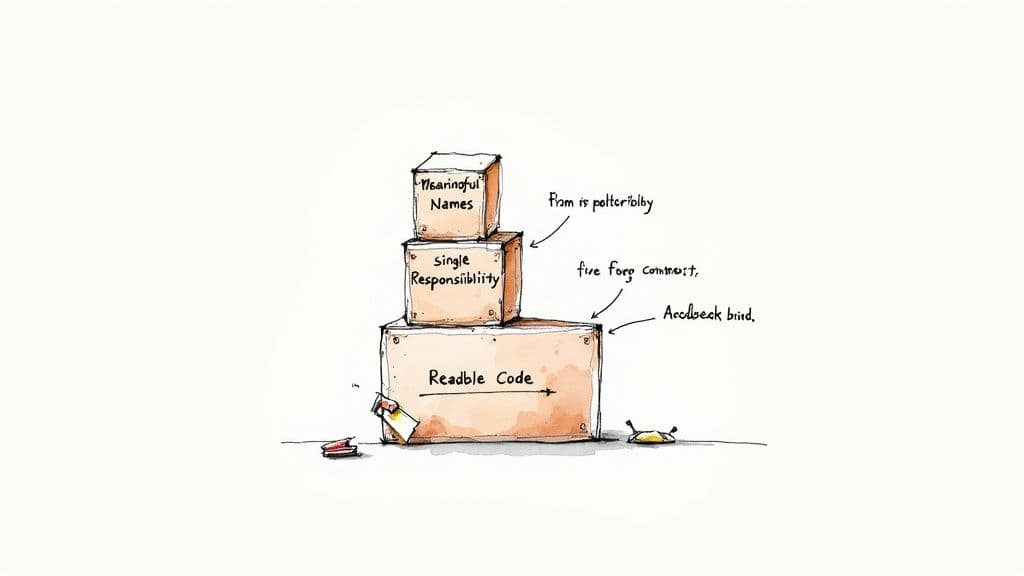
Uncle Bob’s guidance is pragmatic. These are guiding principles, not rigid laws. They help teams build systems that are easy to understand, simple to change, and pleasant to maintain.
Core ideas at a glance
| Principle | Problem it solves | Benefit |
|---|---|---|
| Meaningful names | Cryptic identifiers that hide intent | Code reads like documentation |
| Single responsibility | Large functions or classes mixing concerns | Smaller, testable units |
| Readability first | Code written only for machines | Faster onboarding, fewer bugs |
| Boy Scout Rule | Gradual accumulation of technical debt | Continuous small improvements |
Meaningful names reveal intent
Names are the fastest improvement you can make. A name like elapsedTimeInDays communicates purpose at a glance. When function names describe behavior precisely — for example fetchAndValidateUserRecords() — the code becomes self-documenting and easier to trust.
Functions should do one thing
Small functions are easier to test, debug, and reuse. If you describe a function with “and” or “or,” split it. The Single Responsibility Principle helps keep code focused.
“The first rule of functions is that they should be small. The second rule of functions is that they should be smaller than that.” — Robert C. Martin
Here’s a concise TypeScript example showing refactoring toward single-responsibility functions.
Before (messy):
// A function doing too many things
function handleUser(user) {
  if (!user.email || !user.name) {
    console.error("Invalid user data");
    return;
  }
  const db = getDatabase();
  db.save(user);
  const emailService = getEmailService();
  emailService.send("welcome", user.email);
}
After (clean):
function validateUser(user: User): boolean {
  return !!user.email && !!user.name;
}

function saveUserToDatabase(user: User): void {
  const db = getDatabase();
  db.save(user);
}

function sendWelcomeEmail(email: string): void {
  const emailService = getEmailService();
  emailService.send("welcome", email);
}

function registerNewUser(user: User): void {
  if (!validateUser(user)) {
    throw new Error("Invalid user data provided.");
  }
  saveUserToDatabase(user);
  sendWelcomeEmail(user.email);
}
Small functions make unit testing straightforward and build developer confidence.
The Boy Scout Rule
Leave the code a little cleaner than you found it. Small, consistent improvements — renaming a variable, extracting a helper, deleting dead comments — prevent compounding technical debt.
Applying Clean Code to React and Node.js
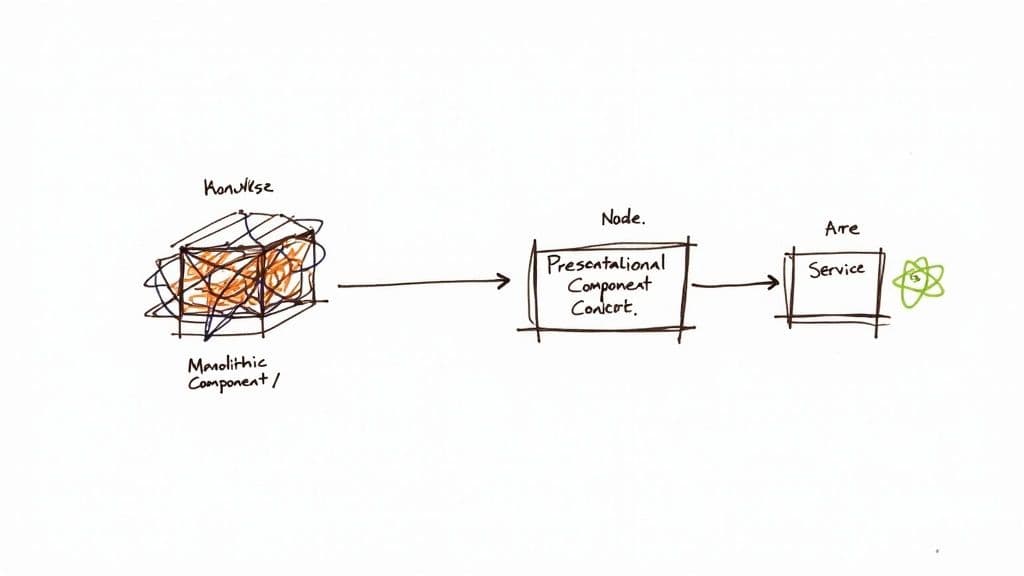
Principles map cleanly to modern stacks: small functions, explicit types, and separation of concerns make React components and Node.js services easier to maintain.
Refactor a bloated React component
If UserProfile fetches data, manages state, and renders UI, split responsibilities:
- Create a custom hook
useUserData()for fetching and state - Build a presentational
UserDisplaycomponent that renders props
Each piece is easier to test, reuse, and reason about.
Clean Node.js backends
Keep controllers thin and delegate to service layers for business logic. Services are testable without HTTP, improving coverage and reliability.
TypeScript enforces clarity
TypeScript’s static types are living documentation. A well-defined User type clarifies expectations across components and services and catches many bugs at compile time. TypeScript is widely adopted and often ranks highly in developer surveys, reinforcing its value for maintainable codebases.7
By applying these patterns to React and Node.js projects, you reduce risk and make features easier to deliver.
Building a Culture of Clean Code
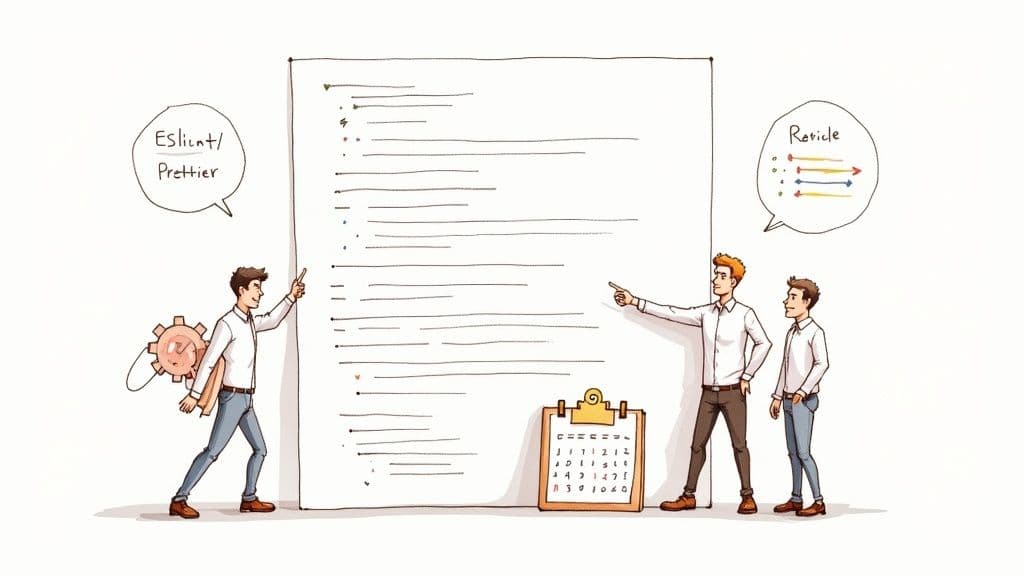
One developer can start improvements, but teams must adopt practices to make clean code the default. Engineering leaders should encourage collective ownership, create standards that reduce friction, and automate trivial checks.
Make code reviews mentoring opportunities
Ask whether functions have a single responsibility, whether names express intent, and whether the architecture fits the use case. Use reviews to teach and reinforce standards.
Practical review practices:
- Use a PR template that asks for the why behind changes
- Focus reviewers on design, naming, and test coverage
- Praise clear examples to reinforce positive behavior
Automate style with linters
Let machines handle style. Tools like ESLint and Prettier remove noisy review comments so humans can focus on architecture.
Introduce a refactoring cadence
Treat technical debt like financial debt. Regular, small repayments prevent interest from crippling future work:
- Follow the Boy Scout Rule on every commit
- Schedule short refactor sessions each sprint or a monthly tech-debt day
- Scope small refactors into feature work so improvements happen continuously
These practices help teams maintain clarity and long-term velocity.
Future-Proofing Your Codebase
Clean code is a down payment on adaptability. In high-stakes domains, teams that embraced quality practices saw large reductions in critical defects during certification efforts, showing how essential code quality is where safety matters.3
Make your codebase AI-ready
AI coding assistants like GitHub Copilot and Cursor work best against clear, consistent code. When names describe intent, functions are small, and patterns are predictable, AI tools generate more accurate suggestions and tests.45
A clean codebase amplifies the value of AI tools rather than hampering them.
The value of a clean code audit
A Clean Code Audit diagnoses hotspots of technical debt and produces a prioritized roadmap. It’s a practical next step when your team wants targeted, measurable progress rather than guessing where to start. Learn more at our Clean Code audit page.
Common questions (concise Q&A)
Q: Is Clean Code still relevant with modern frameworks?
A: Yes. Frameworks change, but managing complexity is constant. Clean Code principles make code understandable regardless of the stack.
Q: How do I convince leadership to invest in refactoring?
A: Frame technical debt as an interest-bearing loan and show metrics for onboarding time, bug rates, and delivery velocity to make the business case.2
Q: What’s the easiest change to start with today?
A: Start with naming and the Boy Scout Rule. Rename unclear identifiers and leave code slightly cleaner on every touch. Small habits compound into big improvements.
At Clean Code Guy, we help teams apply these principles through focused refactors and audits to build software that’s reliable, maintainable, and enjoyable to work on.
1.
Discussion thread reporting on adoption of Clean Code and SOLID practices: https://news.ycombinator.com/item?id=41081237
2.
Overview of productivity and quality benefits linked to clean coding practices: https://cleancodeguy.com/blog/robert-martin-uncle-bob
3.
Analysis of software quality in safety-critical systems and certification impacts: https://www.youtube.com/watch?v=EaEyvLE92no
4.
GitHub Copilot — AI pair programmer: https://github.com/features/copilot
5.
Cursor — AI tools for developers: https://cursor.sh/
6.
Estimates suggest maintenance consumes a large portion of software lifecycle costs, commonly cited between 40 and 80 percent: https://en.wikipedia.org/wiki/Software_maintenance
🙋🏻♂️
AI writes code.You make it last.
In the age of AI acceleration, clean code isn’t just good practice — it’s the difference between systems that scale and codebases that collapse under their own weight.