A definitive guide to software architecture for CTOs. Learn principles, patterns, and practical steps to design scalable, AI-ready systems that remain maintainable as your business grows.
February 3, 2026 (6mo ago) — last updated July 19, 2026 (1mo ago)
Software Architecture Guide for CTOs
Definitive guide for CTOs: principles, patterns, and practical steps to build scalable, maintainable, AI-ready software systems.
← Back to blog
Mastering Software Architecture for CTOs
Summary: A definitive guide to software architecture for CTOs: principles, patterns, and practical steps to build scalable, AI-ready systems that last.
Introduction
A definitive guide to software architecture for CTOs. Learn principles, patterns, and practical steps to design scalable, AI-ready systems that remain maintainable as your business grows.
Think of software architecture as the skeleton of your system. It’s the strategic blueprint that defines how components connect and work together, and it sets the rules for how the system will grow and change over time. This blueprint directly shapes performance, how quickly teams can adapt, and long-term costs.
Why software architecture is your competitive edge
It’s easy for engineering leaders to treat architecture as a purely technical problem, but that’s a mistake. System architecture is a business asset, the foundation that dictates your company’s ability to grow, pivot, and compete.
Imagine building a skyscraper. A weak foundation won’t just make the building wobbly; it limits how high you can build. Every new floor becomes risky and expensive. It’s the same with software.
When architecture is poorly designed, it creates friction that slows everything down. For engineering leaders, that friction appears as real business problems:
- Slower feature delivery: Teams can’t add new features without the risk of breaking unrelated parts.
- Plummeting team morale: Developers burn out on a tangled, unpredictable codebase, increasing turnover.
- Inability to innovate: The system is too brittle to handle new market demands or integrate modern technologies.
The hidden costs of moving fast
The startup mantra “move fast and break things” often comes with a steep, hidden architectural cost. Speed helps find product-market fit, but ignoring structure builds technical debt that eventually chokes growth. A pragmatic approach to architectural design matters, even early on.
“Great architecture isn’t about building a perfect, rigid system from day one. It’s about making intentional choices that enable sustainable speed and future flexibility.”
A clear architecture also makes onboarding new engineers faster because system boundaries and logic are explicit. Clean, modular design unlocks the power of AI-assisted tooling, which amplifies productivity in structured codebases but struggles in tangled ones, so architecture enables that synergy.
Decoding modern software architecture patterns
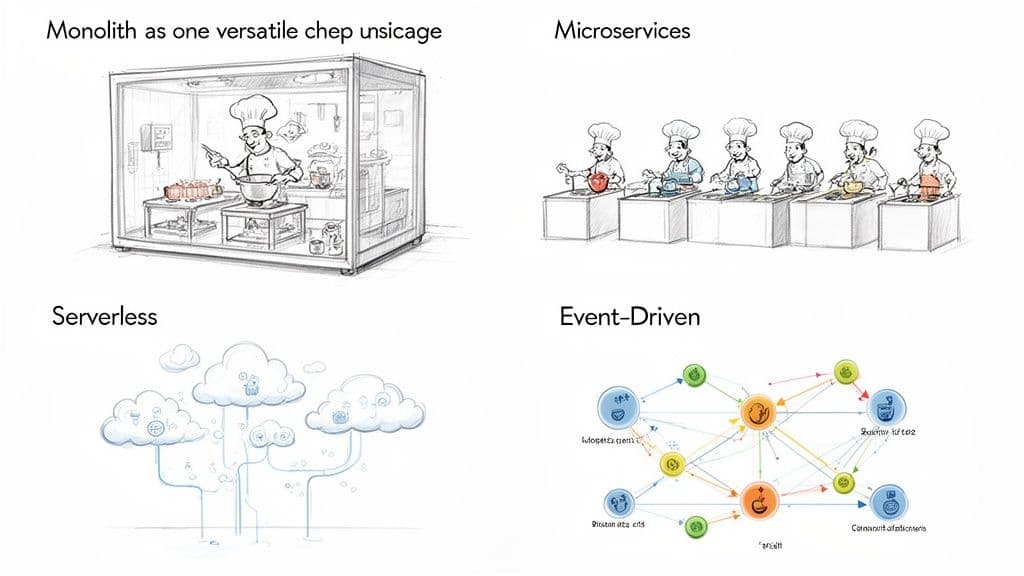
Choosing an architectural pattern isn’t about finding one “best” answer. It’s about making a strategic choice that fits your business, your team, and your roadmap—like a chef choosing a kitchen layout that suits the operation.
Below are practical notes on common patterns, why teams choose them, and the trade-offs to expect.
Monolith: The versatile chef
A monolithic architecture bundles the application into a single codebase. For new projects and startups, this is often the smartest way to start.
- Speed to market: A single codebase gets your first version out quickly.
- Simplicity: Debugging and testing are straightforward; you can trace a request end-to-end in one environment.
- Lower initial overhead: No distributed system to manage.
When popularity grows, a monolith can become a “big ball of mud,” where small changes break other parts. For many early-stage products, a modular monolith is the right choice to reach product-market fit before adopting more complex patterns.
Microservices: A kitchen of specialists
Microservices split the application into small, independently deployable services, each owning a business capability.
- Independent deployment: Teams ship without a single coordinated release.
- Targeted scalability: Scale only the services under load.
- Tech flexibility: Teams can choose the best tool for each service.
The flexibility comes with operational complexity: monitoring, service discovery, and failure handling become critical. Adopt microservices when business needs justify that investment.
Serverless and event-driven architectures
Serverless runs small functions on demand, reducing server management and optimizing cost for unpredictable workloads. Event-driven architecture uses events on a message bus so services react without tight coupling, improving resilience.
Architectural patterns at a glance
| Pattern | Best for | Key benefit | Main challenge |
|---|---|---|---|
| Monolith | Startups, MVPs | Simplicity and speed | Can become slow to change |
| Microservices | Large systems needing scale | Independent scaling and deployments | High operational overhead |
| Serverless | Event-driven tasks, unpredictable loads | Pay-per-use, zero server ops | Vendor lock-in, cold starts |
| Event-driven | Real-time, decoupled systems | Loose coupling and resilience | Harder to trace workflows |
Patterns can be combined. Many systems are hybrids, such as a modular monolith augmented with serverless functions for specific tasks. The skill is understanding trade-offs and choosing the right mix.
Practical frameworks for better architectural decisions
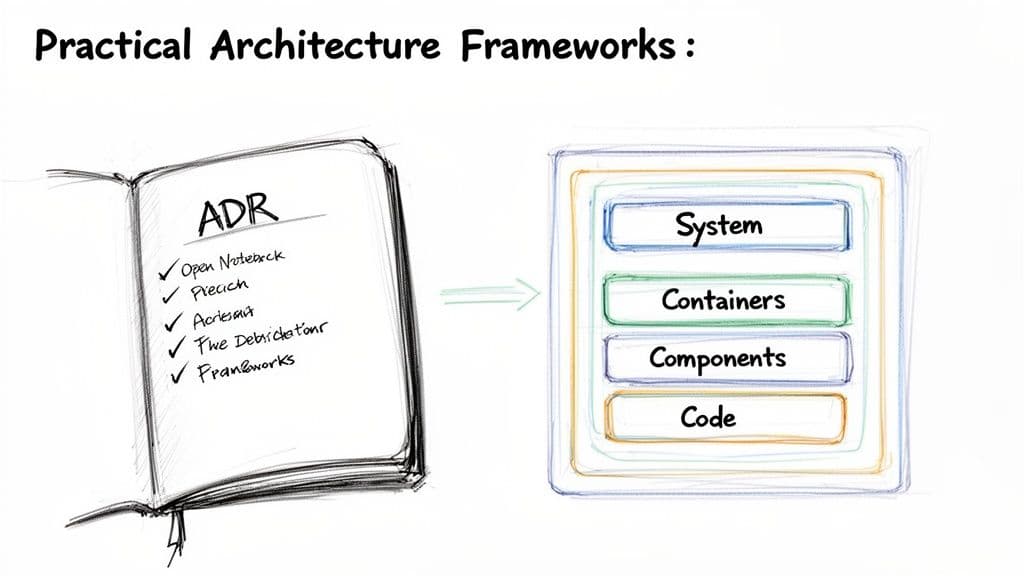
Great architecture comes from deliberate choices. Practical frameworks give teams the balance of autonomy and alignment they need to scale without chaos.
Capture the why with Architecture Decision Records
An Architecture Decision Record (ADR) is a short memo that documents an important architectural choice and its context. A good ADR answers:
- What’s the decision?
- What’s the context?
- What alternatives were considered?
- What are the consequences?
Store ADRs as Markdown files in your repository to preserve institutional knowledge and prevent repeated debates6.
Visualize your system with the C4 model
The C4 Model helps you describe your architecture at four levels: Context, Containers, Components, and Code. This layered approach creates maps useful for technical and non-technical stakeholders and prevents unwieldy single-diagram approaches5.
With C4 diagrams and ADRs, your team moves faster and with confidence. You’re building a resilient, understandable architecture that’s ready for what comes next.
How to spot and measure hidden architectural debt
Architectural debt is structural decay that makes new features more expensive and riskier. It shows up as persistent friction that drains engineering velocity.
Common symptoms of architectural decay
- Persistent bugs concentrated in specific modules.
- Painfully slow feature delivery and cross-team coordination.
- High developer turnover or burnout.
- Long onboarding time for new engineers.
If these sound familiar, your architecture likely needs attention.
From gut feeling to hard data
Translate symptoms into metrics stakeholders care about:
- Cyclomatic complexity: high values signal hard-to-test, error-prone code.
- Code churn: frequent changes in core files indicate instability or poor separation of concerns.
- Module coupling: tight coupling increases maintenance effort.
These metrics tie architecture to business KPIs such as time-to-market and developer productivity. Legacy monoliths have been shown to slow feature delivery substantially, which has meaningful economic impact1. The enterprise architecture market is large and growing, making modernization a strategic imperative for many organizations2. Security and bug rates in popular stacks can vary significantly, particularly in fast-moving JavaScript ecosystems, and that affects maintenance costs and delivery speed3.
Creating a strategic refactoring and migration roadmap
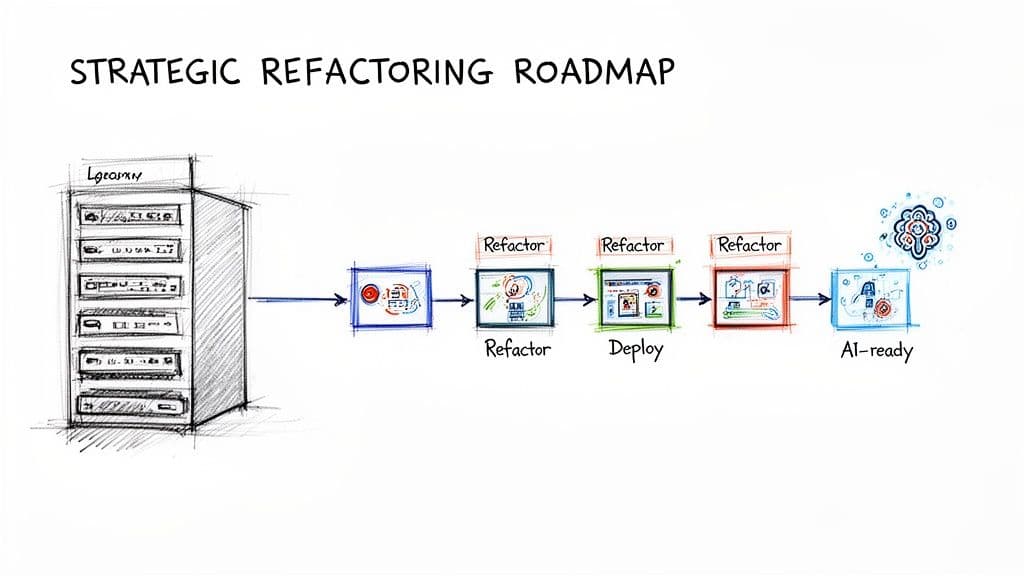
Spotting debt is one thing; fixing it without derailing the roadmap is another. A good refactoring plan is incremental, delivers value at each stage, and keeps stakeholders aligned.
Avoid the big-bang rewrite
A full rewrite is risky. A safer approach is incremental refactoring, such as the Strangler Fig Pattern, where you build new components around the legacy system and cut over traffic gradually4.
How to prioritize refactoring efforts
Prioritize work where high business impact meets high developer friction. Ask:
- Which modules are bug factories?
- Where is development grinding to a halt?
- What keeps you up at night: security, test gaps, legacy dependencies?
Fixing high-impact hotspots builds credibility and momentum for further architectural work.
Building an AI-ready architecture
Refactoring should aim to make the codebase AI-ready. Clean, modular, and well-documented code lets AI assistants deliver real value:
- Clear boundaries: Well-defined interfaces help AI understand scope.
- Consistent patterns: Predictability improves AI suggestions.
- Good documentation: Docstrings and comments explain the “why.”
Preparing your codebase for AI tools turns them into force multipliers for your team.
From theory to action
A Clean Code Audit is a practical first step. It gives a data-driven view of your codebase and a prioritized roadmap for improvements. From there, incremental actions such as targeted codebase cleanups and AI-ready refactors deliver measurable improvements without stopping feature delivery.
Services that help turn strategy into reality include codebase cleanups and AI-ready refactors. These efforts make architecture an engine for sustainable growth rather than a cost center. Learn more at https://cleancodeguy.com/services/codebase-cleanups.
Common questions and concise answers
What’s the best architecture for a new product?
Start with a well-structured monolith. It delivers speed and simplicity. Design modular boundaries inside the monolith so you can evolve to services later when scale demands it.
How do we justify a major refactor to the business?
Translate technical needs into business outcomes. Frame refactors as ROI: reduced bug rates, faster time-to-market, and lower operational costs. Use measurable metrics to make the case.
When should we move to microservices?
Move when the pain of a monolith exceeds the cost of running a distributed system. Signs include frequent team collisions, uneven scaling needs, and parts of the system that require independent deployments.
Quick Q&A: common pain points and practical answers
Q: How do I know if my architecture is the problem or if it’s process issues?
A: Look for symptoms tied to the codebase, such as persistent module-specific bugs, high churn, and long onboarding times. If those correlate with technical metrics like complexity and coupling, architecture is a likely root cause.
Q: Can we refactor while continuing to ship features?
A: Yes. Use incremental approaches like the Strangler Fig Pattern, prioritize high-impact hotspots, and deliver value at every step so product momentum continues.
Q: What low-effort changes give the biggest ROI?
A: Document key decisions with ADRs, adopt consistent linting and patterns, and add targeted tests around the most error-prone modules.
If you’d like services such as Codebase Cleanups or AI-Ready Refactors, see our offerings at https://cleancodeguy.com and the Codebase Cleanups page at https://cleancodeguy.com/services/codebase-cleanups.
1.
CompTIA, Cyberstates: The U.S. Tech Industry and Workforce, 2023. https://www.cyberstates.org/
2.
IDC, Enterprise Software Market insights, 2023. https://www.idc.com/
3.
Snyk, State of Developer Security and open-source risk reports. https://snyk.io/
4.
Martin Fowler, “Strangler Fig Application,” MartinFowler.com. https://martinfowler.com/bliki/StranglerFigApplication.html
5.
Simon Brown, C4 Model for visualising software architecture. https://c4model.com/
6.
ADR documentation and templates, adr.github.io. https://adr.github.io/
🙋🏻♂️
ШІ пише код.Ви робите його довговічним.
В епоху прискорення ШІ чистий код — це не просто хороша практика — це різниця між системами, які масштабуються, та кодовими базами, які руйнуються під власною вагою.