Whether you spell it stabilization or stabilisation, the goal is the same: stop flaky systems from slowing your team. This guide gives practical, actionable steps—sprints, CI/CD hardening, feature flags, refactors, and talent strategies—to reduce bugs and ship confidently.
January 31, 2026 (7mo ago) — last updated July 5, 2026 (2mo ago)
Software Stabilization: Fix Flaky Code
Practical stabilization techniques—sprints, CI/CD hardening, feature flags, and refactoring—to reduce flaky code, lower bugs, and ship with confidence.
← Back to blog
Software Stabilization: Fix Flaky Code
Discover stabilization or stabilisation techniques to turn flaky code into reliable features. Practical strategies to reduce bugs and ship confidently.
Introduction
Whether you spell it stabilization (American English) or stabilisation (British/Canadian English), the goal is the same: stop unstable, flaky systems from slowing your team down. This guide explains practical steps — stabilisation sprints, CI/CD hardening, feature flags, targeted refactoring, and talent strategies — that help teams reduce technical debt, ship with confidence, and restore developer velocity.
What Is Software Stabilisation and Why It Matters
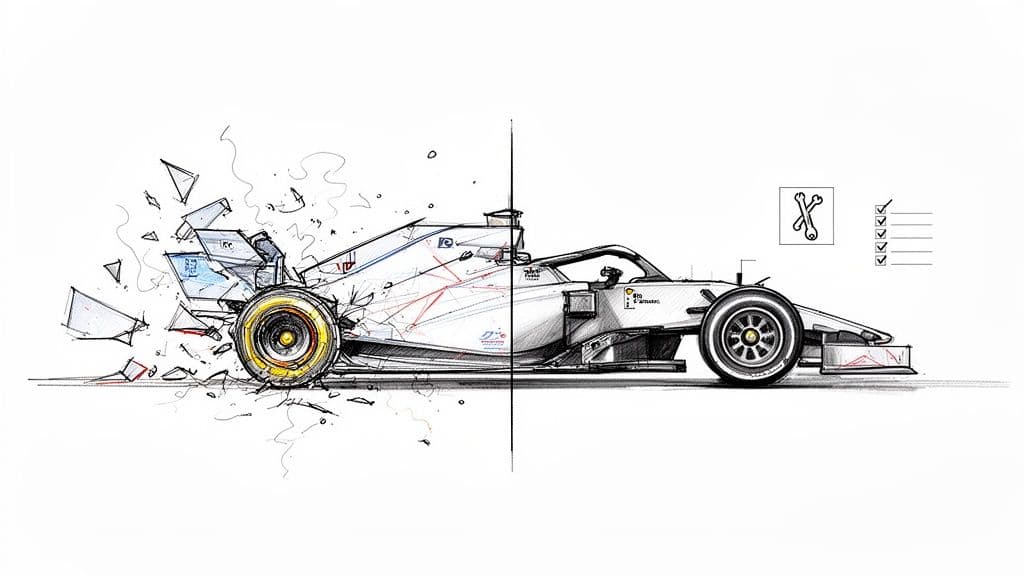
Think of your software as a high-performance race car. Constantly adding features without checking brakes or suspension eventually makes the whole thing dangerously unstable. Software stabilisation is the methodical pit stop where you reinforce the system, find root causes of instability, and address not only bugs but also performance bottlenecks and architectural flaws. The end goal is a product that’s robust and predictable every time.
The True Cost of Instability
An unstable system chips away at customer trust, drains engineering resources, and slows innovation. When developers are constantly firefighting, they can’t build the new features the business needs. A relentless focus on shipping new work without dedicated stabilisation time is a classic sign of accumulating technical debt, and that debt compounds over time1.
This reactive cycle burns out teams and crushes morale. Understanding why stabilisation matters is essential to customer retention: a buggy product is one of the fastest ways to lose users.
Beyond Bug Fixes: A Strategic Investment
Stabilisation is more than a bug hunt. It’s a strategic phase that restores confidence in the codebase for engineers, product managers, and leadership. For engineering leaders, carving out stabilisation time moves teams from reactive firefighting to proactive resilience.
This shift is even more important as teams adopt AI-assisted tools and pair-programming workflows. Those tools are only as effective as the codebase they work with. A clean, stable foundation helps AI deliver reliable suggestions; a messy one lets bad patterns multiply.
Key benefits of a dedicated stabilisation phase:
- Increased predictability: smoother, lower-risk releases.
- Improved developer velocity: fewer workarounds and faster delivery.
- Enhanced user trust: fewer incidents and better reviews.
Prioritising stabilisation is an investment in sustainable growth and long-term product health.
The Common Causes of Software Instability
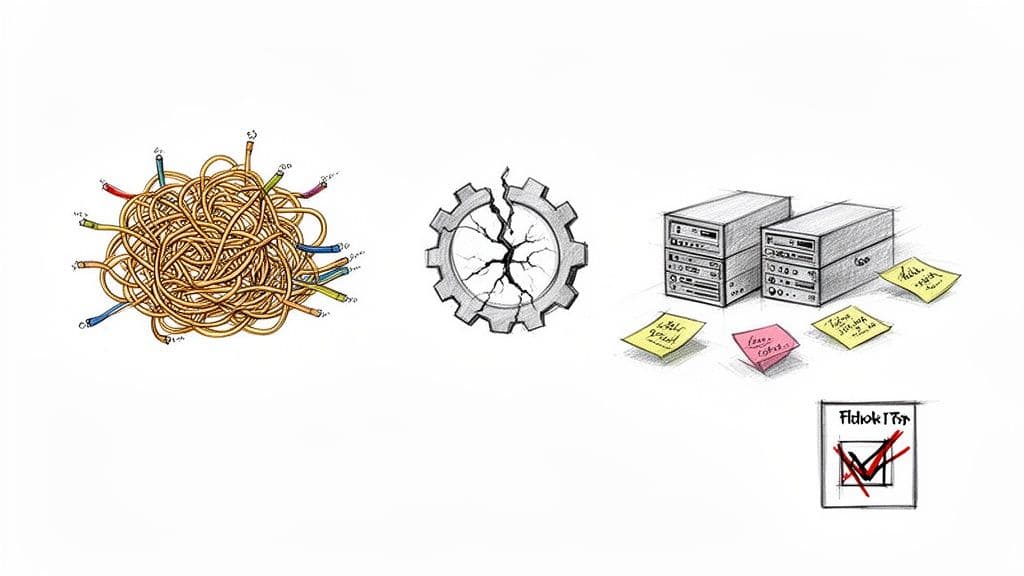
Instability creeps in through small, hurried decisions made under pressure. To fix it, you must first identify the root causes.
The Crushing Weight of Technical Debt
Uncontrolled technical debt is often the prime suspect. Shortcuts taken to meet deadlines — skipping tests, quick hacks, or ignoring architecture — are like taking a high-interest loan on future development. That loan is paid back in bugs, performance issues, and slower delivery. Real stabilisation requires paying down that debt with deliberate refactoring and time-boxed remediation1.
The Illusion of Flaky or Missing Tests
A weak or flaky test suite gives a false sense of security. A green CI checkmark should mean “all clear,” but flaky tests or gaps in coverage let regressions slip into production. The consequences:
- Regression bugs that show up in unexpected places.
- Fear of refactoring because developers can’t trust tests.
- Slow feedback loops that force manual verification.
A solid testing culture is the bedrock of stabilisation.
The Domino Effect of Tightly Coupled Code
Tightly coupled systems make every change risky. A minor fix can cascade into widespread failures, turning simple tasks into high-stakes gambles. Breaking dependencies through refactoring and modular design is essential to reduce brittleness and improve maintainability.
5 Practical Patterns for Achieving Codebase Stabilisation
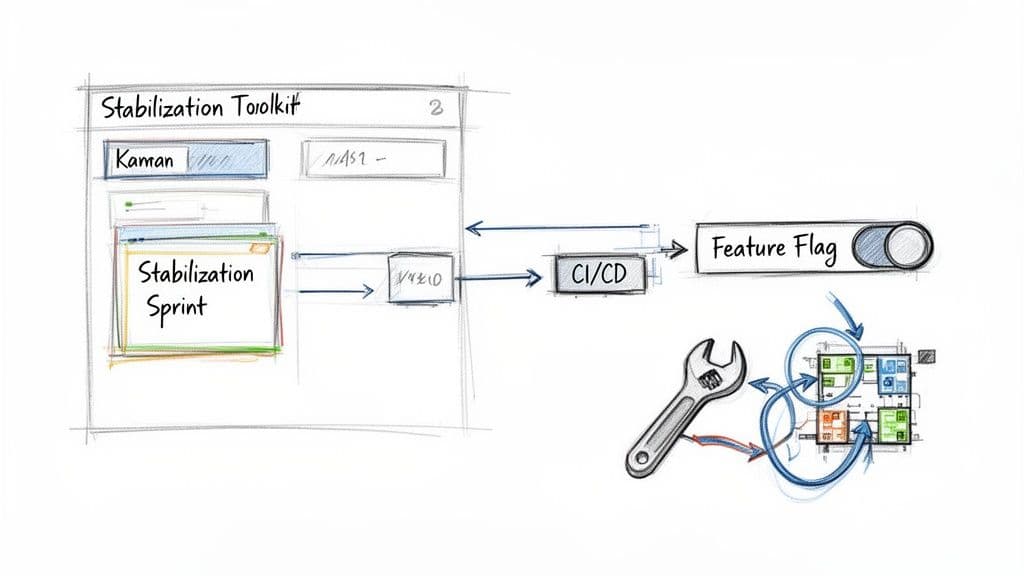
Use a toolkit of proven strategies and apply the right pattern at the right time. These five patterns build resilience into how your team works.
1. Implement Focused Stabilisation Sprints
Run one- or two-week stabilisation sprints where new feature work is paused and the whole team focuses on bugs, performance issues, and targeted refactors. This concentrated time lets teams pay down technical debt and regain control without the pressure to ship new features.
2. Harden Your CI/CD Pipelines
Your pipeline should be an automated quality gate that runs static analysis, security scans, and comprehensive tests on every commit. If tests fail, the deployment stops. Hardening the pipeline reduces risky releases and improves confidence in changes. These gates also make it easier to measure and improve pipeline success rates and catch flaky tests early2. For practical steps, see the CI/CD hardening guide at /guides/ci-cd-hardening.
3. Decouple Deployment from Release with Feature Flags
Feature flags let you deploy incomplete or experimental code hidden from users until it’s ready. They decouple deployment from release, reduce merge conflicts, and let you instantly disable problematic features without emergency rollbacks.
4. Embrace Strategic Refactoring
Refactor with intent. Focus on the parts of the system that cause the most pain — large “god” objects, tightly coupled modules, or components blocking velocity. Targeted refactoring gives the highest return on effort and makes the codebase friendlier to modern tooling. See the refactoring guide at /guides/refactoring.
5. Stabilise Your Talent Pipeline
People are part of the system. Ensure consistent access to reliable engineering talent that values maintainable code. Regional markets are shifting, and some areas are becoming stable hubs for quality development partnerships3. For services, see /services/codebase-cleanups.
Stabilisation Patterns At a Glance
| Pattern | Primary Goal | Best For | Effort Level |
|---|---|---|---|
| Stabilisation Sprints | Pay down technical debt and fix bugs quickly | Teams overwhelmed by instability | Medium to High |
| CI/CD Hardening | Prevent bad code reaching users | Any team adopting automation | Medium |
| Feature Flags | Reduce release risk | Teams releasing frequently | Low to Medium |
| Strategic Refactoring | Improve maintainability | Legacy or complex systems | High |
| Talent Pipeline | Stable access to skilled developers | Growing teams scaling sustainably | Varies |
Combine these patterns to create a layered defence against instability.
How to Measure Your System's Stability
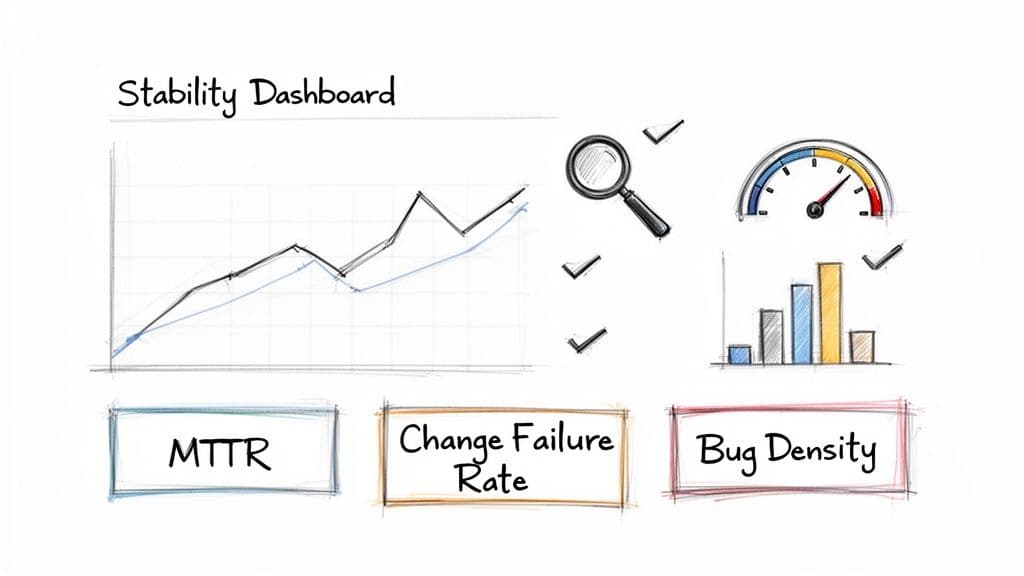
You can’t improve what you don’t measure. Use objective metrics to track progress and guide decisions.
Key Technical Indicators
Start with DORA-style metrics: Mean Time To Recovery (MTTR) and Change Failure Rate (CFR). MTTR measures how quickly you restore service after incidents; CFR shows how often deployments cause failures. These two indicators give a clear view of operational resilience and release quality2.
Leading Indicators of Instability
Leading indicators reveal problems before they become outages. Track bug density and CI/CD pipeline success rate to spot deteriorating code quality or flaky tests early. A rising bug density or falling pipeline success rate signals trouble ahead.
Product-Focused Stability Metrics
Measure stability from the user’s perspective: application crash rate and user-reported issue rate show the real-world impact of technical problems. Use these metrics alongside technical indicators to connect engineering efforts to user experience. Investing in the right tools and processes helps reduce these user-facing issues and supports growth in developing markets4.
A Stabilization Roadmap for Startups and Enterprises
Startups and enterprises need different approaches. The startup path favors lightweight, high-impact practices; the enterprise path emphasizes incremental modernisation.
The Startup Roadmap: Lightweight Practices for Rapid Growth
- Enforce a strict linter configuration to catch issues early.
- Establish a basic CI pipeline that runs linting and unit tests on every commit.
- Prioritise unit tests for critical logic rather than chasing full coverage.
This pragmatic approach prevents technical debt from compounding while keeping momentum.
The Enterprise Roadmap: Incremental Modernisation for Legacy Systems
- Begin with a comprehensive codebase audit to map brittle modules and dependencies.
- Use the Strangler Fig pattern to incrementally replace legacy pieces with modern services.
- Foster a culture of ownership so teams take responsibility for paying down debt in their domains.
Incremental change reduces risk and delivers steady improvements.
Building a Culture of Continuous Stabilisation
Stability is a cultural commitment, not a one-time project. Make stabilisation part of how your team works: include it in roadmaps, measure progress, and reward efforts that reduce risk. Over time, continuous stabilisation becomes part of the team’s DNA and enables long-term velocity.
Common Questions About Software Stabilization
How Long Should a Stabilization Sprint Last?
One to two weeks. Choose two weeks for heavy technical debt and one week for regular hardening between feature cycles.
Can We Ship Features During a Stabilization Phase?
Generally no. The point is to freeze new feature work so the team can focus. Exceptions are rare and must go through strict review, full tests, and ideally a feature flag.
What Is the First Step to Stabilizing a Legacy System?
Start with a thorough codebase audit. It gives you the data to prioritise work and target the areas that will deliver the biggest stability wins.
Is your team tangled in an unstable codebase or trying to build a culture of quality? Clean Code Guy provides Codebase Cleanups, AI-Ready Refactors, and practical workshops to help you ship reliable, maintainable software. Find out how we can help at https://cleancodeguy.com.
Quick Q&A
Q: What should we fix first when stabilising code?
A: Start with a codebase audit to find brittle modules, then focus on tests and CI/CD gates that protect critical paths.
Q: How do feature flags help stability?
A: Feature flags decouple deployment from release, letting you hide unready features and instantly disable anything that causes problems.
Q: How do we measure progress?
A: Track MTTR and Change Failure Rate for operations, and bug density plus CI success rate as early warning signs.
Concise Q&A — Fast Answers
Q: What is stabilization in one sentence?
A: Stabilization is dedicated work to reduce flakiness, pay down technical debt, and make releases predictable.
Q: Which immediate action gives the fastest return?
A: Harden CI/CD gates and fix flaky tests to quickly improve confidence in each deploy.
Q: How do we keep improvements from regressing?
A: Make stabilisation part of the team’s cadence, measure with DORA-style metrics, and require tests and pipeline checks for merges.
1.
https://martinfowler.com/bliki/TechnicalDebt.html — Martin Fowler on technical debt and its long-term costs.
2.
https://dora.dev — DORA metrics and research on deployment frequency, MTTR, and change failure rate.
3.
https://www.statista.com — Market and outsourcing data referenced for regional talent trends and growth projections.
4.
https://www.statista.com/outlook/tmo/software/application-development-software/central-asia?currency=USD — Application development software market projections for Central Asia referenced in the article.
🙋🏻♂️
AI writes code.You make it last.
In the age of AI acceleration, clean code isn’t just good practice — it’s the difference between systems that scale and codebases that collapse under their own weight.