The singleton pattern ensures a class has only one instance and provides a global access point. That convenience can be useful for small utilities, but in modern TypeScript and Node.js applications it often creates hidden coupling, brittle tests, and scaling problems. This article explains what singletons solve, why they’re controversial, and practical, testable alternatives you can adopt today.
January 8, 2026 (8mo ago) — last updated June 20, 2026 (3mo ago)
Singletons in TypeScript: Drawbacks & Alternatives
Why singletons hurt testability and scalability in TypeScript, and how to replace them with dependency injection, ES modules, or factories.
← Back to blog
Singletons in TypeScript: Drawbacks & Alternatives
Summary: Understand why singletons hinder testability and scalability in TypeScript and how to replace them with dependency injection, ES modules, or factories.
Introduction
The singleton pattern ensures a class has only one instance and provides a global access point. That convenience can be useful for small utilities, but in modern TypeScript and Node.js applications it often creates hidden coupling, brittle tests, and scaling problems. This article explains what singletons solve, why they’re controversial, and practical, testable alternatives you can adopt today.
What the singleton pattern actually solves

Imagine an air traffic control tower coordinating dozens of planes. The tower represents a single authority that prevents collisions and confusion. Similarly, a singleton guarantees one shared object for a cross-cutting concern — configuration, logging, or a connection pool — so every part of the app uses the same centralized resource.
The pattern enforces two things:
- Ensure a single instance by hiding the constructor.
- Provide global access through a static accessor such as getInstance().
That combination gives you global convenience, but it also introduces global state with long-term consequences for maintainability and testability1.
Why developers criticize singletons
Singletons often behave like global variables wrapped in a class. That leads to three major problems:
- Hidden dependencies: Code that calls Singleton.getInstance() has an invisible dependency, making components harder to reason about and reuse.
- Poor testability: Shared state persists across tests and makes unit tests flaky and hard to isolate.
- Architectural coupling: Singletons encourage depending on concrete implementations, which works against principles like Single Responsibility and Dependency Inversion.
These critiques are well established in the engineering community and design literature1.
Implementing a singleton in TypeScript (classic)
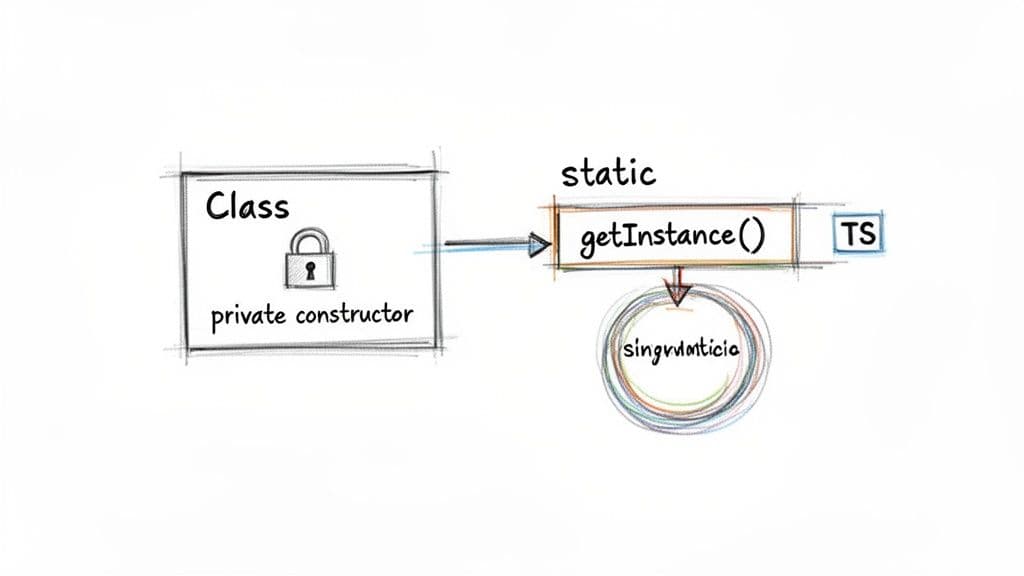
Below is the canonical implementation so you can recognize it in real code.
class SettingsManager {
  private static instance: SettingsManager;

  private constructor() {
    console.log("SettingsManager instance created.");
  }

  public static getInstance(): SettingsManager {
    if (!SettingsManager.instance) {
      SettingsManager.instance = new SettingsManager();
    }
    return SettingsManager.instance;
  }

  public getSetting(key: string): string {
    return `Value for ${key}`;
  }
}

const config1 = SettingsManager.getInstance();
const config2 = SettingsManager.getInstance();
console.log(config1 === config2); // true
Thread-safety note
In multi-threaded languages you must guard against race conditions during initialization. Node.js runs on a single-threaded event loop, so JavaScript singletons don’t face the same concurrency risks at creation time, but thread-safety is a concern in other runtimes2.
Why singletons become an anti-pattern
At scale, singletons introduce global state and hidden coupling across codebases. When a class fetches a global instance, that dependency isn’t visible in the constructor or public API. You can’t identify a component’s needs by inspecting its interface, which makes reasoning and refactoring harder.
Testability problems
Because a singleton instance persists, tests that rely on it can leak state between runs. That makes unit tests brittle and non-deterministic. Modern test strategies favor dependency injection so test doubles can be passed in easily, keeping tests isolated and repeatable4.
Violations of SOLID principles
Singletons mix lifecycle management with business logic, violating the Single Responsibility Principle. They also force code to depend on concrete implementations rather than abstractions, working against the Dependency Inversion Principle and making components harder to substitute or mock.
Better alternatives
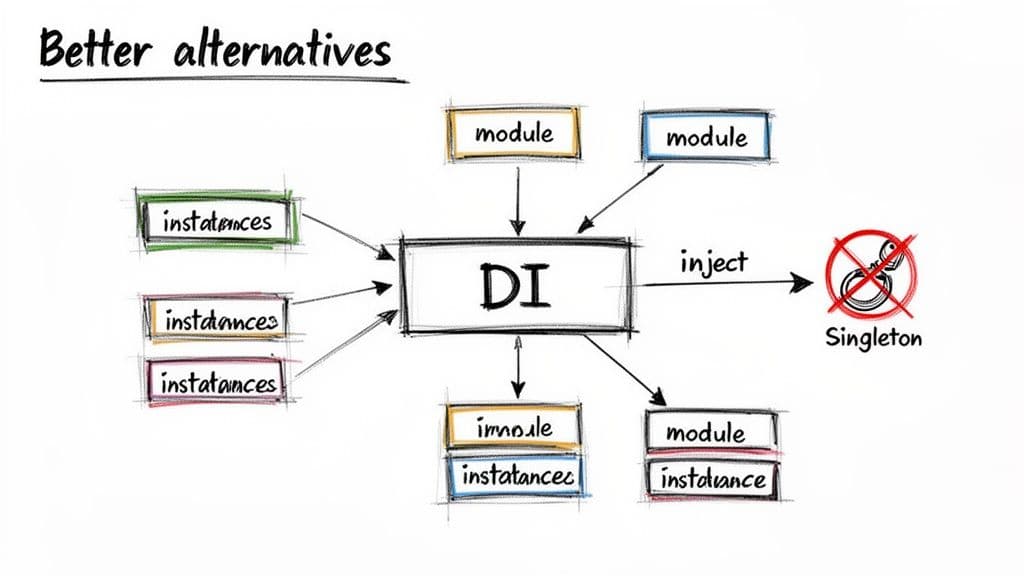
Here are practical, modern alternatives to consider.
Dependency injection (DI)
Instead of a class fetching a global instance, DI supplies dependencies from the outside. Constructor injection is the simplest form: the dependent class declares what it needs, and the composition root wires the concrete instances together. This makes dependencies explicit and easy to mock for tests4.
Refactor the earlier example into a plain, instantiable class:
export class SettingsManager {
  constructor() {
    console.log("SettingsManager instance created.");
  }

  public getSetting(key: string): string {
    return `Value for ${key}`;
  }
}
A consumer receives it via constructor injection:
import { SettingsManager } from './SettingsManager';

export class UserProfile {
  constructor(private settings: SettingsManager) {}

  public loadProfileTheme(): string {
    const theme = this.settings.getSetting('theme');
    return `Theme set to: ${theme}`;
  }
}
Use a DI container like InversifyJS or a framework such as NestJS to manage composition, or wire instances manually at the app entry point. For internal guidance, see /guides/dependency-injection5.
ES modules
Node and modern bundlers evaluate modules once and cache the result. Exporting an instantiated object from a module gives you a lightweight shared instance without singleton boilerplate. This is often suitable for simple shared state or utilities3. See /docs/es-modules for examples.
Factory pattern
If creation logic is complex or you need multiple configured instances, a factory centralizes creation without enforcing a single global instance. Factories give you control over lifecycles while keeping responsibilities separate.
Quick comparison
| Pattern | Testability | Flexibility | Best for |
|---|---|---|---|
| Dependency Injection | Excellent | High | Large apps that need loose coupling and testability |
| ES Modules | Good | Medium | Simple shared state in JS/TS apps |
| Factory Pattern | Good | Medium | Complex creation logic or multiple configuration variants |
Refactoring roadmap: replacing singletons safely
Refactoring singletons in a legacy codebase should be incremental and well tested.
- Identify every call to getInstance() and map the dependencies.
- Convert the singleton class to a normal class by making the constructor public while keeping the static accessor temporarily.
- Introduce an injection strategy at the composition root and start creating the dependency there.
- Replace consumers one by one to accept the dependency via constructor injection, running tests after each change.
- When no callers remain, remove the static accessor and instance.
This gradual, test-driven approach minimizes risk and keeps the application stable during migration. Teams that invest in testability and modular architecture tend to deliver changes more reliably and recover faster in production6.
Singletons in distributed systems: a warning
The idea of a single instance breaks down in distributed systems. Each process will create its own singleton, which defeats the pattern. Attempts to enforce a global, cross-process singleton introduce bottlenecks and single points of failure and are an anti-pattern in distributed architectures7.
If you need coordination across services, prefer distributed coordination primitives such as databases, message queues, or consensus services rather than forcing a single-instance model across processes.
FAQs — Quick answers
When is a singleton acceptable?
A singleton can be acceptable for a truly stateless wrapper around a single physical device, but most use cases such as loggers or config are better served with DI or module exports1.
Doesn’t a singleton just replace globals cleanly?
It may seem that way, but it still creates global state and hidden dependencies. The wrapper doesn’t solve the core problems of coupling and testability1.
How do I start migrating a singleton in a large codebase?
Map all usages, make the constructor public, introduce a top-level composition root, and incrementally replace callers to receive dependencies via constructors. Keep the static API until every caller is migrated, then remove it.
Concise Q&A (common user queries)
Q: How does a singleton hurt unit testing?
A: The same instance is shared across tests, so one test can alter global state and cause other tests to fail unpredictably. DI lets you pass fresh test doubles into each test, keeping them isolated.
Q: What’s the simplest alternative for small TypeScript projects?
A: Use ES module exports for shared utilities or a single instance. It’s simple, requires no extra framework, and avoids explicit global accessor patterns3.
Q: What should I use when building scalable microservices?
A: Avoid distributed singletons. Prefer stateless services, message-driven coordination, or purpose-built distributed systems to coordinate state across services7.
At Clean Code Guy, we help teams replace fragile legacy patterns with maintainable architecture. If your codebase is tangled in globals and singletons, a careful refactor can restore testability and developer confidence.
1.
Martin Fowler, “Singleton,” Martin Fowler’s Bliki, https://martinfowler.com/bliki/Singleton.html
2.
Node.js Documentation, “The Node.js Event Loop,” https://nodejs.org/en/docs/guides/event-loop-timers-and-nexttick/
3.
Node.js Documentation, “Modules: Loading from Cache,” https://nodejs.org/api/modules.html#modules_caching
4.
“Dependency injection,” Wikipedia, https://en.wikipedia.org/wiki/Dependency_injection
5.
InversifyJS, Documentation, https://inversify.io/ and NestJS, Documentation, https://docs.nestjs.com/
6.
Nicole Forsgren, Jez Humble, and Gene Kim, “State of DevOps Report 2019,” Accelerate / DORA, https://services.google.com/fh/files/misc/state-of-devops-2019.pdf
7.
The Twelve-Factor App, “Twelve-Factor App methodology,” https://12factor.net/
🙋🏻♂️
AI writes code.You make it last.
In the age of AI acceleration, clean code isn’t just good practice — it’s the difference between systems that scale and codebases that collapse under their own weight.