Discover essential Pragmatic Programmers books that improve code quality, reduce technical debt, and prepare teams for AI-assisted development. Learn which titles to read by role and how to put ideas into practice.
January 14, 2026 (8mo ago) — last updated June 13, 2026 (3mo ago)
Pragmatic Programmers Books: Essential Reads
Top Pragmatic Programmers books that improve code quality, reduce technical debt, and prepare teams for AI-assisted development.
← Back to blog
Pragmatic Programmers Books: Essential Reads
Discover the essential Pragmatic Programmers books that transform code quality and help teams build clean, scalable, AI-ready software.
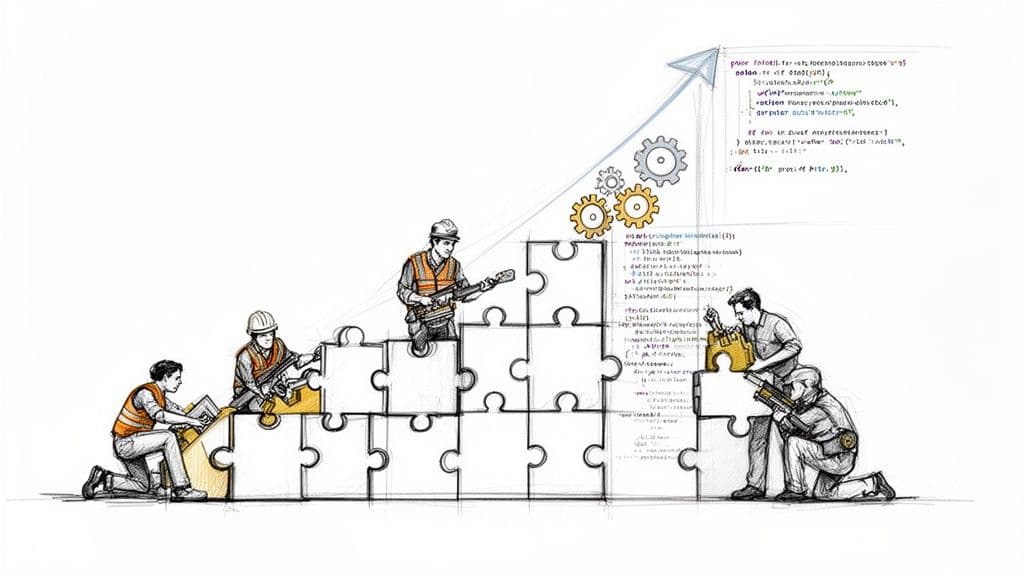
Is your team drowning in technical debt? Does code quality feel inconsistent, and is shipping new features always a struggle? The best Pragmatic Programmers books go beyond coding tips; they teach a philosophy of software craftsmanship that lasts. Titles like the original The Pragmatic Programmer are more than reference material, they’re practical guides for building adaptable, maintainable systems.
Why pragmatic principles are your team’s best investment
It’s tempting to chase the newest framework or tool, but many teams run into the same problems: brittle code, blown deadlines, and low morale. Pragmatic programming gives a mindset and practical habits that help teams avoid those traps.
Pragmatic programming isn’t about rigid rules or a single language. It’s about continuous learning, pragmatic decisions, and designing systems that are easy to change tomorrow. These principles address the pain points that slow teams and kill momentum.
Adopting pragmatic practices lays a strong foundation for scalable applications, whether your stack uses TypeScript, React, or Next.js.
Building a culture of ownership and adaptability
A pragmatic approach encourages developers to own their work, from a single function to system architecture. Thinking beyond the immediate task reduces future rework and improves long-term quality.
Benefits include:
- Improved code quality: Developers who see themselves as craftspeople naturally write cleaner, more thoughtful code.
- Increased adaptability: Principles like loose coupling and orthogonality make systems easier to evolve.
- Faster onboarding: Consistent, well-crafted code reduces ramp-up time for new hires.
This mindset is the foundation of high-performing engineering teams and shows up in well-architected applications like lifepurposeapp.com.
The battle against technical debt
Technical debt starts small—shortcuts and skipped refactors—but compounds quickly and drags down productivity. Treating your codebase as a valuable asset that needs regular care is a core pragmatic tenet1.
The pragmatic toolkit offers practical techniques to fight decay. For example, the “Broken Windows” idea urges teams to fix small problems immediately to prevent larger quality issues later2.
Future-proofing with AI-ready code
AI pair-programmers like GitHub Copilot and Cursor can boost developer productivity, but their value depends on the quality of the code they work with. Clean, well-documented, and logically structured code makes AI suggestions more accurate and refactors safer3.
A codebase that follows pragmatic principles acts as a better prompt for AI tools—clear context yields better, safer output.
Your foundation: The Pragmatic Programmer, 20th Anniversary Edition
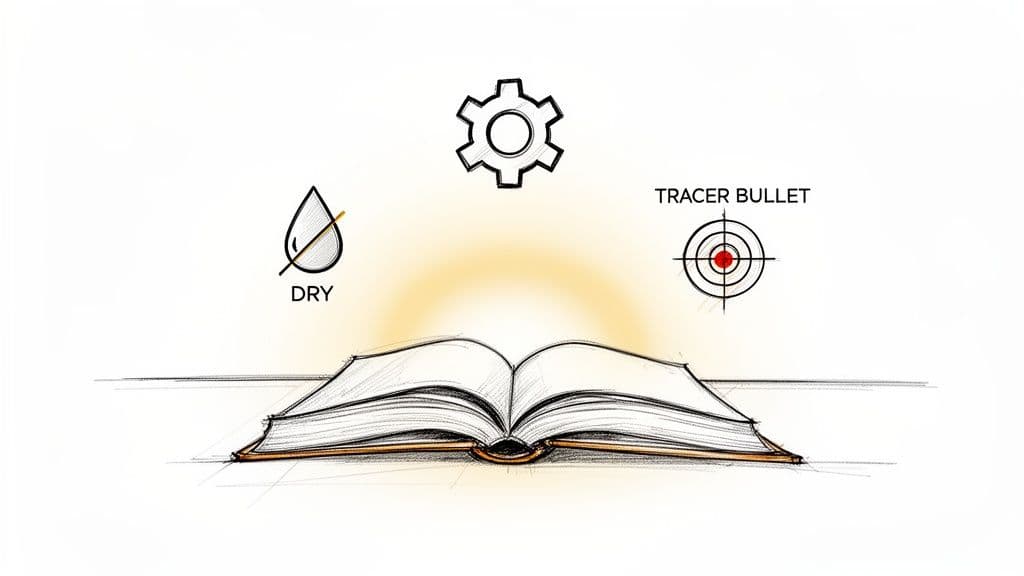
If you could pick one book to shape your team’s engineering culture, this is it. The Pragmatic Programmer: Your Journey to Mastery teaches practical, language-agnostic habits that change how developers approach problems.
What makes it powerful are the direct, actionable tips—everyday habits that lead to measurable improvements in maintainability and developer effectiveness. For teams serious about improvement, this book is the logical starting place.
Core principles for daily practice
High-impact ideas you can adopt immediately:
- Don’t Repeat Yourself (DRY): Ensure each piece of knowledge has a single, authoritative source.
- Orthogonality: Design decoupled components so changes are localized and low-risk.
- Radical automation: Automate builds, tests, and repetitive tasks to free cognitive bandwidth for hard problems.
Adopting these principles is a direct investment in your team’s long-term velocity and stability.
Fixing problems before they grow
The “Broken Windows” principle encourages fixing small issues as you see them, preventing a culture of neglect that leads to larger, riskier rewrites2.
Another pragmatic technique is “tracer bullets”: build a tiny, end-to-end slice of functionality early to validate architecture before committing heavy effort.
Who benefits most and why
- Junior engineers: Gain a foundational mindset and better habits from day one.
- Mid-level developers: Level up from writing code to designing maintainable systems.
- Senior developers and architects: Get a shared language for mentoring and justifying architecture.
Adopting these lessons improves maintainability and morale; developers who are proud of their work are more engaged and productive.
Building your pragmatic reading path by role
Handing everyone the same book rarely solves targeted problems. A role-based reading path matches learning to real challenges.
Tech lead and architect path
Focus on system design, team dynamics, and risk management.
- Core: Pragmatic Thinking and Learning: Refactor Your Wetware — teaches how to learn and think more effectively.
- Next: Release It! Design and Deploy Production-Ready Software — practical guidance for production stability and managing operational risk.
Junior and mid-level developer path
Aim to move from writing code that works to engineering solutions that are clean and maintainable.
- Start: The Pragmatic Programmer, 20th Anniversary Edition.
- Deepen: pragmatic unit testing resources, like language-specific testing guides, to learn reliable, readable tests6. See testing resources at /blog/testing for language-specific recommendations.
- Expand: read other clean-code classics to round out design and testing skills.
Front-end developer path
Modern front-end work demands scalable UI architecture and performance awareness.
- Core: books on modern CSS and component design, including utility-first approaches like Tailwind, help keep styles maintainable.
- Next: explore WebAssembly and Rust for high-performance front-end work where appropriate.
Recommended Pragmatic Books by Developer Role
| Developer Role | Core Book Recommendation | Why It’s Essential | Next Step |
|---|---|---|---|
| Junior/Mid-Level Developer | The Pragmatic Programmer | Installs the foundational mindset of a professional craftsperson. | Unit testing resources |
| Tech Lead / Architect | Pragmatic Thinking and Learning | Teaches how to think, learn, and solve complex problems. | Release It! |
| Front-End Developer | Modern CSS and component design books | Provides maintainable styling and UI architecture. | WebAssembly / Rust resources |
| Engineering Manager | Release It! | Practical insights into stability and production risk. | Pragmatic Thinking and Learning |
These paths are starting points; the key is matching reading to current role challenges.
How pragmatic principles make your code AI-ready
AI pair-programmers have changed how we write code, but their usefulness depends on predictable code and clear contracts. Clean code is the best prompt for AI tools: a clear codebase yields higher-quality AI suggestions and safer refactors3.
Design by Contract: a blueprint for AI
Design by Contract—defining precise input, output, and side-effect expectations for components—creates predictable systems that AI tools can reason about confidently5.
When an AI can trust a function’s contract, automated refactors become far less risky, turning high-effort tasks into safe, assisted work.
The AI-ready refactor in action
Compare two teams adding a feature: Team A works in a tangled, inconsistent codebase; Team B follows pragmatic principles and has clear, modular code. AI assistants help Team B far more effectively, producing suggestions that integrate cleanly and speed delivery.
Investing in pragmatic practices is therefore an investment in your team’s ability to leverage next-generation development tools effectively. Research shows engineering practices correlate with delivery performance and reliability4.
Turning theory into team practice
Reading is useful, but embedding ideas into daily work is where the payoff happens. Use books as launchpads for workshops, book clubs, and hands-on exercises that make concepts stick. Host a short workshop and link it to a dedicated team page like /resources/workshops to track outcomes.
From individual reading to team workshops
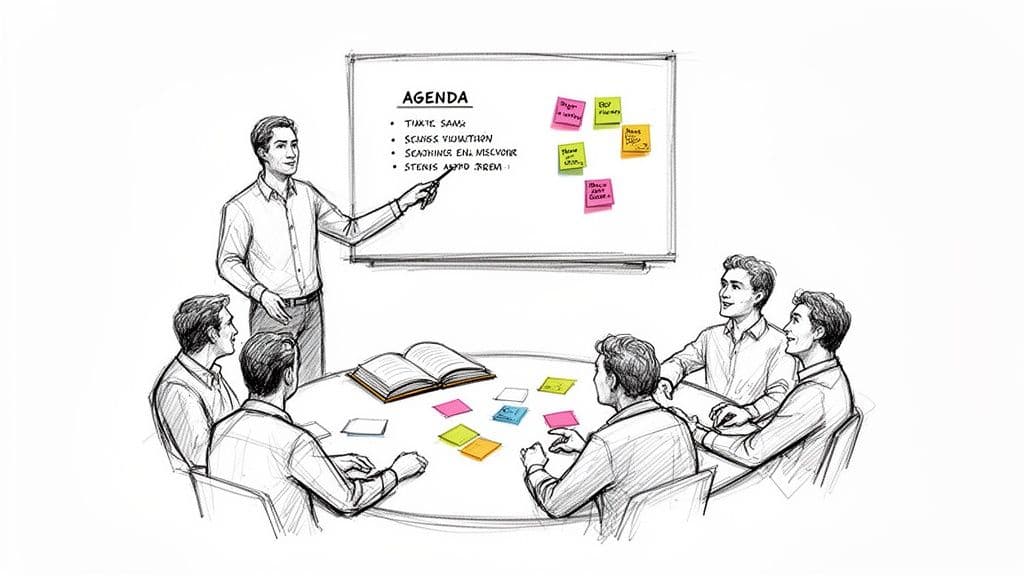
Workshops turn passive reading into active learning. Dedicate short sessions to a single high-impact chapter, connect ideas to current problems, and create clear action items to ensure follow-through.
Sample workshop agenda: the DRY principle (60 minutes)
- Concept review (10 mins): Refresh what DRY really means, a single source of truth for knowledge and intent.
- Codebase exploration (20 mins): Find DRY violations—duplicated business logic, hard-coded values, or repeated docs.
- Refactoring brainstorm (20 mins): Sketch solutions—shared helpers, configuration services, or libraries.
- Action items (10 mins): Create a ticket, assign an owner, and set a deadline.
This format builds a habit of continuous improvement and turns book ideas into team norms.
The enduring legacy of The Pragmatic Bookshelf
The Pragmatic Bookshelf has published many titles that help developers treat coding as a craft. Their focus on practical, DRM-free learning resources helped build a community of professionals committed to continuous improvement.
The catalogue reads like a library of classics, and each title contributes to the skills teams need to build professional, robust systems.
Frequently asked questions
Which Pragmatic Programmers book should I read first?
Start with The Pragmatic Programmer: Your Journey to Mastery, 20th Anniversary Edition. It builds a mindset you’ll use across every other technical book and project.
Are these books still relevant for modern web development?
Yes. Tools change, but principles like loose coupling, orthogonality, and automation stay relevant and help teams avoid technical debt.
How do I convince my manager to invest in these resources?
Frame the investment in business terms: fewer bugs, faster development, and quicker onboarding. These outcomes translate to measurable ROI and reduced operational risk. See related guidance at /blog/engineering-culture.
Quick Q&A: Common team questions
Q: How do these books reduce technical debt?
A: They teach habits—DRY, refactoring, automation—that stop shortcuts from compounding into large problems. Apply one principle in a 60-minute workshop and track the impact.
Q: Will AI make these practices obsolete?
A: No. AI tools amplify the benefits of clean, well-documented code; they’re far less effective in tangled codebases3.
Q: What’s one practical first step for teams?
A: Run a 60-minute workshop on a single principle (DRY, tracer bullets, or radical automation) and create a ticket to apply a concrete fix.
1.
Martin Fowler, “Technical Debt,” https://martinfowler.com/bliki/TechnicalDebt.html.
2.
James Q. Wilson and George L. Kelling, “Broken Windows,” The Atlantic, March 1982, https://www.theatlantic.com/magazine/archive/1982/03/broken-windows/304465/.
3.
GitHub Blog, “Introducing GitHub Copilot,” June 29, 2021, https://github.blog/2021-06-29-introducing-github-copilot-ai-pair-programmer/.
4.
Google Cloud / DORA, “State of DevOps Reports,” for research on how engineering practices correlate with delivery performance, https://cloud.google.com/blog/products/devops-sre/state-of-devops.
5.
Bertrand Meyer, Object-Oriented Software Construction (Prentice Hall), on Design by Contract principles.
6.
Gerard Meszaros, xUnit Test Patterns: Refactoring Test Code, for practical guidance on writing maintainable unit tests.
🙋🏻♂️
AI writes code.You make it last.
In the age of AI acceleration, clean code isn’t just good practice — it’s the difference between systems that scale and codebases that collapse under their own weight.