Kent Beck’s refactoring is the habit of making small, safe structural changes that keep behaviour the same while improving design. When paired with TDD, it reduces bugs, lowers maintenance costs, and speeds feature delivery.
December 28, 2025 (8mo ago) — last updated June 23, 2026 (3mo ago)
Kent Beck Refactoring: Clean Code Techniques
Learn Kent Beck’s refactoring techniques: small, safe code improvements with TDD to reduce technical debt, boost quality, and speed delivery.
← Back to blog
Kent Beck Refactoring: Clean Code Techniques
Explore Kent Beck’s refactoring principles to improve code design, reduce technical debt, and build scalable software with practical examples.
Introduction
Kent Beck’s approach to refactoring treats small, continuous improvements as part of regular work, not a separate cleanup project. By restructuring code without changing behaviour, teams keep systems understandable and easy to change. These habits, rooted in Extreme Programming and Test-Driven Development, lower long-term costs and speed delivery while keeping quality high.1
Kent Beck’s refactoring is a discipline: make tiny, reversible changes, rely on tests, and separate restructuring from feature work. The result is cleaner code, fewer bugs, and faster onboarding.
Kent Beck’s approach to refactoring isn’t about massive, scheduled clean-up projects. Instead, it’s the disciplined, ongoing practice of restructuring code without changing what it actually does. Think of it as a core part of the development rhythm, not a separate task. This philosophy, a cornerstone of Extreme Programming, makes software easier to grasp and far less costly to change down the road.2
Unpacking the philosophy behind Kent Beck refactoring
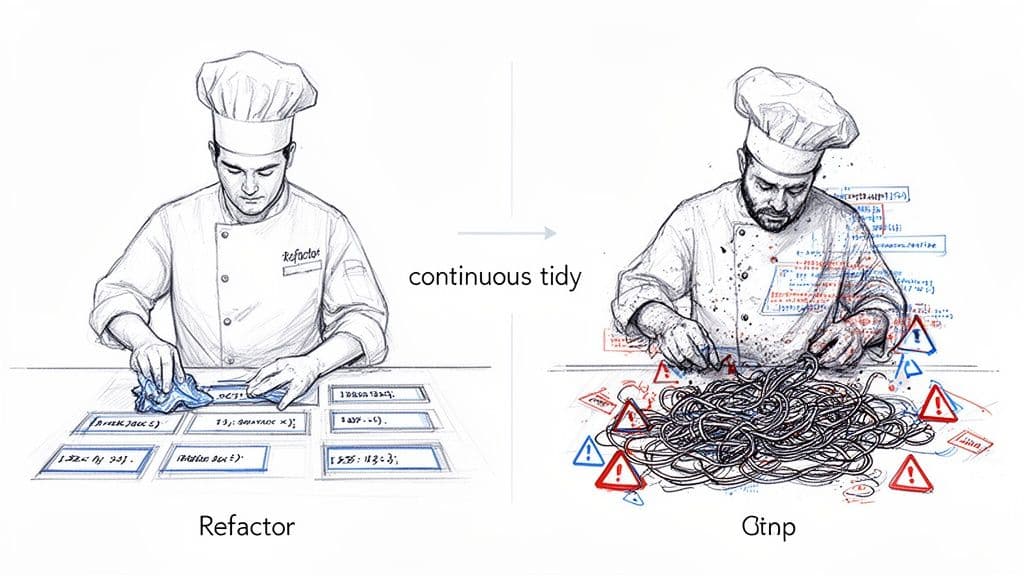
Picture two chefs in a busy kitchen. One cleans their station as they go, keeping everything organized and within reach. The other lets the mess pile up, and eventually, the chaos brings their work to a grinding halt.
Kent Beck’s philosophy is all about being that first chef. Refactoring isn’t a chore you save for later; it’s a constant habit of tidying up your code. Every small improvement—renaming a variable for clarity, splitting a long function into smaller, more focused ones—prevents the codebase from turning into a chaotic mess that slows everyone down. This continuous cleanup is the secret to maintaining momentum.
The core idea: improve code incrementally
At its heart, Kent Beck refactoring is about making a series of small, safe improvements. You aren’t taking on risky, large-scale rewrites. Instead, you’re making tiny structural changes, each one easy to verify so you can confirm it hasn’t broken anything. This incremental process takes the fear out of changing code and builds a culture of shared ownership and quality.
The mantra is simple: leave the code a little better than you found it. This idea fits perfectly with the foundational concepts in our guide on clean code principles, where clarity and simplicity are king.
“For each desired change, make the change easy (warning: this may be hard), then make the easy change.” — Kent Beck
First, refactor the existing code to create the right spot for a new feature. Then add the feature itself. By separating the work of improving structure from adding behaviour, development becomes far more predictable and a lot less stressful. This method has been crucial in building robust systems and inspired many modern workflows and projects.
Core principles of Kent Beck refactoring
| Principle | Core idea | Why it matters |
|---|---|---|
| Small, safe steps | Make tiny, incremental changes that are easy to test and reverse. | Reduces the risk of introducing new bugs and builds confidence in making changes. |
| Refactor before adding | Improve the code’s design first to make adding a new feature simple. | Separates concerns, making development smoother and more predictable. |
| Two hats | Consciously switch between “refactoring” (improving structure) and “adding functionality.” | Prevents doing two complex things at once, which often leads to mistakes. |
| Continuous integration | Refactor constantly as part of the daily development cycle, not a separate phase. | Prevents technical debt from accumulating and keeps the codebase healthy and adaptable. |
These principles create a virtuous cycle where a cleaner codebase makes it easier to add features, and adding features creates opportunities to clean up further.
From niche practice to industry standard
Beck’s ideas on refactoring took shape in the mid-1990s through his work on Extreme Programming and xUnit testing frameworks. His practice of making small, reversible changes quickly caught on across the Bay Area and beyond. The movement gained a major boost when Martin Fowler documented many refactoring patterns, and those patterns later appeared inside modern IDEs and developer workflows.2
Embracing continuous improvement leads to clear benefits: improved readability, fewer bugs, faster feature development, and lower maintenance costs. Industry research links disciplined engineering practices to higher throughput and lower failure rates, making refactoring a measurable driver of performance and quality.1
- Improved code readability and team comprehension.
- Reduced complexity and fewer bugs.
- Faster feature development thanks to predictable, clean structure.
- Lower maintenance costs and quicker onboarding.
Mastering the two hats of development
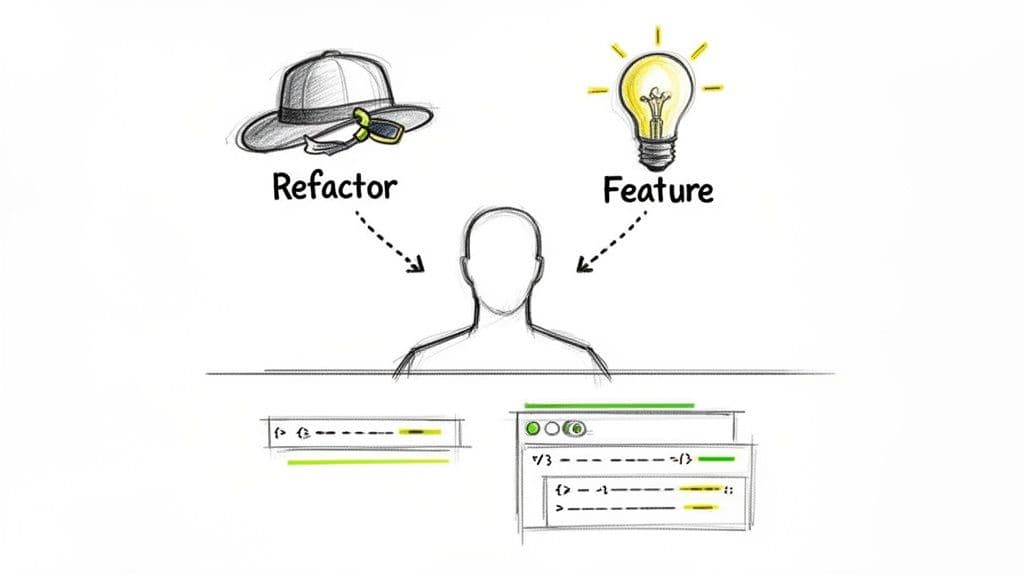
One of the most powerful ideas from Beck’s playbook is the Two Hats metaphor. At any given moment, a developer is doing one of two things—adding a new feature or refactoring existing code. Never both at the same time.
Imagine adding a payment gateway and discovering the checkout code is a mess. If you add new logic while cleaning up, you quickly create a tangled blend of old and new changes. When a bug appears, it’s impossible to know what caused it. That’s a direct path to frustration and missed deadlines.
Now imagine that same task approached with the Two Hats discipline. Before writing feature code, the developer puts on the refactoring hat and only improves structure until tests are green. Then they switch to the feature hat and implement the payment option. The separation of concerns breaks one complex job into two simpler, lower-risk tasks.
Wearing the refactoring hat
When you put on the refactoring hat, your mission is laser-focused: improve design without changing behaviour. You’re a custodian, tidying things up so the next developer can work more effectively.
Key activities include:
- Renaming variables and functions for clarity.
- Extracting complex logic into well-named functions.
- Simplifying conditional logic.
- Removing duplicate code to create a single source of truth.
The golden rule is simple: while refactoring, all your tests must pass. If a test fails, you’ve changed behaviour. You’re no longer just refactoring.3
Donning the feature hat
Once the cleanup is done and tests are green, switch to the feature hat. Your focus shifts: add new value without restructuring. This makes changes more direct and easier to test. The mental context-switch helps teams move faster without piling on technical debt.
How TDD provides a refactoring safety net
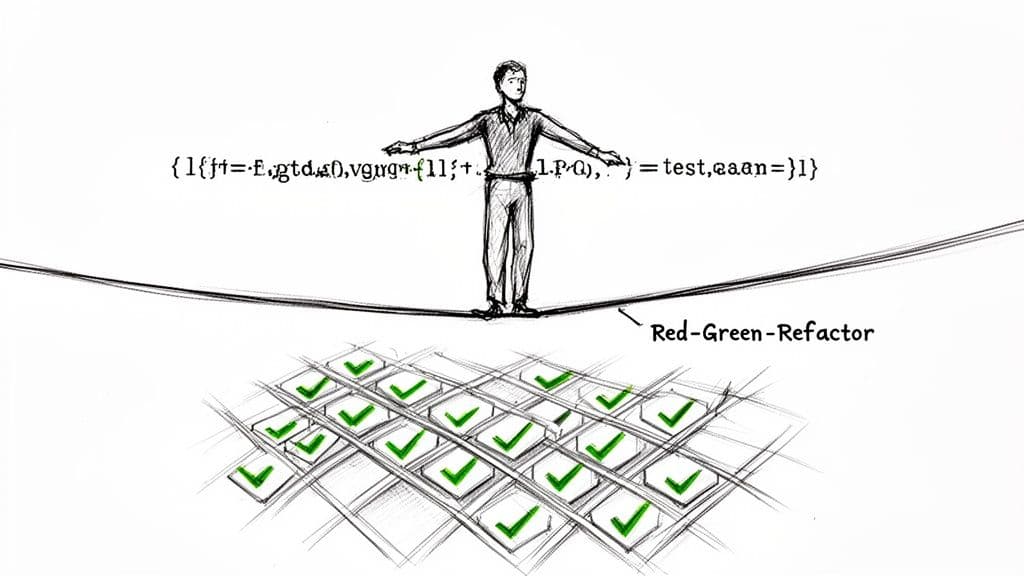
Refactoring without a solid test suite is like walking a tightrope with no net. Test-Driven Development, another practice championed by Kent Beck, is refactoring’s most important partner. The two are woven together, creating a feedback loop that lets developers improve continuously and fearlessly.3
TDD is the safety net. Write a failing test before you touch production code, then make it pass, then refactor. That suite of tests becomes a guardian that watches behaviour while you change structure.
The Red-Green-Refactor cycle in action
The TDD cycle is a simple three-step rhythm that builds refactoring into the process.
- Red — write a small failing test for the desired behaviour.
- Green — write the minimum code to make the test pass.
- Refactor — clean up the code while keeping tests green.
By making refactoring an explicit final step, TDD turns it from a risky chore into a safe, habitual practice.
This combination of TDD and continuous refactoring spread widely through coaching, training, and presentations on modern refactoring techniques.4
Putting refactoring patterns to work in TypeScript and React
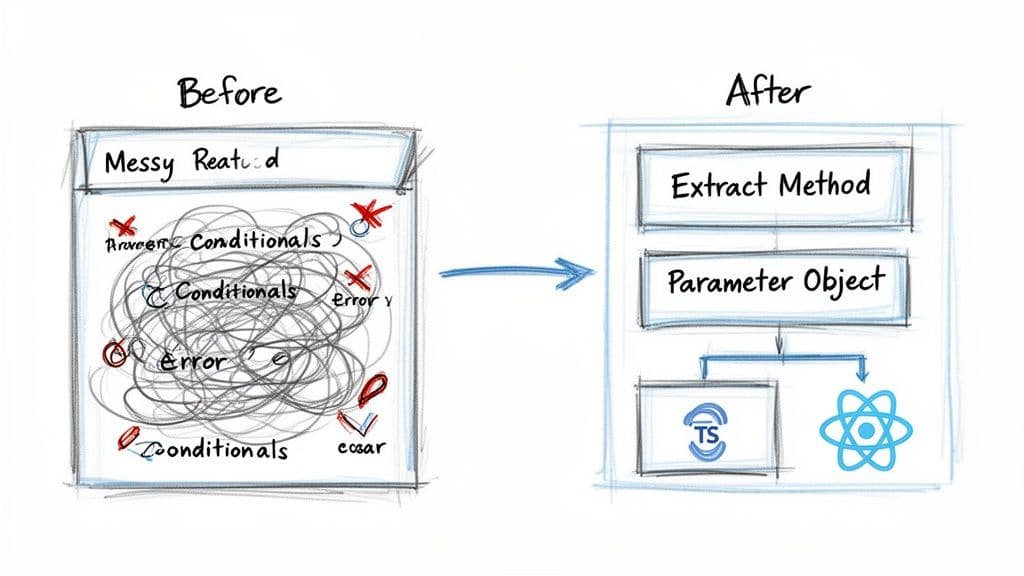
Theory is useful, but the real value comes from applying these ideas in a modern codebase. Below are practical refactorings for TypeScript and React.
Extract method for a cleaner React component
Extract Method moves a messy block of code into its own clearly named function. That makes components simpler and testable.
Before refactoring:
const UserProfile = ({ user }) => {
  // A lot of logic mixed directly into the component
  let planDetails = "No active plan.";
  if (user.subscription.isActive) {
    planDetails = `Current plan: ${user.subscription.planName}. Renews on ${user.subscription.renewalDate}.`;
    if (user.subscription.isTrial) {
      planDetails += ` (Trial period ends ${user.subscription.trialEndDate})`;
    }
  }

  return (
    <div>
      <h1>{user.name}</h1>
      <p>Email: {user.email}</p>
      <p>Subscription: {planDetails}</p>
    </div>
  );
};
After refactoring:
const formatPlanDetails = (subscription) => {
  if (!subscription.isActive) {
    return "No active plan.";
  }

  let details = `Current plan: ${subscription.planName}. Renews on ${subscription.renewalDate}.`;
  if (subscription.isTrial) {
    details += ` (Trial period ends ${subscription.trialEndDate})`;
  }
  return details;
};

const UserProfile = ({ user }) => {
  const planDetails = formatPlanDetails(user.subscription);

  return (
    <div>
      <h1>{user.name}</h1>
      <p>Email: {user.email}</p>
      <p>Subscription: {planDetails}</p>
    </div>
  );
};
Now the component focuses on presentation, while the pure helper function is easy to test and reuse.
Introduce parameter object for clearer function signatures
Functions with long parameter lists are error-prone. Group related parameters into an object to make signatures clear and self-documenting.
Before refactoring:
function createOrder(productId, quantity, customerId, shippingAddress, billingAddress, discountCode) {
  // ...function logic
}

createOrder('prod_123', 2, 'cust_456', '123 Main St', '123 Main St', 'SAVE10');
After refactoring (TypeScript):
interface OrderDetails {
  productId: string;
  quantity: number;
  discountCode?: string;
}

interface CustomerInfo {
  id: string;
  shippingAddress: string;
  billingAddress: string;
}

function createOrder(details: OrderDetails, customer: CustomerInfo) {
  // ...function logic using details.productId and customer.shippingAddress
}

createOrder(
  { productId: 'prod_123', quantity: 2, discountCode: 'SAVE10' },
  { id: 'cust_456', shippingAddress: '123 Main St', billingAddress: '123 Main St' }
);
Bundling parameters into clear objects makes code easier to read and extend.
Replace conditional with polymorphism
Large if/else chains or switch statements are maintenance traps. Let objects handle their own behaviour through polymorphism.
Before refactoring:
function calculateShipping(user, order) {
  switch (user.type) {
    case 'standard':
      return order.weight * 1.5;
    case 'premium':
      return 0;
    case 'business':
      return order.weight * 0.75;
    default:
      return order.weight * 2.0;
  }
}
After refactoring (TypeScript):
interface User {
  calculateShippingCost(order): number;
}

class StandardUser implements User {
  calculateShippingCost(order) {
    return order.weight * 1.5;
  }
}

class PremiumUser implements User {
  calculateShippingCost(order) {
    return 0;
  }
}

class BusinessUser implements User {
  calculateShippingCost(order) {
    return order.weight * 0.75;
  }
}

function calculateShipping(user: User, order) {
  return user.calculateShippingCost(order);
}
Adding a new user type now only requires a new class, keeping the calling code untouched.
The business case for consistent refactoring
Convincing leadership to invest time in refactoring works best when you connect it to outcomes. Small, continuous improvements make the product easier to change, which translates into shipping faster, fewer bugs, and lower costs. Frame refactoring as a way to reduce defect density, speed delivery cycles, and shorten onboarding time. Industry reports find correlations between disciplined engineering practices and improved performance metrics, which helps make the financial case for refactoring investments.1
A culture that embraces refactoring also improves morale and retention. Engineers do their best work when they aren’t constantly fighting a brittle system. That positive cycle—clean code, faster delivery, fewer bugs—becomes a competitive advantage.
Answering common questions about Kent Beck’s refactoring
When is the right time to refactor?
Refactor all the time. Make it part of daily work, not a special event. Consciously put on the refactoring hat:
- During the Refactor step of the TDD cycle.
- Before adding a new feature when the existing code is hard to change.
- When you stall trying to understand a piece of code — rename a variable or extract a function and move on.
Continuous, small refactors prevent the need for disruptive refactoring sprints.
How do I convince management to invest in refactoring?
Speak outcomes. Say, “If we refactor this module, we can cut customer-reported bugs by X% and deliver the next feature Y% faster.” Back claims with data and show how refactoring reduces future cost and risk. Use measurable indicators such as defect rates, lead time, and onboarding time when possible.1
What’s the difference between refactoring and rewriting?
Refactoring changes internal structure without altering behaviour, done in small, tested steps. Rewriting replaces the system entirely, which is risky and often slower than expected. Kent Beck’s approach favors safe, continuous evolution over big-bang rewrites.
Can AI tools help with refactoring?
Yes. AI pair-programming tools can automate mechanical refactors like extracting functions, renaming symbols, or suggesting parameter objects. They speed execution, but strategy and architectural judgment remain human responsibilities.
Three concise Q&A summaries
Q: What is Kent Beck refactoring in one line?
A: A practice of making small, safe structural changes to code continuously, keeping behaviour the same while improving design.
Q: How does TDD connect to refactoring?
A: TDD provides the tests that let you refactor with confidence: write a failing test, make it pass, then refactor while tests guard behaviour.3
Q: What immediate wins should teams expect?
A: Better readability, fewer bugs, faster feature delivery, and shorter onboarding time—outcomes that show up in measurable team performance metrics.1
1.
Nicole Forsgren, Jez Humble, and Gene Kim, State of DevOps Report 2019, https://services.google.com/fh/files/misc/state-of-devops-2019.pdf.
2.
Martin Fowler, Refactoring: Improving the Design of Existing Code, resources and patterns: https://martinfowler.com/books/refactoring.html.
3.
Test-Driven Development and Kent Beck’s work: https://en.wikipedia.org/wiki/Test-driven_development.
4.
Presentations and tutorials on modern refactoring techniques: https://www.infoq.com/presentations/refactoring-cleaning-code/.
🙋🏻♂️
AI writes code.You make it last.
In the age of AI acceleration, clean code isn’t just good practice — it’s the difference between systems that scale and codebases that collapse under their own weight.