Discover how to master the hashmap in Ruby (Hash) for cleaner, faster, and more scalable code. A deep dive into internals, performance, and best practices.
January 30, 2026 (7mo ago)
Mastering Hashmap in Ruby for Clean and Scalable Code
Discover how to master the hashmap in Ruby (Hash) for cleaner, faster, and more scalable code. A deep dive into internals, performance, and best practices.
← Back to blog
If you're familiar with the term hashmap in Ruby, you're really talking about Ruby's built-in Hash class. This powerful key-value store acts like a digital filing cabinet: every piece of data gets a unique label so you can find it again almost instantly.
Why Mastering Ruby's Hash Changes How You Code
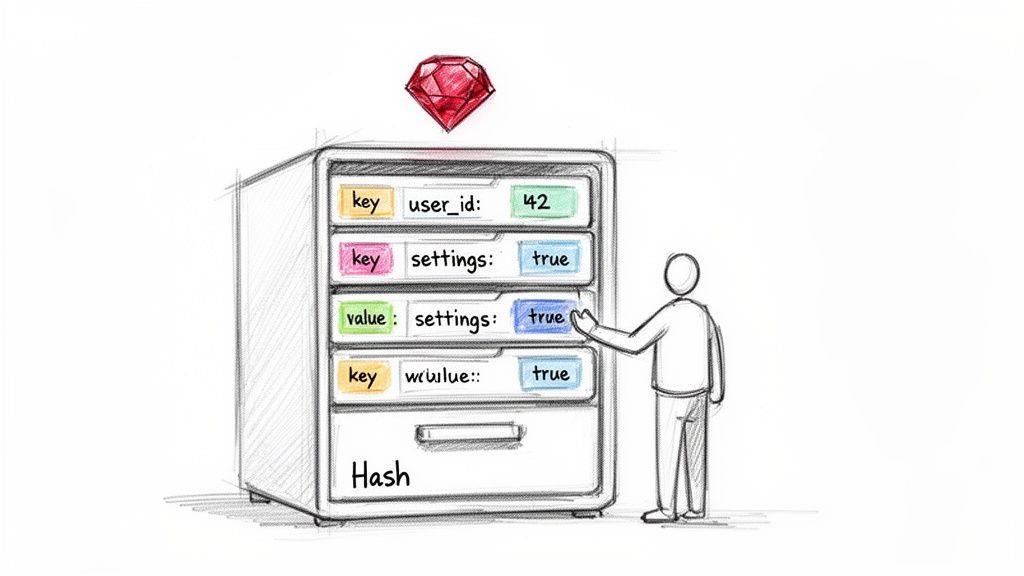
At its heart, a Ruby Hash is a collection of unique keys and their values. Think of it like a dictionary: you look up a word (the key) to find its definition (the value). Hashes are used everywhere—from session data in web apps to configuration—and they shine because of fast, near-constant-time operations for insertions and lookups1.
Getting good with Hashes is more than learning syntax. It means adopting a cleaner, more direct style of coding. Instead of sprawling if/else chains, you can often replace logic with a simple key lookup. That leads to reduced complexity, better readability, and easier maintenance.
This guide walks through how Ruby's Hash works, idiomatic usage and pitfalls, practical recipes, alternatives when a Hash isn't the best fit, and refactoring patterns you can apply today.
How a Ruby Hash Works Under the Hood
A Ruby Hash is an optimized C implementation of a hash table. When you add a key-value pair, Ruby runs the key through a hash function to compute a hash code. That code maps to a bucket index in an internal array, allowing Ruby to jump directly to the right slot instead of scanning items one by one1.
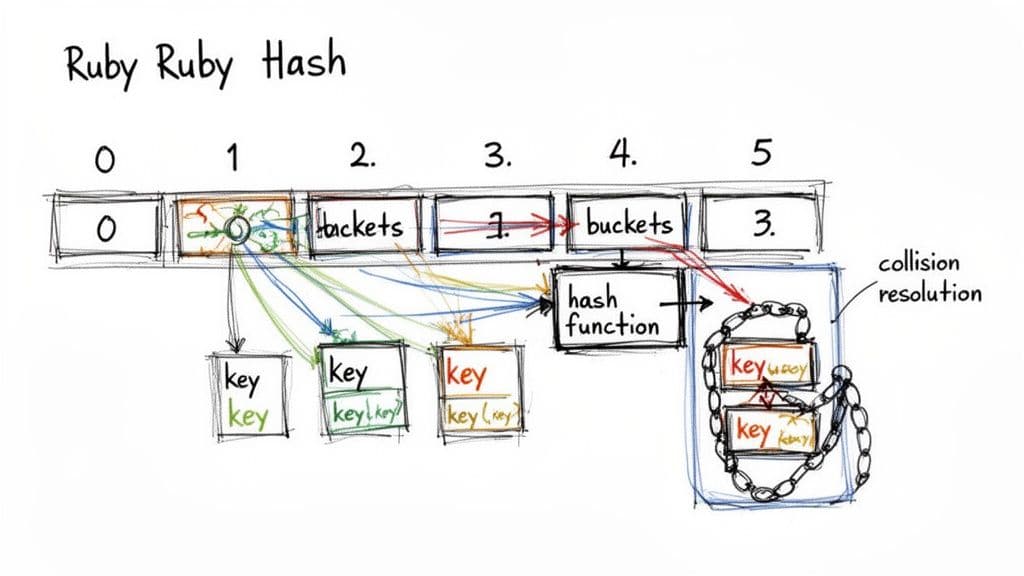
Hash function, buckets, and collisions
The hash function reduces any key to a numeric hash code, which is then converted to a bucket index. Collisions—when two keys map to the same index—are normal. Ruby stores multiple entries per bucket and scans the small list when necessary. Recent Ruby optimizations keep that scan small and fast.
Ruby 2.4 introduced major internal changes that improved hash performance by improving data locality and resizing behavior; those changes delivered substantial speedups across common workloads2.
Idiomatic Hash Usage and Common Pitfalls
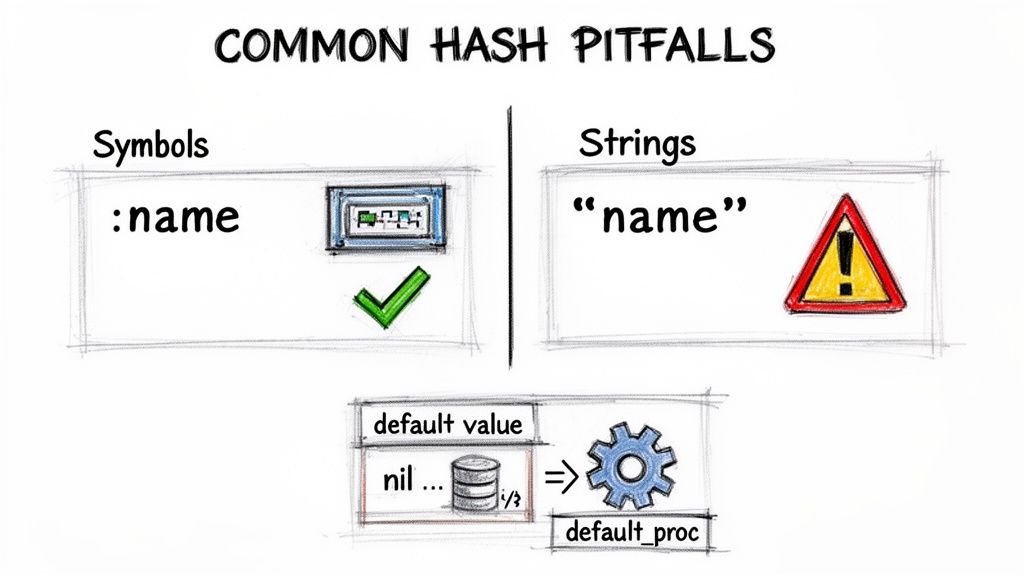
Knowing the theory is useful, but making Hashes sing in production means avoiding subtle bugs and writing predictable code.
Symbol vs String keys
Symbols and Strings may look similar, but they behave differently. A Symbol is immutable and reused across uses, while a String creates a new object each time. Symbols are typically faster and more memory-efficient for keys, because comparisons can be done by object identity rather than character-by-character comparison3.
A common bug is expecting a Symbol key when the data uses String keys (for example, incoming web params). Use consistent conventions—convert incoming keys with symbolize_keys or stringify_keys—to avoid this mismatch.
Default values and default procs
Accessing a non-existent key returns nil, which can cause NoMethodError when you call methods on it. Use a default value to avoid surprises:
# Safe default
fruit_counts = Hash.new(0)
fruit_counts["apple"] = 5
fruit_counts["orange"] # => 0
For more advanced behavior, a default proc lets you compute or initialize values lazily.
Merge vs merge!
merge returns a new Hash and preserves the original. merge! mutates in place. Prefer non-destructive methods when you want to avoid side effects and keep data flow predictable.
Freezing for immutability
For constants and settings that must not change, call .freeze to prevent accidental mutations:
CONFIG = { api_key: "abc-123", timeout: 5000 }.freeze
# CONFIG[:timeout] = 3000 # raises FrozenError
Practical Ruby Hash Cookbook
This section is a recipe collection for common tasks.
Iteration and transformation
Use each to iterate and select, reject, map, and to_h to filter and transform cleanly:
user_permissions = { admin: true, editor: true, viewer: false }
active_roles = user_permissions.select { |role, has_access| has_access }
role_descriptions = user_permissions.map { |role, has_access| [role, "Can perform #{role} actions: #{has_access}"] }.to_h
Safely navigating nested data with dig
dig prevents NoMethodError when traversing nested hashes:
api_response = { user: { profile: { name: "Alice" } } }
email = api_response.dig(:user, :profile, :email) # => nil
name  = api_response.dig(:user, :profile, :name)  # => "Alice"
Cleaning and transforming keys/values
compact, transform_keys, and transform_values make reshaping and sanitizing data concise and readable:
messy_data = { "firstName" => "bob", "lastName" => "smith", "age" => 30 }
clean_data = messy_data
  .transform_keys(&:to_sym)
  .transform_values { |v| v.is_a?(String) ? v.capitalize : v }
# => { firstName: "Bob", lastName: "Smith", age: 30 }
Choosing the Right Tool
A Hash is flexible, but it isn't always the best choice. For fixed schemas use Struct; for dot-notation with unpredictable keys use OpenStruct (but note the performance cost); for uniqueness checks use Set—which is optimized for membership tests and built on Ruby's core structures4.
When you pick the right structure, your code becomes faster, clearer, and easier to maintain.
Quick comparison
| Structure | Best for | Advantage | Consideration |
|---|---|---|---|
| Hash | Dynamic key-value data | Ultimate flexibility | More memory; potential key typos |
| Struct | Small, fixed attribute sets | Memory efficient; method access | Inflexible |
| OpenStruct | Prototyping, unpredictable keys | Dot-notation convenience | Slower; high memory |
| Set | Fast uniqueness checks | O(1) membership tests | No associated values |
Refactoring with Hash Patterns
Use Hashes to replace long if/elsif or case chains by moving data into a lookup table. That separates data from logic and makes adding new cases as easy as adding a key.
ENDPOINTS = {
  development: "http://dev.api.example.com",
  staging: "http://staging.api.example.com",
  production: "https://api.example.com"
}.freeze

def get_api_endpoint(environment)
  ENDPOINTS.fetch(environment, "http://localhost:3000")
end
Options Hashes also simplify method signatures by bundling optional parameters into a single, extensible argument.
Frequently Asked Questions
Is a Ruby Hash the same as a hashmap?
Yes. A hashmap is the generic computer science term; in Ruby the class is called Hash and implements a hash table with the typical time complexity characteristics of the data structure1.
What common mistake should I avoid with Hashes?
The most frequent mistake is mixing Symbol and String keys. Establish and enforce a convention—typically Symbols for internal keys—and normalize external input early.
How does Hash usage affect Rails performance?
Hashes are everywhere in Rails: params, session data, and JSON handling. Inefficient Hash creation and repeated heavy operations can cause memory bloat and slow requests. Profile hotspots and prefer in-place or lazy patterns when appropriate.
Quick Q&A — Common developer questions
Q: How do I avoid nil errors when accessing nested keys?
A: Use dig or provide safe defaults with Hash.new(default) or a default proc.
Q: When should I switch from Hash to Struct or Set?
A: Use Struct when fields are fixed and known; use Set when you only need uniqueness and fast membership checks.
Q: How can I safely merge configurations from multiple sources?
A: Prefer non-destructive merge and freeze the final config. If you need in-place updates, use merge! with caution and document side effects.
At Clean Code Guy, our mission is to help teams turn complicated codebases into assets that are easy to maintain and scale. We dive deep into principles like these to help you ship better software, faster. See how we can help you build a resilient, AI-ready application at cleancodeguy.com.
1.
Wikipedia, "Hash table." https://en.wikipedia.org/wiki/Hash_table
2.
Ruby Issue Tracker, "Hash improvement (power-of-two, data locality)". https://bugs.ruby-lang.org/issues/12142
3.
Ruby Guides, "Symbols in Ruby". https://www.rubyguides.com/2019/03/ruby-symbols/
4.
Ruby Standard Library Documentation, Set. https://ruby-doc.org/stdlib-2.7.0/libdoc/set/rdoc/Set.html
🙋🏻♂️
AI writes code.You make it last.
In the age of AI acceleration, clean code isn’t just good practice — it’s the difference between systems that scale and codebases that collapse under their own weight.