The key difference between functional programming and object-oriented programming is one of focus: are you organizing code around what you do or who does it? This guide compares both paradigms with practical TypeScript and React examples, explains trade-offs for maintainability and concurrency, and provides a pragmatic checklist to help teams decide. FP ideas are increasingly present in mainstream stacks while OOP remains central to many large systems12.
December 2, 2025 (10mo ago) — last updated October 15, 2026 (9d ago)
FP vs OOP: TypeScript and React Comparison
Compare FP and OOP in TypeScript and React with examples, trade-offs for maintainability and concurrency, and a pragmatic decision checklist.
← Back to blog
FP vs OOP: TypeScript and React Comparison
Introduction
The key difference between functional programming and object-oriented programming is one of focus: are you organizing code around what you do or who does it? Functional programming (FP) emphasizes stateless, composable functions and immutable data, while object-oriented programming (OOP) models data and behavior together as interacting objects. This guide compares both paradigms with practical TypeScript and React examples, explains trade-offs for maintainability and concurrency, and provides a pragmatic checklist to help teams decide. FP ideas are increasingly present in mainstream stacks while OOP remains central to many large systems12.
At a glance: FP vs OOP
Choosing between functional and object-oriented styles isn’t only a technical decision — it’s a mindset for structuring software and handling data flow. Below is a concise comparison to set context for examples and trade-offs.
Core philosophical differences
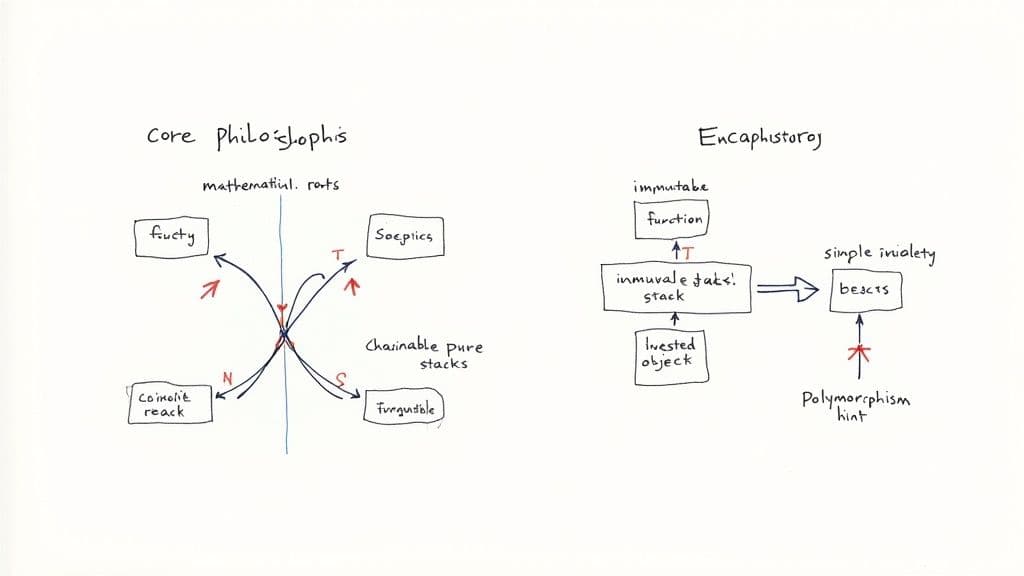
OOP bundles data and behavior into objects. Imagine a User object that holds name and email and exposes methods such as updateEmail() or sendPasswordReset(). Each object manages its own state.
FP separates data and behavior. Data is often immutable, and pure functions take inputs and return outputs with no side effects. That reduces the surface area for bugs caused by shared mutable state.
Many teams combine ideas from both paradigms to get the best of each world.
Quick comparison
| Concept | Functional Programming (FP) | Object-Oriented Programming (OOP) |
|---|---|---|
| Primary unit | Functions | Objects |
| State management | Immutable state | Mutable state |
| Data & operations | Kept separate | Encapsulated together |
| Concurrency | Easier with stateless functions | Requires locks or careful sync |
| Flow control | Function composition and pipelines | Methods and object interactions |
| Key principles | Pure functions, immutability | Encapsulation, inheritance, polymorphism |
Understanding the core philosophies
These paradigms are more than syntax choices; they’re ways of thinking about data, behavior, and system structure. Which one fits your project depends on how you want to manage change and complexity.
The functional programming paradigm
FP traces back to lambda calculus and treats computation as evaluation of mathematical functions. Pure functions always return the same output for the same input and produce no side effects. Immutability prevents in-place changes and encourages returning new values instead.
This predictability makes FP code easier to test and reason about, especially for concurrent systems where shared mutable state is a frequent source of bugs. FP’s one-way data flow tends to produce clear pipelines for transforming data and can simplify parallel processing4.
The object-oriented programming paradigm
OOP models systems as interacting objects that encapsulate both state and behavior. Encapsulation hides internal details, exposing a simpler interface to the rest of the system. Inheritance and polymorphism support code reuse and flexible abstractions.
OOP is well suited for modeling complex domain entities and their interactions. When domain concepts are stable and relationships map naturally to business rules, OOP can produce intuitive, maintainable designs.
Maintainability and scalability: trade-offs
Choosing a paradigm affects long-term maintenance and scalability. Both FP and OOP offer valuable strategies, but they approach complexity differently.
Maintainability: predictability vs encapsulation
FP prioritizes predictability through pure functions and immutability. A pure function that always returns the same result for the same inputs is easy to test and isolate. OOP organizes related data and behavior together, which helps developers reason about the system by examining self-contained components.
The trade-off: FP’s clarity comes from separating data and behavior, while OOP’s clarity comes from grouping them. This affects debugging workflows — FP often narrows bugs to specific functions, while OOP may require tracing interactions among objects.
Scalability: concurrency and parallelism
FP’s stateless approach simplifies concurrency because pure functions don’t mutate shared data, reducing the need for locks. OOP can be made concurrent, but it often requires careful state management and synchronization to avoid race conditions.
FP is gaining traction in domains that need predictable, concurrent behavior, though mainstream adoption remains concentrated in multi-paradigm languages such as TypeScript and Python12.
Real-world examples: TypeScript and React
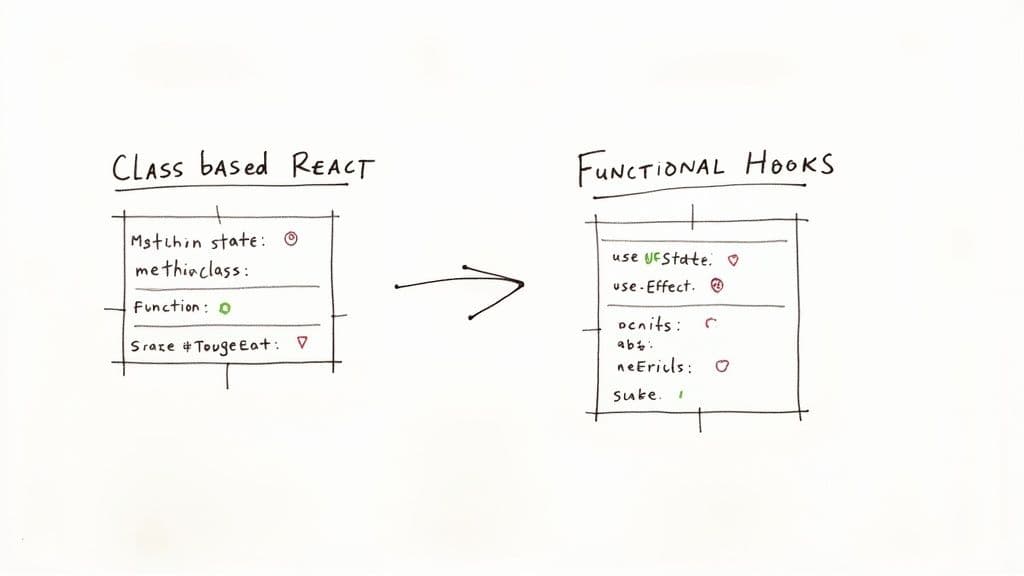
Below we build the same user settings form in two styles: a classic React class component (OOP) and a modern functional component with Hooks (FP-style). This highlights how the architectural choice affects state handling, logic reuse, and structure.
OOP approach: React class component
The class component groups state and methods into a single object, which fits the OOP model of encapsulation.
import React, { Component } from 'react';

interface UserSettings {
  name: string;
  email: string;
}

class UserSettingsForm extends Component<{}, UserSettings> {
  state: UserSettings = {
    name: 'Jane Doe',
    email: 'jane.doe@example.com',
  };

  handleChange = (event: React.ChangeEvent<HTMLInputElement>) => {
    const { name, value } = event.target;
    this.setState({ [name]: value } as Pick<UserSettings, keyof UserSettings>);
  };

  handleSubmit = (event: React.FormEvent) => {
    event.preventDefault();
    console.log('Submitting data:', this.state);
  };

  render() {
    return (
      <form onSubmit={this.handleSubmit}>
        <input name="name" value={this.state.name} onChange={this.handleChange} />
        <input name="email" value={this.state.email} onChange={this.handleChange} />
        <button type="submit">Save Settings</button>
      </form>
    );
  }
}
This pattern keeps related data and behavior together, but larger components can become harder to refactor and reuse without additional patterns like higher-order components.
Functional refactor: hooks and pure helpers
The functional approach separates state and pure functions, making individual pieces easier to test and reuse. React’s Hooks popularized this approach and encouraged splitting logic into reusable hooks and pure helpers3.
import React, { useState } from 'react';

const formatUserDataForApi = (name: string, email: string) => ({
  userName: name,
  userEmail: email,
});

const UserSettingsFormFunctional = () => {
  const [name, setName] = useState('Jane Doe');
  const [email, setEmail] = useState('jane.doe@example.com');

  const handleChange = (event: React.ChangeEvent<HTMLInputElement>) => {
    const { name, value } = event.target;
    if (name === 'name') {
      setName(value);
    } else {
      setEmail(value);
    }
  };

  const handleSubmit = (event: React.FormEvent) => {
    event.preventDefault();
    const payload = formatUserDataForApi(name, email);
    console.log('Submitting data:', payload);
  };

  return (
    <form onSubmit={handleSubmit}>
      <input name="name" value={name} onChange={handleChange} />
      <input name="email" value={email} onChange={handleChange} />
      <button type="submit">Save Settings</button>
    </form>
  );
};
How to choose the right paradigm
The right choice depends on your team, problem domain, and long-term goals. Use these pointers to guide a pragmatic decision.
When to choose OOP
Choose OOP when you’re modeling rich domain entities with persistent state and behaviors, for example:
- Large enterprise systems with many interrelated modules
- Rich, stateful UI components where component-level state maps naturally to objects
- Domains with stable, well-defined entities
When to choose FP
Choose FP when predictability, concurrency, and data transformations are priorities, for example:
- Data processing pipelines and ETL tasks
- Concurrent or parallel systems where state synchronization is costly
- Mathematical or scientific computing where functions map cleanly to algorithms
Practical decision checklist
- What’s the nature of your data: stateful objects or transformable flows?
- How critical is concurrency for performance and correctness?
- What is your team’s expertise and willingness to learn new patterns?
- Can a hybrid approach fit the problem without forcing one paradigm?
Embracing a hybrid approach
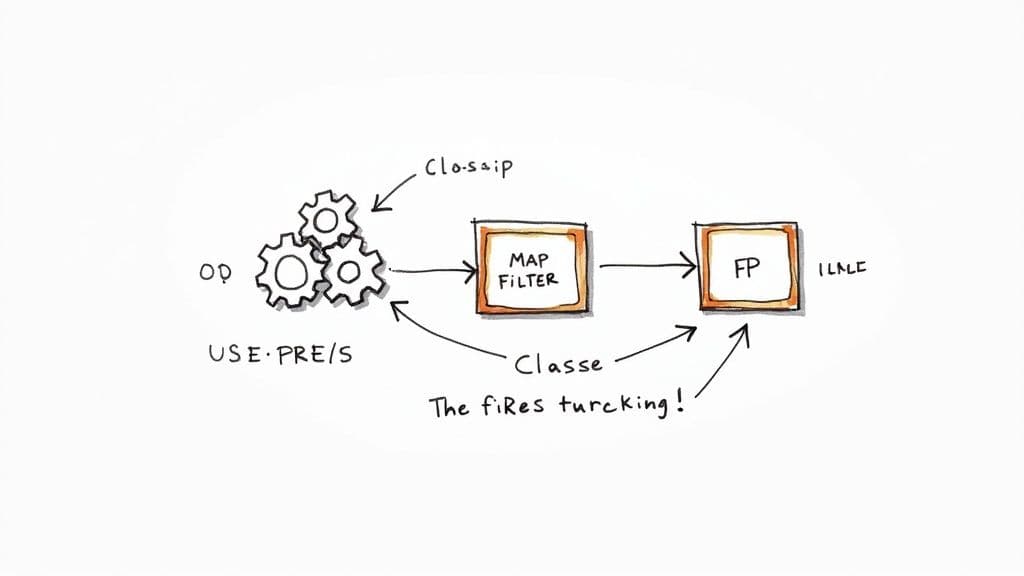
Most successful systems combine both paradigms. Multi-paradigm languages like TypeScript and Python let you use immutable data inside classes, apply map and filter on collections, and isolate pure functions for core business logic.
Combining paradigms in practice
Common hybrid patterns:
- Immutable state inside classes: methods return new instances instead of mutating internal state.
- Pure functions for services: business logic implemented as stateless functions that take inputs and return outputs.
- Functional collection methods: use map, filter, reduce to process arrays instead of mutating loops.
Use objects to model “things” and pure functions to orchestrate behavior between them. That separation improves clarity and testability.
Frequently asked questions
Is functional programming faster than object-oriented programming?
Performance depends on problem, language, and runtime. FP’s immutability can add allocation overhead, but its stateless nature simplifies concurrency and can improve throughput in parallel systems. Single-threaded tasks that rely on in-place updates may run faster with OOP-style mutation.
Can I mix functional and object-oriented code?
Yes. Mixing paradigms is common and often the most practical choice. Model core entities with objects while expressing complex logic as pure functions.
Which paradigm should a beginner learn first?
OOP is often easier to grasp initially because classes and objects map intuitively to real-world concepts. Learning core functional ideas early — pure functions and immutability — builds habits that improve code quality.
Bottom-line recommendations
- Match the paradigm to the problem. Use FP for predictable data transformations and concurrency. Use OOP for rich domain modeling.
- Prefer small, pure functions for core logic. Keep components and classes focused and small.
- Adopt a hybrid approach where useful. You don’t need to commit to a single paradigm for an entire codebase.
Practical Q&A
Q: How do I decide between FP and OOP for an existing codebase?
A: Evaluate the biggest pain points. If bugs stem from shared mutable state, introduce immutability and pure functions. If the domain is naturally object-based, keep objects but extract stateless services.
Q: How can I introduce FP principles safely into an OOP project?
A: Start with small, testable services implemented as pure functions, add functional array methods, and consider returning new object instances instead of mutating state.
Q: What are quick wins to improve maintainability today?
A: Enforce small functions, add automated tests for pure logic, use map/filter instead of mutating loops, and document invariants for stateful objects.
Three concise Q&A sections (Bottom summary)
Q1: Which paradigm reduces concurrency bugs?
A1: Functional programming reduces concurrency bugs because pure functions avoid shared mutable state, lowering the need for locks and synchronization.
Q2: Which paradigm fits complex business domains?
A2: Object-oriented programming fits complex business domains well because objects encapsulate state and behavior, making domain models explicit.
Q3: What’s a safe hybrid strategy?
A3: Model entities with objects and extract transformation and business rules into pure functions. Use functional collection methods for processing.
1.
Stack Overflow Developer Survey 2023. https://insights.stackoverflow.com/survey/2023
2.
GitHub Octoverse. https://octoverse.github.com/
3.
React documentation, “Introducing Hooks.” https://reactjs.org/docs/hooks-intro.html
4.
John Hughes, “Why Functional Programming Matters.” https://www.cs.kent.ac.uk/people/staff/dat/miranda/whyfp.html
🙋🏻♂️
AI writes code.You make it last.
In the age of AI acceleration, clean code isn’t just good practice — it’s the difference between systems that scale and codebases that collapse under their own weight.