When you’re building large-scale software, architecture decisions determine whether the system scales, remains maintainable, and supports fast delivery. This article breaks down common enterprise patterns—monoliths, modular monoliths, microservices, hexagonal, and event-driven—so you can choose the right blueprint and avoid costly anti-patterns.
January 11, 2026 (8mo ago) — last updated August 19, 2026 (1mo ago)
Enterprise Architecture Patterns for Scalable Software
Learn enterprise architecture patterns—monoliths, modular monoliths, microservices, hexagonal, and event-driven—to design scalable, maintainable software and avoid common pitfalls.
← Back to blog
Enterprise Architecture Patterns for Scalable Software
Explore enterprise application architecture patterns to design scalable, maintainable software and balance monoliths and microservices.
Introduction
When you’re building large-scale software, you can’t just start coding and hope for the best. Enterprise application architecture patterns are the strategic blueprints that guide how everything fits together. Think of them as proven, reusable solutions to common structural problems that arise with complexity. They help make an application scalable, maintainable, and resilient enough to run a business on.1
Building Software That Lasts
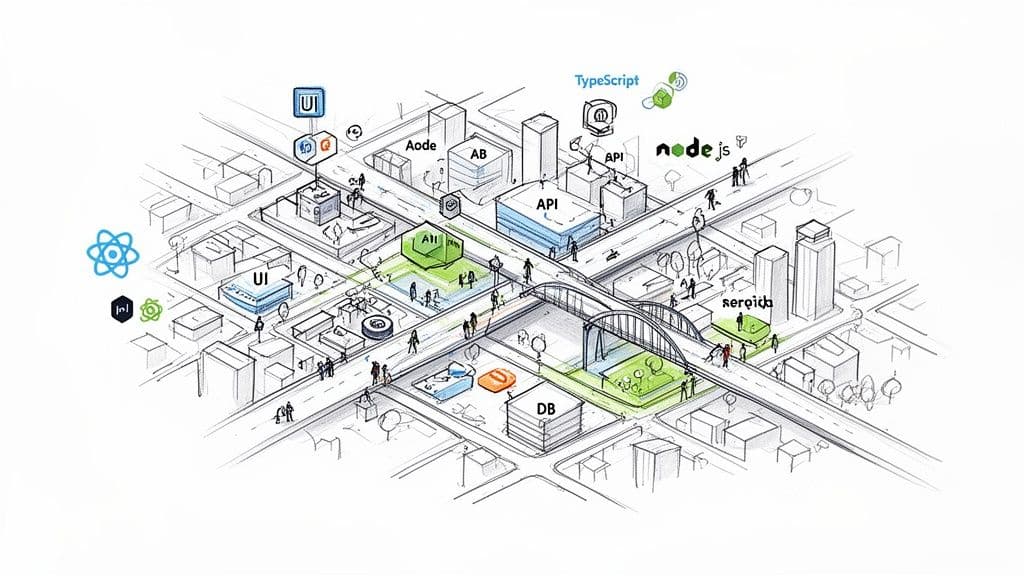
Could you imagine building a skyscraper without a plan? The first floors might rise quickly, but foundational weaknesses show up fast. Enterprise applications are the same. Without deliberate architecture, a growing codebase becomes a “big ball of mud,” where small changes can break unrelated parts of the system. That slows feature delivery and creates technical debt that can paralyze a business. Catching architectural mistakes early saves time and money—often by orders of magnitude.1
The Value of a Deliberate Architecture
A clear architectural pattern draws boundaries and sets interaction rules for the system. It defines zones such as presentation, business logic, and data access, and infrastructure elements like APIs and event buses. This foresight is critical for sustaining development momentum.
In modern web stacks—TypeScript, React, and Node.js in particular—a solid foundation delivers clear benefits:
- Improved scalability: scale specific components without rebuilding everything.
- Enhanced maintainability: developers can modify and extend code with confidence.
- Increased team autonomy: teams work in parallel with minimal interference.
- Future-proofing: adapt to new technologies and shifting business needs.
These advantages aren’t theoretical. Early architectural decisions reduce long-term costs and risk, especially when teams scale and systems become distributed.1
For foundational principles, see Clean Architecture and essential software architecture best practices referenced below.
Choosing the Right Architectural Blueprint
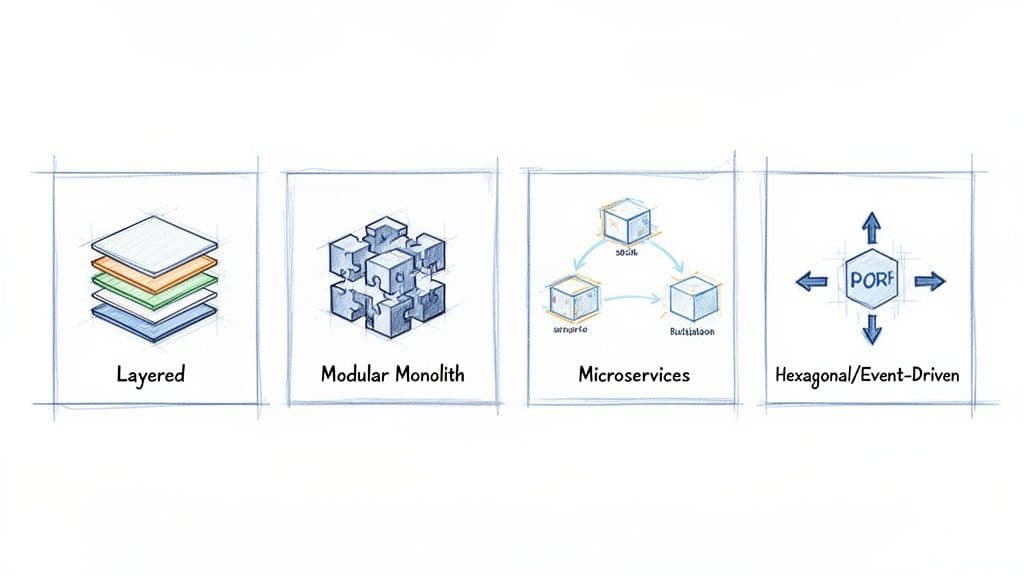
Choosing an architecture is less about picking a tech and more about selecting the system blueprint. That decision shapes team workflows, scaling behavior, and how easy it is to change the system later. Below are practical, trade-off focused descriptions of common blueprints.
Layered Architecture (Classic Monolith)
The layered or n-tier pattern separates presentation, business logic, and data access. Communication typically flows downward. This structure is easy to understand and quick to implement. For new products or stable requirements, a monolith is often the most practical choice. Start simple and avoid premature complexity.
Pragmatic Modular Monolith
A modular monolith keeps a single deployable unit but enforces internal modules with clear APIs. Imagine a department store under one roof, with each department handling its own responsibilities. This approach reduces internal coupling and prepares a codebase for a future migration to microservices if needed.
A modular monolith gives teams velocity and simplicity without immediately accepting the operational costs of distribution.
Microservices
Microservices split functionality into small, independent services, each owned by a team. Benefits include independent deployment, technology flexibility, and targeted scalability. These gains come with operational costs: networking, data consistency, service discovery, and observability become first-class concerns. Use this pattern when team size, scale needs, and organizational capability justify the complexity.2
Hexagonal and Event-Driven Variants
Hexagonal (Ports and Adapters) isolates core logic from external concerns, improving testability and longevity. Event-driven architectures use asynchronous events to decouple components and support real-time workflows. Both patterns are powerful when used for their specific strengths.
Comparison at a Glance
| Pattern | Key Characteristic | Best For | Scalability | Development Complexity |
|---|---|---|---|---|
| Layered Monolith | Single codebase with distinct layers | Small-to-medium apps, MVPs | Vertical | Low |
| Modular Monolith | Single codebase, internally decoupled modules | Growing apps needing structure | Vertical | Medium |
| Microservices | Small, independent services | Large systems, large teams | Horizontal | High |
| Hexagonal | Core logic isolated from infra | High testability, maintainability | Varies | Medium |
| Event-Driven | Async communication via events | Real-time workflows, IoT | High | High |
There is no single best pattern; choose based on trade-offs and business goals.
Common Architectural Pitfalls and How to Avoid Them
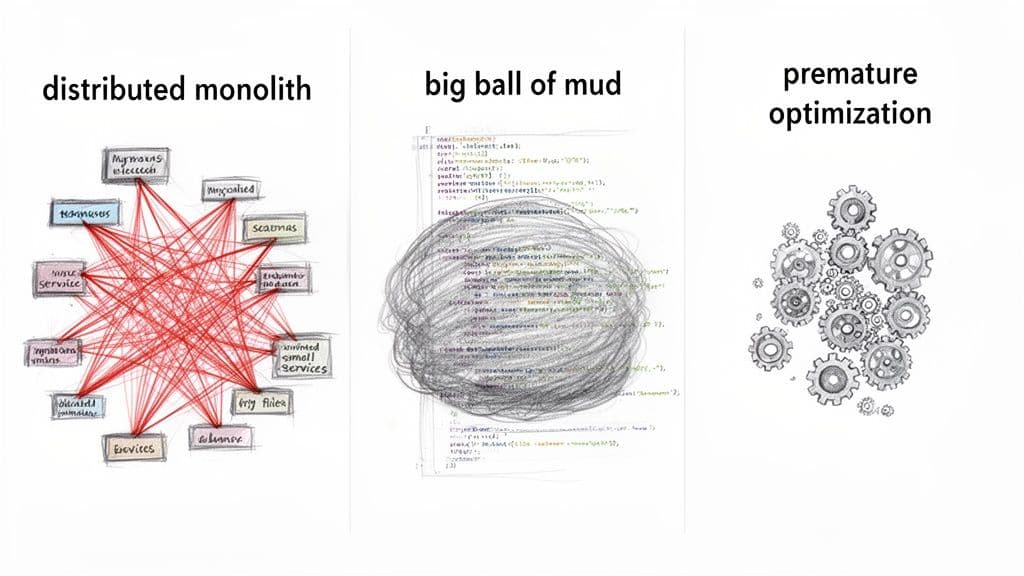
Selecting a pattern is only half the battle. Anti-patterns turn good ideas into maintenance nightmares. Spotting these early keeps a system healthy and teams productive.
The Distributed Monolith
This anti-pattern appears when microservices are implemented but remain tightly coupled: shared databases, synchronous call chains, and deployments that must move together. You get the complexity of distribution without autonomy. Avoid it by ensuring services own their data, prefer asynchronous communication, and ensure services can be deployed independently.2
The Big Ball of Mud
When boundaries blur, the codebase becomes tangled and fragile. Enforce modularity inside monoliths with clear APIs and separation of concerns. This prevents slowdowns, reduces risk, and delays calls for risky rewrites.
Premature Optimization
Avoid building a complex distributed system for a problem that doesn’t require it. Start with the simplest architecture that delivers business value now, with a clear path to evolve. Often, a modular monolith is the best starting point.
How Architecture Choices Affect Your Dev Tools
Architecture shapes CI/CD, testing strategy, and how helpful AI coding assistants can be. Clear boundaries unlock automation, while hidden dependencies force manual workarounds.
Testing Strategy
Monoliths often rely too heavily on slow end-to-end (E2E) tests. Moving to modular architectures enables:
- Contract testing to validate service APIs without spinning up the whole system.
- Isolated integration tests for a faster feedback loop.
Shifting tests earlier and making them faster is a hallmark of high-performing teams.3
Observability
In distributed systems, tracing a request across services requires logs, metrics, and distributed traces. Observability is essential—without it, debugging and performance tuning are almost impossible. Event-driven systems need tools that correlate events across topics and consumers to reconstruct workflows.4
AI Coding Assistants and Architecture
AI tools work best on clean code with clear separation of concerns. Feed an AI a muddled codebase and it will generate low-quality or harmful suggestions. With a well-structured architecture and automation—linters, custom static rules, and guided AI configurations—these assistants become force multipliers.
Use static analysis tools like ESLint with custom rules to prevent architectural violations. Train AI tools against your codebase and documentation so generated code follows your patterns.
Modernizing a Legacy System: A Practical Roadmap

Most teams inherit a legacy monolith. A big-bang rewrite is risky. A pragmatic approach is incremental modernization that delivers value continuously.
Start with the Strangler Fig Pattern
The Strangler Fig Pattern lets you route new features to modern components while leaving the legacy system in place. Over time, the new system replaces the old one piece by piece. This reduces risk, delivers immediate value, and allows continuous deployment.5
Identify Bounded Contexts
Map the monolith to find bounded contexts like “User Management” or “Billing.” These seams are your safest places to extract features. Understanding domain boundaries is critical for successful modularization and service extraction.
Align with Business Priorities
Create a modernization plan that targets the highest business impact first. That ensures architectural work directly supports faster feature delivery and measurable business outcomes.
Top Questions About Enterprise Architecture
When should we move from a monolith to microservices?
Typically when team size and delivery pain become the bottleneck: frequent merge conflicts, deployment gridlock, or wildly different scaling needs across components. Usually, internal modularization is a better first step.
How does serverless fit into architecture?
Serverless is a tool, not a replacement for architecture. It’s ideal for isolated, event-driven tasks—image processing, background jobs, or spiky APIs—while core services may remain containerized.
What’s the biggest mistake teams make?
Choosing a complex distributed architecture for prestige or theoretical scale rather than real needs. Start with the simplest architecture that solves current problems and plan a clear evolution path.
At Clean Code Guy, we help teams turn architectural theory into practice, implementing scalable enterprise patterns that speed delivery and cut technical debt. If your codebase feels like a roadblock, our AI-Ready Refactors and Codebase Cleanups can help you build a solid foundation. Schedule your free consultation today.
Quick Q&A — Concise Answers
When is it worth extracting services from a monolith?
When delivery, scaling, or team autonomy suffers and you can identify clear bounded contexts. Start by modularizing internally, then extract services incrementally.
What are the fastest improvements for a messy monolith?
Identify bounded contexts, add internal APIs, enforce module boundaries, and introduce contract tests to reduce coupling and unlock safer refactors.
How do we keep AI-generated code aligned with architecture?
Document conventions, enforce rules with linters and CI checks, train AI on your codebase, and keep regular architecture reviews to maintain standards.
1.
NIST, “The Economic Impacts of Inadequate Infrastructure for Software Testing,” National Institute of Standards and Technology, 2002. https://www.nist.gov/publications/economic-impact-inadequate-infrastructure-software-testing
2.
Martin Fowler, “Microservices,” martinfowler.com. https://martinfowler.com/articles/microservices.html
3.
Puppet, “State of DevOps Report,” Puppet. https://puppet.com/resources/report/state-of-devops-report/
4.
Cloud Native Computing Foundation, “CNCF Survey 2020,” CNCF. https://www.cncf.io/blog/2020/09/17/cncf-survey-2020/
5.
Martin Fowler, “Strangler Fig Application,” martinfowler.com. https://martinfowler.com/bliki/StranglerFigApplication.html
🙋🏻♂️
AI writes code.You make it last.
In the age of AI acceleration, clean code isn’t just good practice — it’s the difference between systems that scale and codebases that collapse under their own weight.