Discover the essential Domain‑Driven Design books and learn which to read first for TypeScript, React, and Node.js projects. This guide compares Evans and Vernon and shows practical ways to apply DDD in modern stacks.
January 25, 2026 (9mo ago) — last updated July 29, 2026 (3mo ago)
Top Domain‑Driven Design Books: DDD Guide
Compare the top Domain‑Driven Design books by Evans and Vernon and learn which to read first for applying DDD in TypeScript, React, and Node.js projects.
← Back to blog
Top Domain‑Driven Design Books: DDD Guide
Discover the essential Domain‑Driven Design books for your team. This guide compares Eric Evans and Vaughn Vernon and recommends which book to start with to apply DDD in TypeScript, React, and Node.js projects.
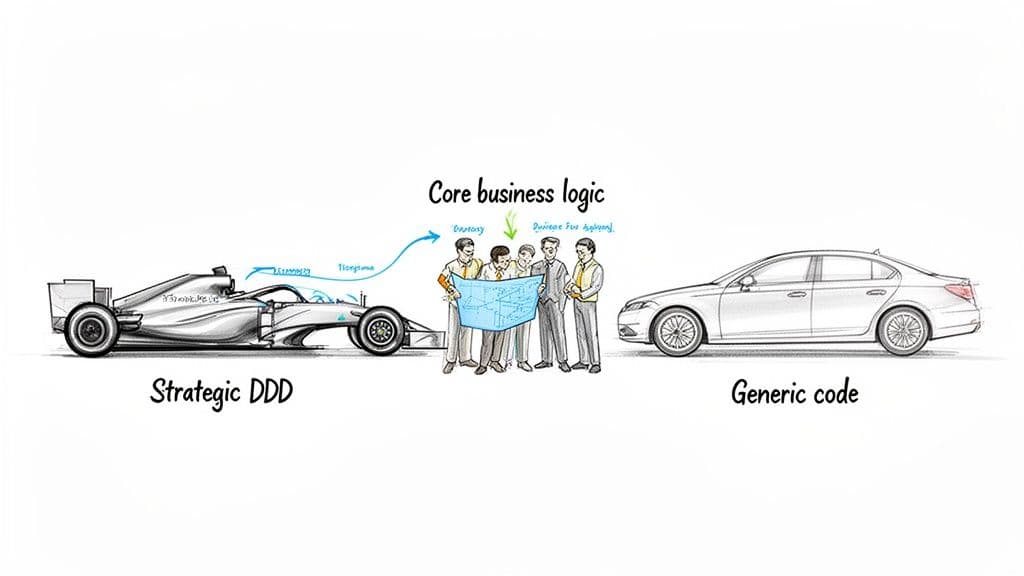
Before you pick a Domain‑Driven Design book, understand that DDD isn’t a passing technical trend. It’s a strategic approach to building software that maps directly to your business, helping teams focus effort where it matters most. When done well, DDD turns a codebase into a competitive asset rather than a maintenance burden.1
Many teams build generic “sedans” that work but don’t differentiate the business. DDD teaches you to design a high‑performance solution tailored for your core domain. That shifts conversations from “How do we build this feature?” to “How does this feature solve a core business problem?”
Why DDD Is Your Team’s Strategic Advantage
Without a methodology like DDD, teams often face recurring problems: technical debt, slow feature delivery, and miscommunication between engineering and business stakeholders. DDD addresses these issues by:
- Untangling convoluted codebases so changes don’t break unrelated areas.
- Speeding feature delivery by isolating domains so teams can iterate independently.
- Creating a Ubiquitous Language that aligns developers and domain experts.
- Forcing a software model that reflects real business needs, not just technical correctness.
When organizations invest in DDD, that investment pays off in maintainability and clarity—especially in TypeScript and React stacks where component and domain isolation map well to DDD concepts5. In the Canadian publishing market, book publishing is a notable industry for technical content and DDD adoption; industry analysis highlights this intersection of content and software development investment1.
“By focusing on the core domain, DDD forces your team to become experts in the business itself. The code becomes a direct reflection of that expertise, making it more intuitive, maintainable, and valuable over time.”
We’ve applied these ideas in projects such as lifepurposeapp.com and microestimates.com. When teams model domains clearly from the start, the software becomes a foundation for sustainable growth rather than a constant liability.
Choosing Your Foundational DDD Book
Choosing the right book depends on your role, experience, and immediate goals. Pick the wrong starting point and you risk being overwhelmed by theory or left without practical guidance. Below are three foundational books and when to read them.
The Strategic Blueprint — Eric Evans
Domain‑Driven Design: Tackling Complexity in the Heart of Software by Eric Evans is the original source of the DDD philosophy. It focuses on strategy and the mental models that guide a DDD transformation. This book explains why a Ubiquitous Language and Bounded Contexts are essential for long‑term success.
This is a strategic, often dense text best suited for architects, senior engineers, and technical leaders who must guide organizational change.
The Tactical Manual — Vaughn Vernon
Implementing Domain‑Driven Design by Vaughn Vernon bridges Evans’ strategy with practical implementation. Vernon explains Aggregates, Entities, Domain Events, and how to apply them in code. This book is ideal for mid‑to‑senior developers and tech leads who are ready to put DDD into practice.
The Accessible Starting Point — Vaughn Vernon
Domain‑Driven Design Distilled is a concise introduction that summarizes the most important concepts. It’s an excellent team starter: buy this for developers, product managers, and business stakeholders to create shared understanding before diving deeper.
Quick Comparison
| Book Title | Best For | Key Focus | When to Read |
|---|---|---|---|
| Domain‑Driven Design Distilled | Whole team, beginners | Core strategic concepts, concise | Start here to align everyone |
| Domain‑Driven Design (Evans) | Architects, senior engineers | Why DDD matters, strategy | Read after Distilled to lead initiatives |
| Implementing Domain‑Driven Design | Mid/senior devs, tech leads | How to implement DDD, tactical | Read after Evans when ready to code |
Core DDD Patterns You’ll Use Every Day
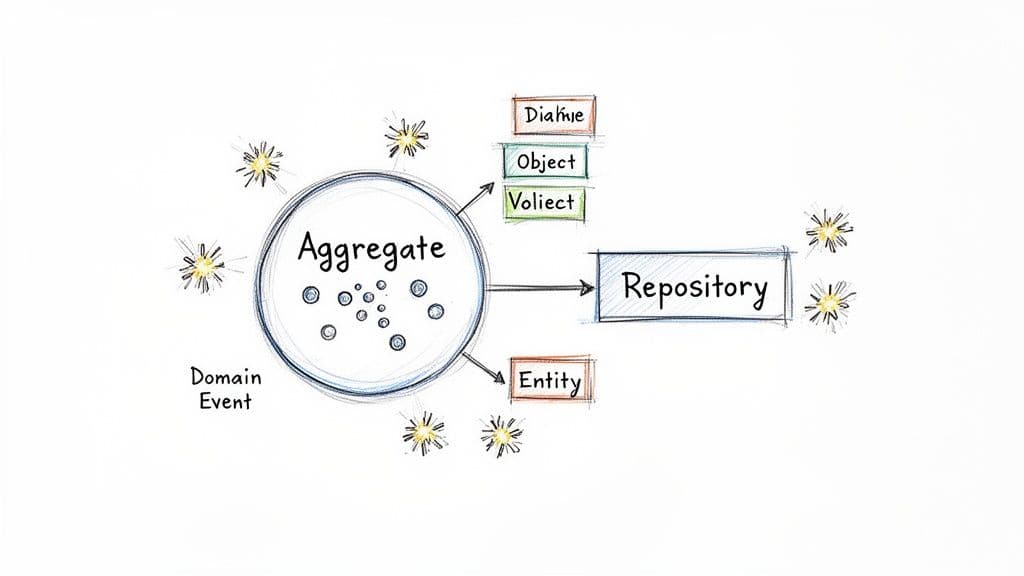
Learning the core patterns turns abstract ideas into practical modeling tools. Treat these patterns as a toolkit: know what each one does and when to use it.
Entities and Value Objects
Ask a simple question: does this thing have a stable identity that matters over time? If yes, model it as an Entity. If no, it’s likely a Value Object.
- Entities have identity and are mutable (for example, a User tracked by userId).
- Value Objects are immutable and defined by their attributes (for example, a ShippingAddress).
Using Value Objects prevents invalid data from spreading through your code and makes intent explicit.
Aggregates: Guardians of Consistency
An Aggregate is a cluster of related objects treated as a single unit to enforce invariants. The Aggregate Root is the only entry point for external interaction, making sure business rules are respected. For example, a ShoppingCart should manage adding or removing items rather than exposing internal lists directly.
Repositories: Abstracting Persistence
Repositories give the illusion of an in‑memory collection for your Aggregates. They keep domain logic free from database concerns, which makes testing and evolution much easier. For a deeper look at data source patterns, see our guide on Patterns of Enterprise Application Architecture.
Domain Events: Communicating Change
Domain Events describe things that happened in the domain and let other parts of the system react without tight coupling. Publish an OrderPlaced event when an order is created; other services — notifications, shipping, analytics — can listen and react independently.
Putting DDD to Work in a Modern TypeScript Stack
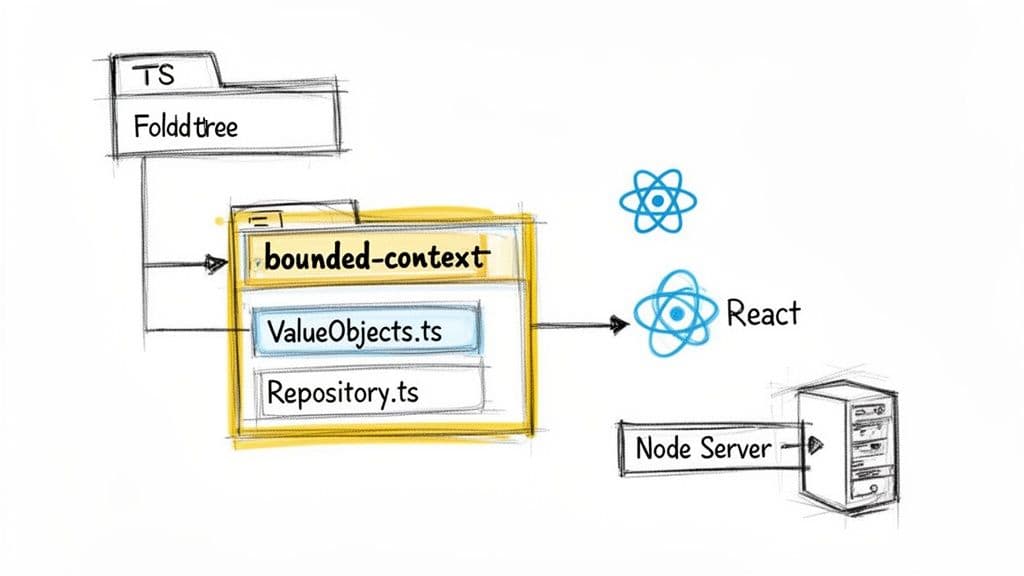
TypeScript’s type system and React’s component model align naturally with DDD. Use folder structure to represent Bounded Contexts instead of organizing by technical layers.5
Example top‑level folders for an e‑commerce app:
- /src/catalog/
- /src/ordering/
- /src/identity/
- /src/shipping/
Each folder contains domain entities, value objects, repositories, and even domain‑specific UI components in a full‑stack app. This mirrors the business model and improves developer clarity. For more on organizing code this way, see our guide to Vertical Slice Architecture.
Crafting Type‑Safe Value Objects
TypeScript helps you make immutable, validated Value Objects. Example: an Email Value Object with a private constructor and a factory method guarantees validity at creation and prevents invalid values from leaking into the domain.
export class Email {
  private readonly value: string;

  private constructor(email: string) {
    if (!Email.isValid(email)) {
      throw new Error("Invalid email format");
    }
    this.value = email.toLowerCase();
  }

  public static create(email: string): Email {
    return new Email(email);
  }

  public static isValid(email: string): boolean {
    const emailRegex = /^[^\s@]+@[^\s@]+\.[^\s@]+$/;
    return emailRegex.test(email);
  }

  public toString(): string {
    return this.value;
  }
}
Implementing a Clean Repository Pattern
Define repository interfaces in the domain layer so your core models stay independent from infrastructure. Implement concrete repositories in the infrastructure layer using Prisma, TypeORM, or another ORM.
// /src/ordering/domain/i-order-repository.ts
import { Order } from './order';

export interface IOrderRepository {
  findById(orderId: string): Promise<Order | null>;
  save(order: Order): Promise<void>;
}
Concrete implementations live in /src/ordering/infrastructure/ and deal with mapping persistence models to your domain aggregates. When working with JSON APIs, reliable tools like a JSON‑to‑TypeScript converter can speed up model creation.
Applying these practices yields measurable benefits in many teams. Industry analysis and internal audits show clear business value from investing in domain modeling and clean architecture234.
Common DDD Implementation Pitfalls and How to Avoid Them
Adopting DDD is a shift in how teams think. Knowing common failure modes helps you adopt DDD pragmatically.
The Big‑Bang Rewrite
Rewriting an entire legacy system at once is high risk. It stalls feature delivery and usually fails. Instead, identify one painful Bounded Context in the core domain and refactor it as a focused, incremental project. That delivers a quick win and reduces risk.
Over‑Engineering Simple Domains
DDD’s most powerful patterns are for the core domain. Avoid applying Aggregates and Domain Events to simple CRUD features. Categorize your domains as core, supporting, or generic. Apply heavy DDD where it yields competitive advantage; use off‑the‑shelf solutions for generic needs.
Letting the Ubiquitous Language Decay
Ubiquitous Language must be maintained. Hold regular model review sessions with domain experts and update a shared glossary. Treat the language as a living artifact so the code and business vocabulary stay aligned.
Frequently Asked Questions
Which DDD book should my team start with?
If you need fast alignment across roles, start with Domain‑Driven Design Distilled by Vaughn Vernon. For deep strategy, read Eric Evans’ Domain‑Driven Design, then Vernon’s Implementing Domain‑Driven Design to learn the implementation patterns.
Is DDD relevant for microservices?
Yes. Bounded Contexts map naturally to microservice boundaries. Using DDD principles helps avoid a distributed monolith by ensuring services own their models and vocabulary.
Can I use DDD on the frontend?
Absolutely. Structure React and Next.js apps around business domains rather than technical layers. This improves maintainability and helps frontend developers think in terms of business capabilities.
Quick Q&A — Fast Answers
What’s the best first book for a team new to DDD?
Start with Domain‑Driven Design Distilled to align roles quickly and create a shared vocabulary.
When should we apply full DDD patterns?
Reserve full DDD for your core domain where strategic differentiation exists; keep supporting and generic domains simple.
How do we start DDD with a legacy system?
Choose one bounded context, iteratively refactor it, and expose a clean domain model behind a repository or API.
1.
Ontario Creates, “Industry Profile: Book Publishing,” https://www.ontariocreates.ca/research/industry-profile/ip-book.
2.
Statistics Canada, “Book sales, 2022,” https://www150.statcan.gc.ca/n1/pub/13-605-x/2023001/article/00002-eng.htm.
3.
IBISWorld, “Software Publishing in Canada,” https://www.ibisworld.com/canada/industry/software-publishing/1239/.
4.
Clean Code Guy, case studies and audits on DDD adoption and outcomes, https://cleancodeguy.com.
5.
Stack Overflow, “Developer Survey 2023,” adoption and preference data for TypeScript and frontend tooling, https://insights.stackoverflow.com/survey/2023.
🙋🏻♂️
AI writes code.You make it last.
In the age of AI acceleration, clean code isn’t just good practice — it’s the difference between systems that scale and codebases that collapse under their own weight.