Discover the concentric circle model and build scalable, maintainable software. Learn how clean architecture principles can transform your development process.
January 5, 2026 (8mo ago)
A Guide to the Concentric Circle Model in Software
Discover the concentric circle model and build scalable, maintainable software. Learn how clean architecture principles can transform your development process.
← Back to blog
A Guide to the Concentric Circle Model in Software
Summary: Learn the concentric circle model and Clean Architecture techniques to build maintainable, testable, and technology-independent software.
Introduction
The concentric circle model is a practical visualization of Clean Architecture that helps teams build scalable, maintainable software. At the center sits your highest-value business logic, protected from volatile implementation details like databases or UI frameworks. This separation of concerns improves testability, reduces risk when swapping technologies, and speeds up development cycles.
Decoding the Concentric Circle Model
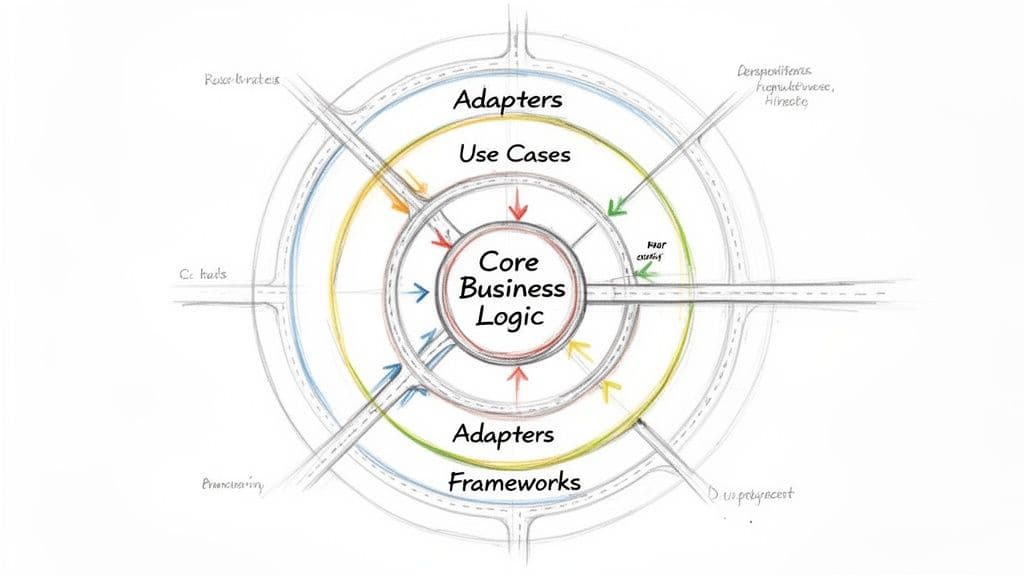
Picture the model as a city map. The business core is the city centre, holding enterprise rules and core data structures. Surrounding suburbs represent delivery mechanisms such as the UI, APIs, and databases. The essential principle is the Dependency Rule: dependencies must point inward, toward the core. This keeps your most important logic isolated from technical details and prevents widespread breakage when implementation choices change1.
This approach creates a strong separation of concerns, making code easier to maintain, test, and evolve.
The Key Architectural Layers
The model is commonly divided into four layers, each with a clear responsibility:
- Entities — the core business objects and enterprise rules, stable and framework-free.
- Use Cases — application-specific business logic that orchestrates work around Entities.
- Adapters — controllers, presenters, and gateways that translate between the application core and external systems.
- Frameworks & Drivers — external tools, databases, UI libraries, and delivery mechanisms.
Layer Breakdown
| Layer | Responsibility | Example Components |
|---|---|---|
| Entities | Enterprise-wide business rules and core data structures. | Customer object, Product class, validation rules |
| Use Cases | Application-specific logic and orchestration. | CreateOrder use case, GetUserProfile service |
| Adapters | Translators between layers and external systems. | REST controllers, database gateways, GUI presenters |
| Frameworks & Drivers | External technologies and delivery tools. | Web framework (e.g., Spring Boot), database (PostgreSQL), UI library (React) |
This structure protects the core logic, so a change in the outer layer—such as switching databases—only affects the adjacent adapter code.
This pattern has been used on production platforms to keep core logic insulated from changing technology choices. It also appears in other domains, such as community detection algorithms and visualization systems, demonstrating the idea’s versatility.
Exploring the Four Circles of Clean Architecture
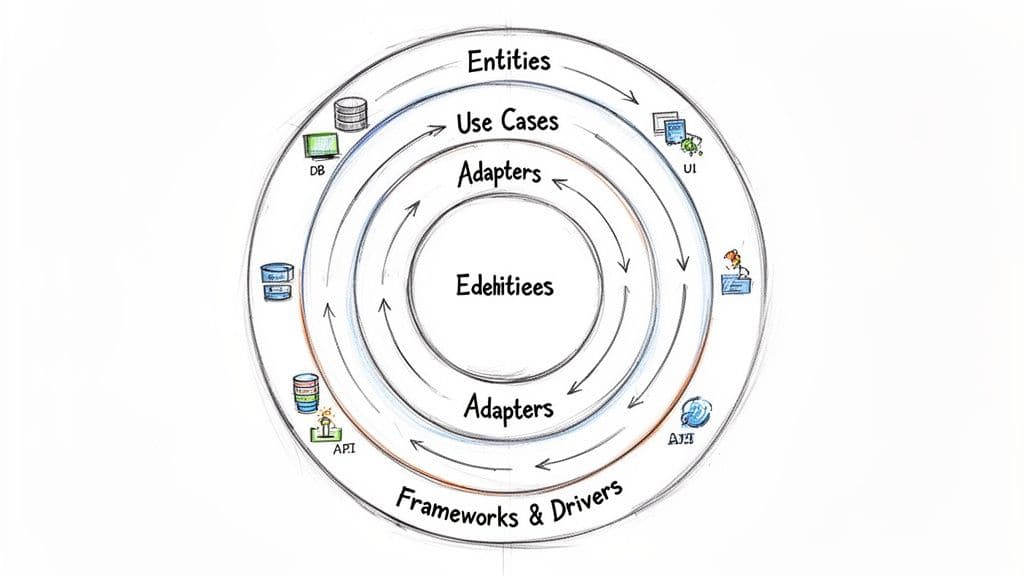
The model’s power comes from the rules that govern interactions. The Dependency Rule means outer layers may depend on inner layers, but inner layers never reference outer ones. This one-way dependency protects business rules from external volatility and makes the system easier to test and change1.
Circle 1: Entities (The Business Core)
Entities are pure business objects and rules that should not depend on frameworks or infrastructure. Examples include a User object with validation or an Order class that calculates totals. This layer is the most stable and framework agnostic.
Circle 2: Use Cases (Application Logic)
Use Cases define what the application does. They orchestrate interactions with Entities to accomplish tasks such as CreateUserAccount. Use Cases express their needs through interfaces instead of concrete implementations—an application of the Dependency Inversion Principle—so they remain independent of delivery mechanisms and data stores1.
This separation enables isolated, fast tests. You can verify Use Case behavior with lightweight fakes rather than full integration stacks, which significantly speeds up feedback cycles and developer confidence3.
Circle 3: Interface Adapters (The Translators)
Interface Adapters convert external data formats into plain data structures the core understands and vice versa. Typical components are controllers, presenters, and gateways. If you change your database schema, ideally only the gateway in this layer needs revising.
Circle 4: Frameworks and Drivers (The Outside World)
The outer layer holds volatile technologies like web frameworks, UI libraries, and database drivers. Keeping these at the edge confines their churn to the periphery, making major migrations more manageable and lowering the risk to core business code. Teams that implement layered designs often achieve faster, more reliable deployments, which correlates with higher-performing engineering organizations2.
Why This Model Is a Game-Changer for Your Business
Adopting concentric circles delivers practical benefits your whole team will notice: faster tests, fewer risky deployments, and less vendor lock-in. Core business logic that’s independent of UI and persistence lets you run extensive unit and acceptance tests without a database, resulting in quicker iteration and higher confidence3.
Gaining Technology Independence
The Dependency Rule forms a protective barrier around your core logic. You can swap frameworks or databases without touching the business rules. This makes shifts like a monolith-to-microservices migration easier because business domains and boundaries are already defined.
Building for Maintainability and the Future
When changes are contained to a single layer, you reduce the blast radius of bugs and accelerate feature work. Architectures that minimize coupling and contain technical debt give organizations more predictable delivery and lower long-term maintenance costs4.
Defining Clear Code Ownership for Your Teams
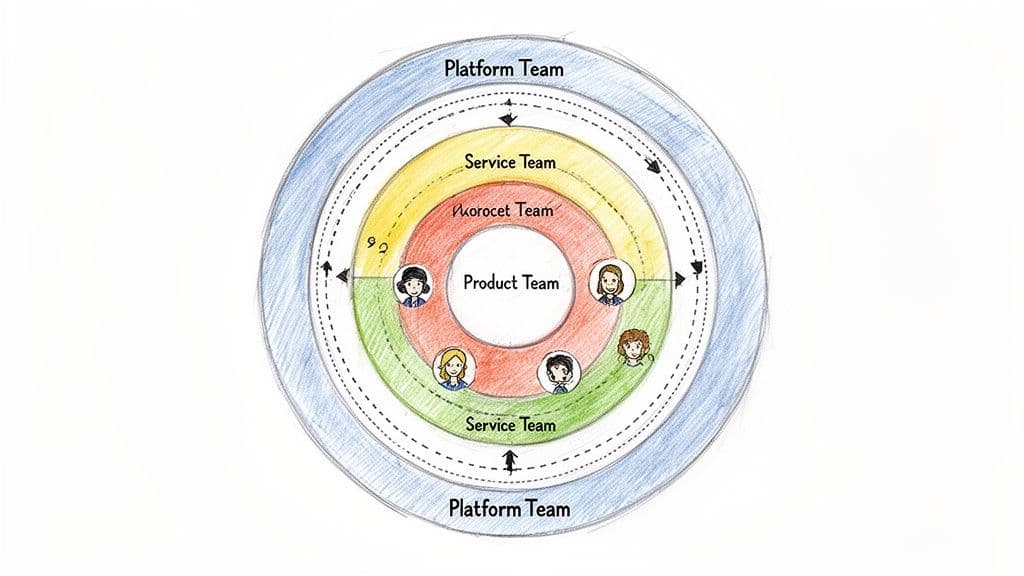
A good architecture should make team organization simpler. Map teams to layers to clarify ownership and reduce cross-team friction.
- Platform Team — owns Frameworks & Drivers. They provide the infrastructure, CI/CD, and shared tooling.
- Product Teams — own Use Cases and Entities. They focus on delivering business value within clear boundaries.
Aligning teams with architecture turns dependency rules into team contracts, enabling safer, autonomous work and reducing accidental cross-team breakages.
How to Audit Your Codebase With This Model
Use the concentric circles as an audit lens to find and fix dependency violations. This three-step process exposes where architectural drift has crept in and helps you plan refactors.
Step 1: Identify Your Core Business Logic
Gather your team and determine which code you’d keep if you removed the UI and swapped the database. That code belongs at the centre.
Step 2: Map Your Code to the Circles
Create a high-level map that assigns modules and packages to layers. Expect to find gray areas—modules that mix responsibilities are a sign of drift.
Step 3: Pinpoint Dependency Violations
Hunt for inner-layer code importing outer-layer frameworks or drivers. Typical violations include a use case executing raw SQL or an Entity annotated with an ORM, both of which tie core logic to infrastructure. Address these by introducing interfaces and moving implementation details into the Adapters layer.
Common Violations and Refactoring Solutions
| Violation Example | Risk | Refactoring Strategy |
|---|---|---|
| Core logic references a UI framework class. | UI changes can break business rules. | Add a Presenter in Adapters to handle UI formatting. |
| Use Case runs raw SQL. | Locks the application into a specific database. | Define a Gateway interface in Use Cases and implement it in Adapters. |
| Entity contains ORM annotations. | Pollutes business objects with persistence code. | Use DTOs to move persistence details to Adapters. |
A methodical audit produces a clear refactoring roadmap to reduce technical debt and restore clean boundaries.
Common Pitfalls and How to Sidestep Them
This model isn’t a silver bullet. Two common mistakes are over-engineering and leaky abstractions. Overly strict layering on a small project adds needless complexity. Leaky abstractions occur when outer-layer details creep into the inner layers, eroding the model’s benefits.
Be pragmatic. For small projects, combining Entities and Use Cases into a single core layer often delivers most benefits without unnecessary complexity. Use automated linting and static analysis to catch dependency violations early, and ensure team-wide buy-in so the architecture becomes part of the development culture.
Frequently Asked Questions
How does the concentric circle model relate to other patterns?
It’s a visualization of Clean Architecture and shares goals with Hexagonal (Ports and Adapters) and Onion Architecture. All aim to protect business logic by keeping dependencies inward-facing.
How should I handle cross-cutting concerns like logging or metrics?
Use dependency inversion. Define small interfaces (for example, ILogger) in inner layers and provide implementations in the outer layer. This preserves inward dependencies while allowing outer layers to supply concrete behavior.
Is this model overkill for small projects?
It can be if applied rigidly. Start lightweight: separate business logic from frameworks and persistence. Even minimal separation improves testability and future growth.
Three Concise Q&A Sections
Q: What problem does the concentric circle model solve?
A: It isolates core business logic from volatile implementation details, reducing risk when changing technologies and improving testability and maintainability.
Q: When should we introduce these layers in development?
A: Apply the core ideas early—keep business rules framework-free. For small projects, start with a lightweight separation and expand layers as complexity grows.
Q: How do we find and fix dependency violations?
A: Audit your code by mapping modules to circles, identify inner-to-outer references, then refactor by adding interfaces and moving implementations into Adapters.
At Clean Code Guy, we guide teams through audits and refactoring roadmaps that apply these principles to real-world systems. Whether you’re modernizing a legacy codebase or starting a new project, clear boundaries and inward dependencies help you ship with confidence.
1.
Robert C. Martin, “The Clean Architecture,” Uncle Bob’s blog, 2012. [https://8thlight.com/blog/uncle-bob/2012/08/13/the-clean-architecture.html]
2.
DORA, “Accelerate State of DevOps Report,” findings on performance benefits from modular, well-structured architectures. [https://cloud.google.com/blog/topics/devops-sre/state-of-devops-report-2019]
3.
Martin Fowler, “The Practical Test Pyramid,” guidance on test speed and isolation benefits. [https://martinfowler.com/articles/practical-test-pyramid.html]
4.
CAST Research Lab, “The Technical Debt Landscape,” on technical debt impact to software projects. [https://www.castsoftware.com/resources/white-paper/technical-debt-landscape]
🙋🏻♂️
AI writes code.You make it last.
In the age of AI acceleration, clean code isn’t just good practice — it’s the difference between systems that scale and codebases that collapse under their own weight.