Deciding between classes and structs isn’t just syntax. The key question is whether you need value semantics (data is copied) or reference semantics (shared identity). That choice shapes memory use, performance, mutability, and overall architecture. This guide explains the trade-offs, shows how languages treat each model, and gives practical rules to pick the right type for cleaner, faster code.
November 15, 2025 (7mo ago) — last updated May 10, 2026 (1mo ago)
Classes vs Structs: How to Choose Value or Reference
Decide between classes and structs: clear rules on value vs reference types, memory and performance trade-offs, and practical guidance for safer, faster code.
← Back to blog
Classes vs Structs: How to Choose Value or Reference
Summary: Decide between classes and structs with clear rules on value versus reference types, memory impacts, performance trade-offs, and design guidance to write safer, faster code.
Introduction
Deciding between classes and structs isn’t just syntax. The key question is whether you need value semantics (data is copied) or reference semantics (shared identity). That choice shapes memory use, performance, mutability, and overall architecture. This guide explains the trade-offs, shows how languages treat each model, and gives practical rules to pick the right type for cleaner, faster code.
The core distinction: value vs reference semantics
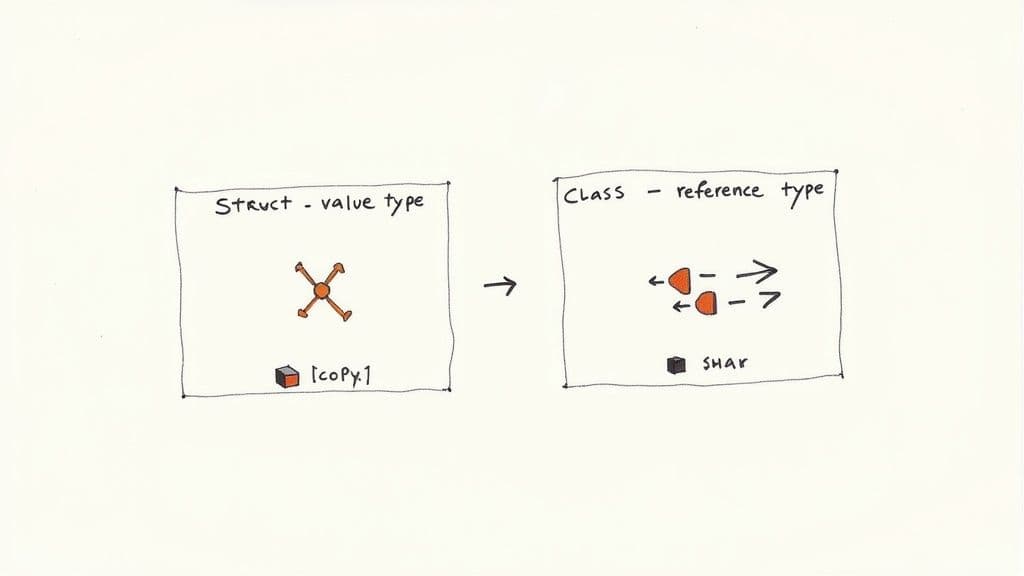
Strip away the keywords and you’re deciding between values and identities. A struct is like a photocopied notepad: when you hand it to someone they get their own copy and can change it without affecting your original. That’s value semantics. A class is like a shared document: you send a link and everyone edits the same live object. That’s reference semantics.
Key differences at a glance
| Characteristic | Structs (Value Types) | Classes (Reference Types) |
|---|---|---|
| Data handling | Data is copied when passed | A reference (pointer) is passed |
| Memory allocation | Often stored inline or on the stack | Allocated on the heap |
| Lifecycle | Short-lived, local copies | Long-lived, shared instances |
| Identity | Defined by data equality | Distinct identity independent of data |
| Inheritance | Usually no inheritance | Supports inheritance and polymorphism |
| Primary use case | Small, self-contained values | Complex entities with behavior |
These principles affect latency, memory usage, and correctness. Choosing deliberately makes code more predictable and easier to maintain.
How memory allocation impacts performance
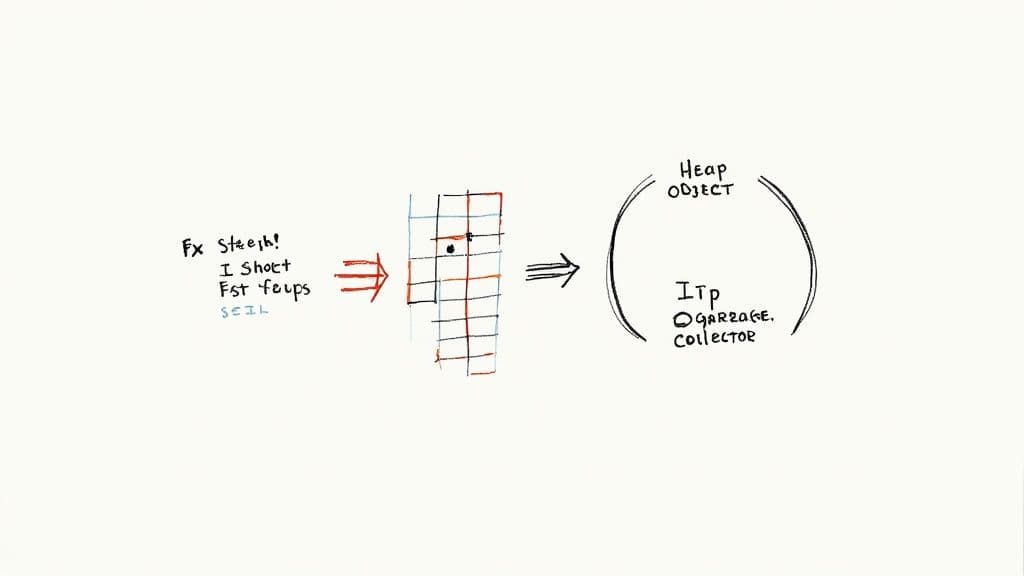
Most performance differences come from where data lives: the stack or the heap.
The stack: fast and predictable
The stack is a LIFO region used for function-local data. Allocating on the stack is cheap because it’s simple pointer arithmetic. For small value types, allocation and deallocation are nearly free.
The heap: flexible but costlier
The heap lets objects outlive a single function call, but heap allocation is slower and may trigger garbage collection or manual deallocation. Reference types add an extra indirection: the stack holds a pointer to heap data. Repeated heap allocations increase GC pressure and can cause pauses in managed runtimes1.
Example (C#)
// Value Type - often lives inline
public struct PointStruct {
    public int X;
    public int Y;
}

// Reference Type - object lives on the heap
public class PointClass {
    public int X;
    public int Y;
}

public void ProcessPoints() {
    PointStruct p1 = new PointStruct { X = 10, Y = 20 };
    PointClass p2 = new PointClass { X = 10, Y = 20 };
}
In tight loops, thousands of heap allocations for small objects can increase GC activity; using structs in arrays often improves cache locality and reduces GC pressure2.
How languages treat classes and structs
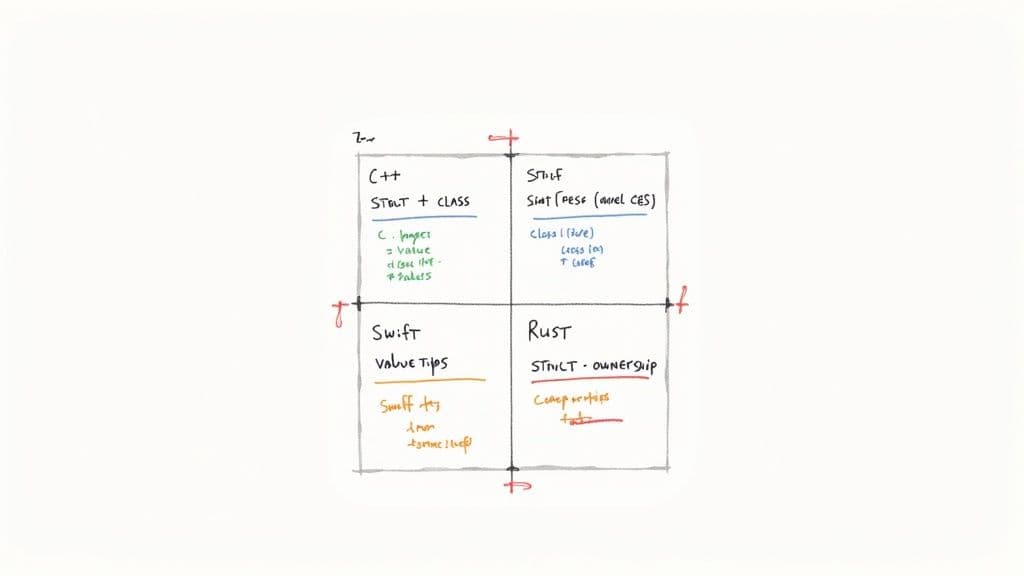
Language idioms matter. The best choice depends on the language and the runtime.
C++: keywords are similar
In C++, struct and class are nearly identical; the practical difference is default member access. Use struct for plain data aggregates and class for encapsulation and complex behavior3.
C#: explicit value/reference split
C# makes the distinction explicit: struct is a value type and class is a reference type. Prefer structs for small, immutable values (coordinates, colors) and classes for entities with identity or shared mutable state.
Swift: value-first approach
Swift encourages value types. The language and community favour struct by default and reserve class for reference cases, such as shared mutable state or Objective-C interop4.
Rust: ownership and safety
Rust uses struct with ownership and borrowing rules to provide memory safety without a garbage collector. Behavior is attached via impl blocks, and the compiler enforces ownership and borrowing at compile time, preventing many shared-state bugs before runtime5.
struct Player {
    username: String,
    level: u32,
    is_active: bool,
}

impl Player {
    fn level_up(&mut self) {
        self.level += 1;
    }
}
Rust’s model gives you direct memory control plus compile-time safety.
When to choose a struct for better performance
Choose a struct when the type is small, self-contained, and treated as a value rather than an identity. Typical candidates:
- Geometric points (Point2D)
- Color values (RGB/RGBA)
- Small configuration payloads
- Lightweight computation inputs
Benefits include fewer heap allocations, better cache locality, and lower GC pressure in managed runtimes. Those improvements often show up in data-heavy loops where memory access patterns matter most2.
When to choose a class to model complex behavior
Choose a class when an object has a stable identity, shared mutable state, or when you need inheritance or complex lifecycle management. Typical candidates:
- User profiles or domain entities
- Database or network connection objects
- Services and managers that coordinate state
Classes support many object-oriented patterns. Inheritance and polymorphism make it easier to model complex relationships and behavior.
Decision checklist: struct vs class
| Consideration | Use struct (value) | Use class (reference) |
|---|---|---|
| Identity | Data is identity | Object has unique identity |
| Mutability | Immutable or small, isolated state | Shared, mutable state |
| Behavior | Simple logic tied to data | Complex interactions and behavior |
| Lifecycle | Short-lived, local scope | Long-lived, application-wide |
| Sharing | Safe to copy | Must be shared by reference |
Common questions
Can a struct have methods?
Yes. Languages like C#, Swift, and Rust let structs have methods, initializers, and protocol or interface conformance. The main difference is still how they’re copied and passed.
Are structs always faster?
No. Small structs often outperform heap-allocated objects, but large structs can be expensive to copy. Always measure: profile real workloads before broad changes.
Do structs support inheritance?
Usually not. Structs rarely support inheritance, but many languages let structs implement interfaces or protocols, enabling composition without deep inheritance chains.
Practical Q&A
Q: When should I refactor a class into a struct?
A: Refactor when the type is a small, immutable value without unique identity and you want fewer heap allocations and clearer value semantics.
Q: How do I avoid GC pauses in managed languages?
A: Reduce short-lived heap allocations by preferring structs for small values, reusing objects, using object pools, and profiling GC behavior under load1.
Q: What’s a simple rule of thumb?
A: If the object represents “a value,” use a struct. If it represents “a thing with identity,” use a class.
Three concise Q&A sections
Q&A 1 — Performance trade-off
Q: Will switching to structs always improve speed? A: No. Use structs for small, frequently created values to reduce GC pressure and improve cache locality; avoid large structs that are expensive to copy.
Q&A 2 — Safety and correctness
Q: Do structs reduce bugs from shared state? A: Yes. Value semantics prevent accidental shared mutation, which reduces concurrency and state-related bugs when values are copied instead of shared.
Q&A 3 — Design and architecture
Q: When is a class a better model than a struct? A: Use a class when identity, a long-lived lifecycle, or inheritance and polymorphism are required.
At Clean Code Guy, we help teams refactor for scalability and maintainability. Learn more at https://cleancodeguy.com.
1.
Microsoft Docs. “Garbage collection performance and tuning.” https://learn.microsoft.com/dotnet/standard/garbage-collection/
2.
Ulrich Drepper. “What Every Programmer Should Know About Memory.” https://people.freebsd.org/~lstewart/articles/cpumemory.pdf
3.
cppreference.com. “class vs struct.” https://en.cppreference.com/w/cpp/language/class
4.
Apple. “Structures and Classes” (Swift Programming Language). https://docs.swift.org/swift-book/LanguageGuide/ClassesAndStructures.html
5.
The Rust Programming Language. “Ownership.” https://doc.rust-lang.org/book/ch04-00-understanding-ownership.html
🙋🏻♂️
AI writes code.You make it last.
In the age of AI acceleration, clean code isn’t just good practice — it’s the difference between systems that scale and codebases that collapse under their own weight.