Transform your C projects with this practical guide to case c code. Learn to structure, refactor, and avoid common pitfalls for clean, scalable code.
February 1, 2026 (7mo ago)
A Developer's Guide to Clean Case C Code
Transform your C projects with this practical guide to case c code. Learn to structure, refactor, and avoid common pitfalls for clean, scalable code.
← Back to blog
In C programming, the switch statement is a powerful control-flow tool. Often called case c code, it routes execution down one of several paths based on a single expression. Used well, it’s a cleaner, more readable alternative to a long if-else if chain; used poorly, it becomes a common source of bugs and technical debt.
Decoding the switch/case Structure in C
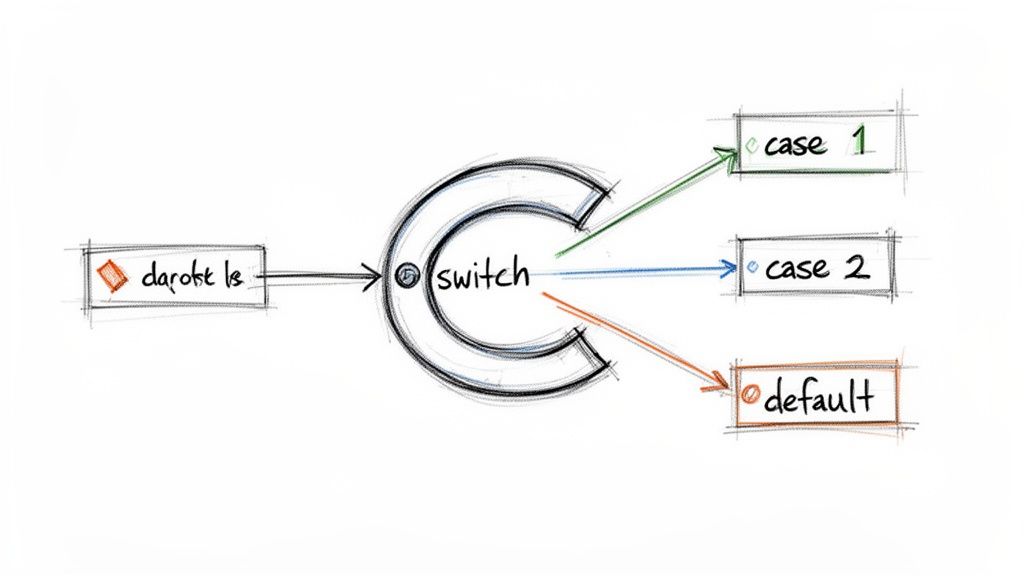
Think of a switch statement as a traffic controller for your code: it evaluates one expression and directs execution to the matching case. It’s a fundamental structure for handling complex decisions in a clear, organized way. But it has quirks—forgetting a break can cause “fall-through,” where execution continues into the next case, producing unexpected behavior.
Core Purpose and Use Cases
Use switch when a single variable can take many distinct values and each value maps to a clear, separate action. Common use cases include:
- Menu selections in command-line tools.
- State machines managing object lifecycles (for example,
DRAFT→REVIEW→PUBLISHED). - Protocol or message parsing where a field determines handling.
Understanding the basic parts of a switch is the first step toward writing clean, maintainable C code.
Key Components of a Switch Statement
| Component | Purpose | Clean-code consideration |
|---|---|---|
switch (expression) | Evaluates an integral expression to select a case. | Keep the expression simple; push complex logic out of the switch. |
case constant-expression: | Marks a specific execution path. | Use meaningful constants or enum members instead of magic numbers. |
break; | Exits the switch to prevent fall-through. | Always include break unless a documented fall-through is intended. |
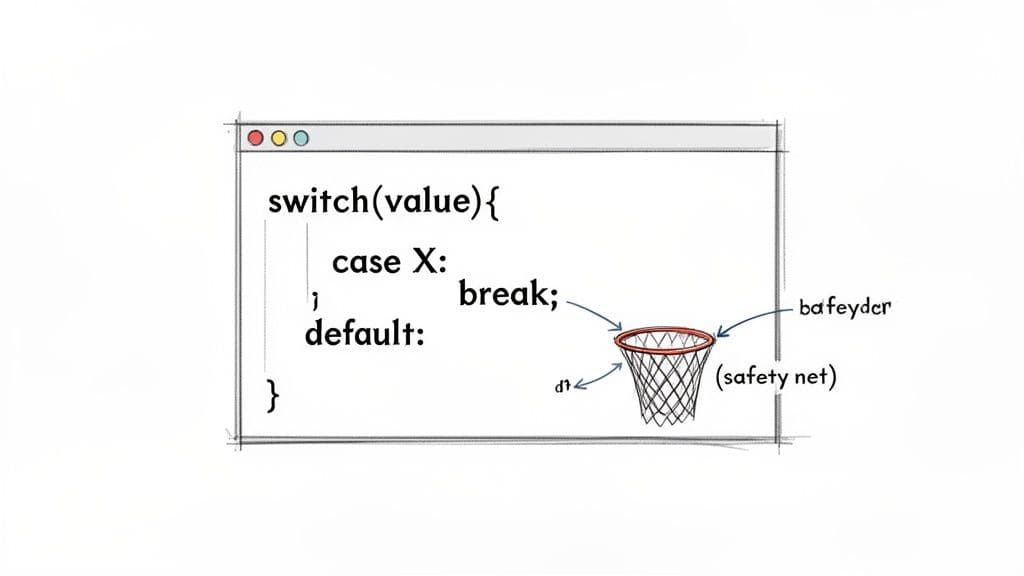
default: | Runs if no case matches. | Use as a safety net to handle unexpected values. |
Each piece affects both correctness and readability.
A well-structured
switchgroups related logic and makes the developer’s intent obvious.
Mastering the Fundamentals of switch and case
A switch statement is like a filing cabinet: one key (the switch expression) opens the drawer for the matching case. Getting comfortable with its parts helps avoid common bugs.
The Anatomy of a C switch Statement
Here’s a simple example: a text editor command handler.
#include <stdio.h>

void handle_command(char command) {
    switch (command) {
        case 'c':
            printf("Executing Copy...\n");
            break;
        case 'p':
            printf("Executing Paste...\n");
            break;
        case 'x':
            printf("Executing Cut...\n");
            break;
        default:
            printf("Unknown command: %c\n", command);
            break;
    }
}
The break statement is critical: it stops execution inside the switch. If omitted, the code falls through to the next case, often creating subtle bugs.
The Importance of the default Case
Without a default block, unmatched inputs are ignored and failures can be silent. Use default as a catch-all to handle invalid or unexpected values and make the program fail gracefully.
For comparisons between switch and if-else readability or performance, see our deeper guide on when to choose switch statements over if-else chains.
How to Avoid Common switch Statement Pitfalls
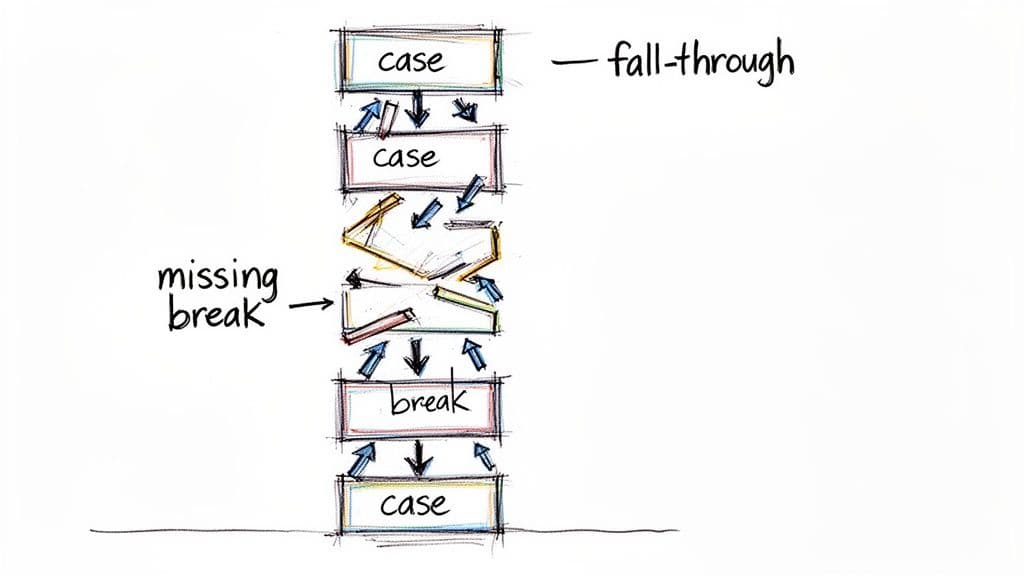
Even experienced programmers can be tripped up by careless switch use. The most infamous issue is accidental fall-through, caused by a missing break.
The Notorious Fall-Through Bug
A missing break can produce incorrect behavior and even security issues. For example:
#include <stdio.h>

void assign_role(int role_id) {
    switch (role_id) {
        case 1:
            printf("User granted GUEST access.\n");
            // Missing break — fall-through
        case 2:
            printf("User granted EDITOR access.\n");
            break;
        case 3:
            printf("User granted ADMIN access.\n");
            break;
        default:
            printf("Invalid role ID.\n");
            break;
    }
}
Calling assign_role(1) prints both guest and editor messages—likely unintended. Modern compilers can warn about implicit fall-through when you enable options like -Wimplicit-fallthrough1.
Avoiding Magic Numbers and Sparse Cases
Replace raw integers with descriptive enum members to make intent clear and let the compiler help catch errors. Also be cautious when case values are sparse (for example, 1, 100, 5000), as compilers may not be able to generate an efficient jump table in those cases2.
Clean coding habits reduce technical debt and help teams move faster over time3.
Refactoring Large switch Statements for Maintainability
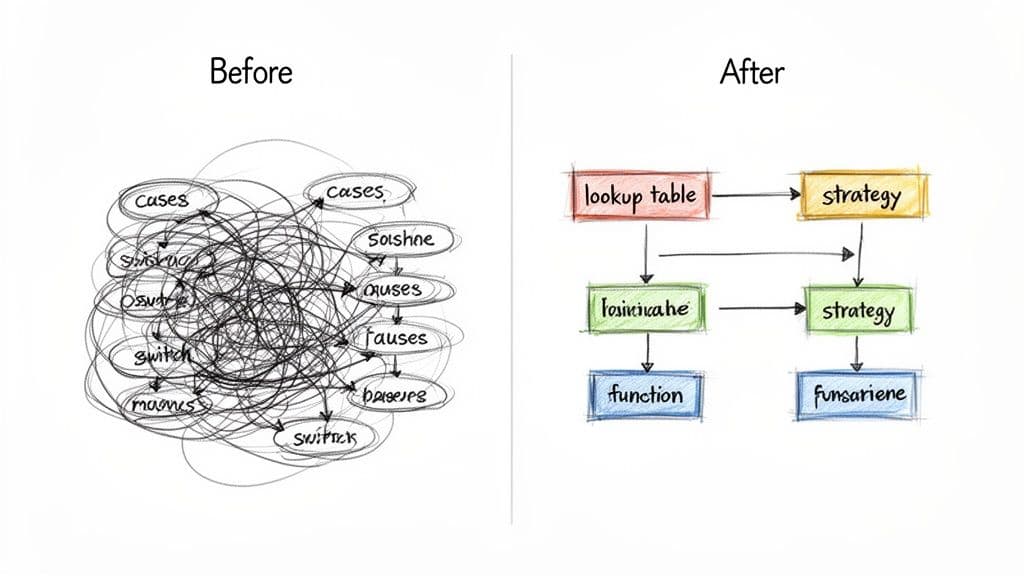
A massive switch is a code smell: it centralizes a lot of logic and often violates the Single Responsibility Principle. Large switch blocks become hard to read, modify, and test.
From switch To a Lookup Table
When each case maps an input to a static output, move the mapping into data. This separates data from logic and makes updates trivial.
Before:
const char* get_error_message(int error_code) {
    switch (error_code) {
        case 400: return "Bad Request";
        case 401: return "Unauthorized";
        case 403: return "Forbidden";
        case 404: return "Not Found";
        default: return "Unknown Error";
    }
}
After (lookup table):
typedef struct { int code; const char* message; } ErrorMapping;

static const ErrorMapping error_map[] = {
    {400, "Bad Request"},
    {401, "Unauthorized"},
    {403, "Forbidden"},
    {404, "Not Found"},
};

const char* get_error_message(int error_code) {
    for (size_t i = 0; i < sizeof(error_map) / sizeof(error_map[0]); ++i) {
        if (error_map[i].code == error_code) return error_map[i].message;
    }
    return "Unknown Error";
}
Adding a new error is now a single line in error_map—no function changes required.
The Strategy Pattern for Complex Behaviors
If case blocks contain complex logic, move each behavior into its own function or strategy object. This makes code extensible, testable, and easier to reason about.
Improving Readability with Enums and Structs
Replace magic numbers with enums to document intent and leverage compiler checks. Pair enums with structs to build clear state machines where an object’s data and state travel together.
From Magic Numbers to Meaningful Enums
Before:
void process_document_status(int status) {
    switch (status) {
        case 1: /* approved */ break;
        case 2: /* pending */ break;
        case 3: /* rejected */ break;
        default: /* unknown */ break;
    }
}
After:
typedef enum { STATE_APPROVED, STATE_PENDING, STATE_REJECTED } DocumentStatus;

void process_document_status(DocumentStatus status) {
    switch (status) {
        case STATE_APPROVED: /* approved logic */ break;
        case STATE_PENDING:  /* pending logic */ break;
        case STATE_REJECTED: /* rejected logic */ break;
    }
}
Combining enums with structs creates cohesive units that tame complexity and reduce global state.
Common Questions About C's switch/case
When should I use switch instead of if-else if?
Prefer switch when checking a single integral expression against many constant values. switch often improves readability, and compilers can optimise dense case ranges into jump tables for constant-time dispatch2.
Can you switch on a string in C?
No. switch requires an integral type (for example, char, int, or enum) per the C language rules4. Workarounds include hashing strings to integers, mapping strings to enum values, or using an if-else if chain with strcmp() for small sets.
How should I unit test a large switch statement?
Aim to refactor heavy case logic into separate functions. If refactoring isn’t possible, ensure tests cover each case, the default, and any intentional fall-through behavior. Smaller functions are vastly easier to test in isolation.
At Clean Code Guy, we specialise in turning tangled codebases into maintainable assets. Whether you’re modernising legacy C code or preparing systems for AI-assisted development, our audits and refactors help teams deliver reliable software, faster.
Learn more about our Codebase Cleanup and AI-Ready Refactor services.
1.
GCC warning options and documentation on
-Wimplicit-fallthrough. [https://gcc.gnu.org/onlinedocs/gcc/Warning-Options.html]2.
Description of jump tables and switch optimisations. [https://en.wikipedia.org/wiki/Jump_table]
3.
Discussion of technical debt and why refactoring matters. Martin Fowler, “Technical Debt.” [https://martinfowler.com/bliki/TechnicalDebt.html]
4.
C language reference for the switch statement and valid expression types. [https://en.cppreference.com/w/c/language/switch]
🙋🏻♂️
AI writes code.You make it last.
In the age of AI acceleration, clean code isn’t just good practice — it’s the difference between systems that scale and codebases that collapse under their own weight.